

The state must realise that it is still not too late for it to redress the legitimate grievances of its own citizens.
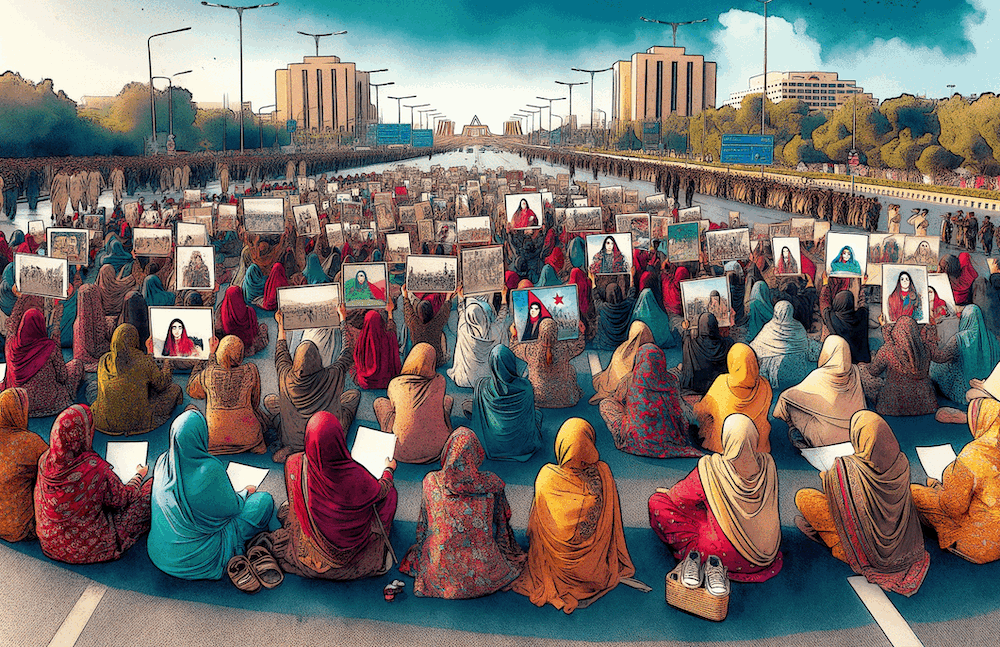
In the wee hours of December 21, 2023, a convoy of almost 300 men, women and children approached the capital. All of the participants were from Balochistan; each had lost a loved one to — in Justice Athar Minallah’s words — the “most heinous crime” of enforced disappearance.
As they approached the capital, a long, emotionally draining journey, riddled with logistical challenges and unnatural obstacles, that started from Turbat some 1,600 kilometres from Islamabad, was nearing its end. Unbeknown to the marchers, who must have been anticipating a well-deserved rest, a large contingent of Islamabad Police personnel lay in wait, ready to intercept and stop them from advancing towards the National Press Club.
What ensued, thereafter, was both appalling and shocking — visuals of women being dragged by police personnel, water cannons being used against the participants, including children, in freezing temperatures, elderly men and women being physically manhandled, the use of indiscriminate tear gas and the detention of nearly all the participants, flashed on TV screens across the country. Following the videos of the incident going viral on social media platforms, for a brief moment, it seemed that the federal government would be compelled to release all those who had earlier been detained.
However, the ordeal was not yet over for our Baloch visitors, with the police subsequently attempting to forcefully load the marchers onto buses, parked outside the G-7 Women Police Station, and force them all to go back to Balochistan.
Ironically, those who had covered all this distance, hoping to be heard and to lodge a peaceful protest against the enforced disappearance of their loved ones were themselves mistreated, humiliated, physically assaulted, illegally detained and worst of all, subjected to expulsion — a concept alien to our law and in fact, a direct violation of Article 15 of the Constitution of Pakistan [Freedom of movement].
Catalyst to the cause
While the above stated acts of brutality cannot be condemned enough, the state, through its own incompetence and mismanagement, had inadvertently provided the biggest stage to the Baloch long march participants and their cause.
For the first time, they mattered to us in a way that they had never mattered to us before. We were able to hear and understand the unfettered version of their stories, see their pain and suffering, appreciate their resilience and commitment and feel the warmth of their love and compassion. We were able to comprehend the genuineness of their grievances and perhaps, most importantly, realise that the actions and inactions of the state had caused the fault lines to grow exponentially and if they were to be left unaddressed, God forbid, the schism would widen further to a point of no return.
Take note, the schism is already there; it is real, it grows and glares back at us without flinching. It feeds and drives strength from the misadventures, uncompassionate policies and lack of empathy of the state. Time and again, attempts have been made by the families of missing persons to highlight this issue. They have protested in every which way possible, held press conferences, observed hunger strikes, approached the courts, held multiple sit-ins, yet their demands remain unmet.
Unsurprisingly, the long march that reached Islamabad on December 21 is not the first of its kind. In 2014, family members of missing persons, the oldest being Mama Qadeer, 72, and the youngest, Ali Haider, 7, made history by walking for 104 days from Quetta to Karachi, then Islamabad, after covering almost 2,800 kilometres.
Similarly, in 2013, families of Baloch missing persons marched for almost two weeks from Quetta to Karachi, covering a distance of over 700kms. Interestingly, these long marches broke the record of Mahatma Gandhi’s longest march against the tax on salt, from Ahmedabad to Dandi, during which he covered a distance of 390kms.
The numbers game
Despite all these efforts, the issue of missing persons and enforced disappearances remains unresolved. As per a report submitted before the Supreme Court of Pakistan by the Inquiry Commission on Enforced Disappearances, on February 1, 2023, a total of 9,224 cases of enforced disappearances have been filed in Pakistan since the Commission was established in 2011. The report further stated that of the 9,224 cases, 2,256 remain pending, whereas the rest were either resolved due to recovery of either the missing person (around 3,800 individuals) or their body, or the case being disposed of as a result of incomplete address, withdrawal of complaint or for non-prosecution.
The aforementioned data, reflected in the Commission’s report, has been challenged by several organisations, such as the Voice for Baloch Missing Persons, which claims that the actual number of missing persons from Balochistan is several times higher than the Commission has reported.
Another non-governmental organisation, Defence of Human Rights (DHR), which has been working on the issue of enforced disappearances since 2004, issued a report which stated that until December 20, 2023, the total number of missing persons’ cases registered with it stood at 2,315. Of these cases, 1,386 individuals remain untraced, 595 had been released, 245 had been traced, said to be in the government’s custody, and 88 were found to have become victims of extrajudicial killings.
The premier’s admissions
The veracity of the claims made by either side — the government and organisations documenting enforced disappearances will always remain questionable and unacceptable to one another. In all fairness, one can appreciate that, at times, due to high illiteracy rate, incidents happening in remote areas, lack of information, extreme poverty, connectivity issues and other cogent factors, there are cases that altogether go unreported, or at the very least, may not have been filed before the Commission.
Be that as it may, incumbent Caretaker Prime Minister Anwaarul Haq Kakar, has for the first time spoken very candidly on the issue of missing persons during Q&A sessions with university students and in TV interviews. In the opinion of PM Kakar, televised on Dawn News, the state enjoys the absolute, inalienable, inherent and unfettered “right of apprehension”.
In other words, the state can detain anyone, at any time and at any place, for any cause, be it against a correct accusation or an incorrect one. The premier further went on to say that sometimes, it may take 10 to 15 days to process the detained individual. He claimed that at times, the detained individual is presented before the magistrate and at times he is not; whatever the case may be, in such situations, that individual cannot be categorised as a “missing person”. Moreover, while acknowledging that there are frequent complaints of missing persons from certain areas of Balochistan and the erstwhile Fata region, where terrorist activities are a recurring phenomenon, he strongly refuted that there are anywhere close to 8,000 cases of missing persons in Pakistan, as claimed by many.
The opinion expressed by the caretaker PM seems to — erroneously it is hoped — provide a rare glimpse into the psyche of the state itself. It should be noted that no law enforcement agency is legally entitled to hold an accused in custody for 10 to 15 days, as boldly claimed by PM Kakar.
Section 61 of the Code of Criminal Procedure, 1898, mandates that any person who is detained by a law enforcement agency has to be presented before the magistrate within 24 hours of their arrest. The arrested individual cannot be detained for more than the prescribed time limit without obtaining orders from the competent court of law, in accordance with the procedure prescribed under the law — Section 167 of the CrPC.
Now, without diving into the factual controversy surrounding the statistical data, let us all just agree that too many citizens of this country have been victims of this heinous crime — a crime that has devastated entire families, affected entire communities and fuelled the fire of hatred and contempt in the hearts of our own people.
And yet this fire rages on — it is visible in the eyes of the families, searching for their loved ones, running from pillar to post to seek justice. At times, all they have is a question, the answer to which the state must provide — they want their loved ones, dead or alive. Some simply seek the site of the final resting place of their father, brother or son; a grave is all they seek, so that they may finally grieve in peace, knowing they did all they could.
Mindful of the provisions and inalienable rights of every citizen of Pakistan, as have been enshrined and guaranteed in the Constitution, it would be fair to observe that the said fundamental rights form the very basis of the social contract between the state and its citizens — a promise that cannot be broken. Its significance can be ascertained by observing that Chapter 1 of the Constitution only encompasses and is dedicated to these “Fundamental Rights”.
Keeping this in mind, it is vehemently argued that if the promise of ensuring, adhering and guaranteeing these fundamental rights is breached by the state, the whole super structure — the Constitution and whatever follows Chapter 1 — comes tumbling down like a house of cards. Needless to say, the state may definitely be able to enforce its writ by use of force, but the absence of moral strength would inevitably result in resistance.
The very spirit of resistance, a consequence of the absence of moral strength, lead the Baloch long march to the gates of Islamabad. A symbolic peaceful reaction to the alleged extrajudicial killing of Balaach Mola Bakhsh on November 23, 2023.
At the time this piece was being committed to paper, Amnesty International South Asia issued a press release, highlighting the above-mentioned extrajudicial killings, condemning the treatment meted out to the long march participants, the practice of enforced disappearances and terming such practices a violation “of several human rights of those disappeared, including their right to life and liberty, as well as the economic and social rights of their families.”
What can we do?
Truth be told, more than what any international organisation says, what counts is where we, as Pakistani citizens, stand on this issue. While remaining within the parameters of law, we can speak and write about this issue, publicly express our disgust towards this “most heinous crime”, meet with the families of missing persons, express our love towards them and make them believe that they matter to us and that we feel their pain.
The way the state has treated the long march participants has inevitably filled their hearts with more hate — they must have felt misunderstood and alienated.
This is exactly why some of us tried to change that. We tried to shower them with love, brought them food, fought to get them warm blankets, took our children to spend time with them, laughed with them and cried with them. This was the bare minimum that we could have done and what is expected from a civilised society. They will soon return to Balochistan, but it is hoped that they will take with them some sense of belonging, a feeling of warmth and love; that they would know that we stand with them and so does the Constitution.
The state must realise that it is still not too late for it to redress the legitimate grievances of its own citizens. Evidently, the damage is enormous, yet the state can, through acts of love, compassion, empathy, courage, accountability, transparency, justice and most importantly, by speaking the truth, stop the ship from sinking. It must realise that the state alone is capable of healing and powerful enough to hold us all together. Otherwise, it is forcefully reiterated, the schism is widening.
One cannot help but remember what Faiz Ahmed Faiz, a poet revered and loved by the people of both Pakistan and Bangladesh, wrote on his way back from Bangladesh, in 1974, after it became a separate country. Faiz, in all his wisdom, seems to have pre-empted that we were inevitably destined to repeat the same mistakes — mistakes that had already cost us so dearly. This couplet of his perfectly sums up this piece in a few sentences and holds a message for all of us.
He writes:
ham ki Thahre ajnabī itnī mudārātoñ ke ba.ad
phir baneñge āshnā kitnī mulāqātoñ ke ba.ad
kab nazar meñ aa.egī be-dāġh sabze kī bahār
ḳhuun ke dhabbe dhuleñge kitnī barsātoñ ke ba.ad
the bahut bedard lamhe ḳhatm-e-dard-e-ishq ke
thiiñ bahut be-mehr sub.heñ mehrbāñ rātoñ ke ba.ad
dil to chāhā par shikast-e-dil ne mohlat hī na dī
kuchh gile shikve bhī kar lete munājātoñ ke ba.ad
un se jo kahne ga.e the ‘faiz’ jaañ sadqe kiye
an-kahī hī rah ga.ī vo baat sab bātoñ ke ba.ad
After so much cordiality we are once again strangers
After how many meetings will we again be friends?
When will we see the unsullied green of spring?
After how many monsoons will the stains of blood be washed?
The time of the end of our love was so cruel
After nights of intimacy the mornings so unkind
My quickly defeated heart did not even allow me
After my entreaties, the chance to fret and fuss
What you had gone to say, Faiz, to swear upon your life
After everything was said, that still remained unsaid