

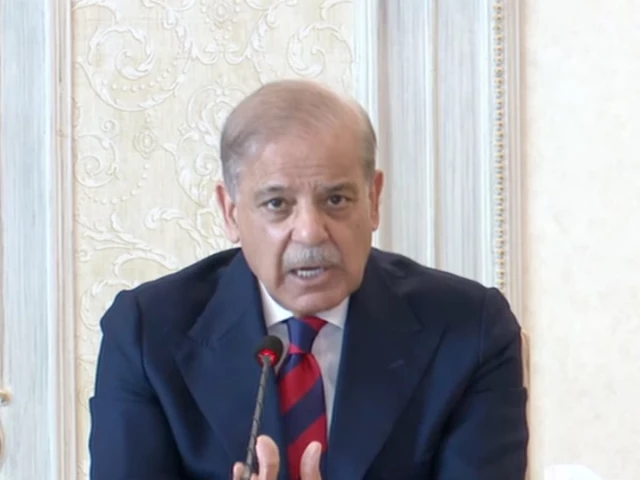
Says the agreement ‘entirely for defensive purposes’, stressing that it is not intended for aggression
Prime Minister Shehbaz Sharif on Monday said the Makkah Defence Agreement was an extension of the bilateral defence pact signed by Pakistan and Saudi Arabia last year.
“Last year, this arrangement was made official and a proper agreement was signed. The trilateral agreement signed this Friday is an extension of that agreement, and it aims to enhance regional stability, peace, and prosperity. It is not meant for aggression and is entirely for defensive purposes, for peace, tranquillity, and prosperity in the region. This pact is a source of pride and strength for the entire Muslim Ummah,” said the prime minister while addressing a meeting of the federal cabinet.
Last year, Pakistan and Saudi Arabia signed a landmark “Strategic Mutual Defence Agreement”, declaring that “any aggression against either country shall be considered an aggression against both”. Last week, Pakistan, Saudi Arabia and Turkiye formalised their longstanding strategic relationship through the newly signed “Makkah Joint Defence Agreement”, a trilateral security framework that its proponents describe as a defensive arrangement aimed at strengthening collective deterrence, enhancing military cooperation and promoting regional stability.
PM Shehbaz also extended his congratulations to Chief of Defence Forces (CDF) and Chief of Army Staff (COAS) Field Marshal Asim Munir for his tireless efforts in securing this agreement, which have been ongoing for several years.
“It is a profound honour for the Pakistan Armed Forces and the people of Pakistan to stand alongside Saudi forces in safeguarding the holy places of Makkah and Madinah,” he added.
PM Shehbaz also addressed the recent wave of terrorist incidents: “In the past few days, we have witnessed unfortunate terrorist incidents, including attacks on police stations in Hangu and Swat. Many police officers were martyred, alongside Captain Hamza Akram, Major Hafiz Ihsan Elahi, and DSP Diyar Khan, who all sacrificed their lives for Pakistan. We honour their supreme sacrifices.”
“Fitna al-Khawarij are being decimated day and night, and these sacrifices will not go in vain. Pakistan will eradicate this scourge of terrorism and will progress towards peace and prosperity,” he said.
Speaking about the elections in Azad Jammu and Kashmir (AJK), the prime minister said polling had previously been held in Mirpur and Muzaffarabad, while voting was taking place in two districts of Poonch on Monday.
“The people of AJK have voted in large numbers for PML-N, and consequently, the results of the first two divisions and the refugee seats that were won have given the party a majority. This vote is an affirmation of Nawaz Sharif’s leadership, and when we form the AJK government under him, there will be a wave of progress and development in AJK,” he said.
PM Shehbaz thanked the people of AJK for placing their trust in the PML-N and voting for the party.
The prime minister also spoke about unrest in AJK, saying that no civilised society could tolerate illegal acts or violence.
“If there is any demand or issue to be resolved, it should be resolved on the negotiating table. Those people who wish to stir up trouble in AJK on purpose are doing so on the instructions of foreign elements and we have credible proof of that,” he said.
He said the government had organised an All-Party Conference in Muzaffarabad before the elections, which was attended by all parties except one, where all aspects and issues were discussed.
“The issue of refugee seats was also discussed, including whether they should be reduced or eliminated altogether. They were advised to present their case in the assembly after the elections so that the issue could be resolved as per the law and Constitution,” he said.
The prime minister said some people nevertheless remained obstinate and created problems afterwards.
“I still believe that the new AJK government will again sit and talk with these people, and I remain hopeful of that. Those who simply wish to spread anarchy, they will not be allowed to do so. But those who are for peace, the new AJK government will sit and resolve things with them,” he added.
What the Pakistan-Saudi Arabia-Turkiye defence pact is — and what it isn’t
The agreement signed during the Makkah Al-Mukarramah Summit for Joint Defence has prompted comparisons with military alliances such as NATO. However, according to security analysts, the pact is intended to formalise decades of existing strategic cooperation rather than create a new military bloc or offensive alliance.
A formal framework for existing ties
According to security analysts, the agreement represents the natural progression of longstanding political, military and strategic relations among the three countries.
They note that Pakistan’s ties with Turkiye date back to the Khilafat Movement, while Pakistan and Saudi Arabia have maintained decades of defence, political, economic and diplomatic cooperation based on what they describe as mutual trust and shared strategic interests.
Rather than establishing an entirely new partnership, analysts say the agreement provides a formal institutional framework for cooperation that has evolved over many years.
Why now?
Security analysts argue that the agreement reflects a rapidly changing regional security environment.
They point to regional conflicts, evolving security threats and changes in the character of modern warfare as factors driving closer strategic coordination among countries that share common security interests.
According to them, the trilateral framework is intended to preserve regional stability by strengthening collective security mechanisms instead of relying on ad hoc bilateral cooperation.
What the agreement does
At its core, the agreement establishes a framework based on the principles of collective security and collective deterrence.
Security analysts say its central premise is that aggression against one member would be regarded as a threat to all three, thereby increasing the potential cost of military action and discouraging conflict through credible deterrence.
The framework also envisages expanded defence cooperation, including closer military coordination, intelligence sharing, strategic consultations, defence planning and broader institutional cooperation between the three countries.
According to analysts, pooling military capabilities and strategic coordination is intended to improve preparedness while reducing the likelihood of regional conflict.
The complementary roles of the three countries
The agreement draws on what security analysts describe as the complementary strengths of each participant.
Pakistan contributes experienced armed forces, operational expertise and strategic planning capabilities developed through decades of counterterrorism operations and conventional military preparedness.
Saudi Arabia brings economic strength, regional influence and political leadership, while Turkiye contributes an advanced defence industry, military technology and industrial capacity.
Together, analysts say, these capabilities form a balanced security architecture capable of responding to emerging regional security challenges.
Pakistan’s evolving diplomatic role
Security analysts also argue that Pakistan has increasingly emerged as a regional stabiliser through its diplomatic engagement in recent regional crises.
They cite Pakistan’s mediation efforts during the recent US-Iran conflict, alongside its diplomatic relations with Saudi Arabia, Turkiye, Iran, China and the United States, as evidence that Islamabad is well positioned to serve as a bridge between regional and global stakeholders.
They say that this broader diplomatic role complements Pakistan’s contribution to the trilateral framework.
What the agreement is not
While comparisons have been drawn with existing military alliances, security analysts reject several common characterisations of the pact.
They emphasise that the agreement is not:
- an offensive military alliance;
- directed against any specific country;
- a “Muslim NATO”;
- a nuclear security arrangement or extended nuclear deterrence agreement; or
- a religion-based political or military bloc.
Instead, they describe it as a defensive security framework designed to deter aggression, strengthen military cooperation and enhance regional stability without targeting any state.
According to the analysts, the agreement is intended to reinforce self-reliance among the three partners while codifying an existing strategic relationship through a formal institutional mechanism.
A collective deterrence model
Security analysts say the credibility of the framework ultimately depends on continued political coordination among the three governments.
They argue that the leadership of Pakistan, Saudi Arabia and Turkiye has consistently combined military preparedness with diplomatic engagement and strategic restraint, making the agreement a mechanism for crisis management as much as defence cooperation.
According to them, the objective is to reduce the likelihood of conflict through credible deterrence while providing a structured platform for long-term security cooperation among the three countries.
Although the agreement significantly deepens trilateral defence coordination, analysts maintain that its stated purpose is not to create a new geopolitical bloc but to institutionalise an existing strategic partnership centred on collective security, stability and regional cooperation.
