
Key takeaways:
- ZetaChain launched Anuma, its first consumer AI product: the private AI that remembers, with one encrypted memory across every AI you use and access controlled by you.
- ZETA is the token that powers Anuma and the network underneath it: unlocking models and agents, backing memory, settling usage, rewarding creators, and securing the network.
- ZetaChain is building the AI consumer layer: a user-owned foundation for memory, identity, permissions, payments, and agents across connected models and apps.
- Anuma started as an experiment to extend interoperability from digital assets to intelligence. With 60,000 users in its first month, ZetaChain is going all-in on the AI consumer layer.
SAN FRANCISCO, June 01, 2026 (GLOBE NEWSWIRE) — Spend six months teaching one AI how you work. The next week, a better model ships. You open a fresh window and start over from nothing.
That is the problem ZetaChain is solving with Anuma, its first consumer AI product: a private AI app that remembers you across every model. Your writing style, preferences, projects, files, goals, and agent history can move with you from ChatGPT to Claude to Gemini to Grok to DeepSeek without starting over, while you decide what each app or agent can access.
Underneath Anuma is ZetaChain: the infrastructure for private memory, identity, permissions, payments, and agents across AI. It lets apps and agents work across models while the user stays in control.
ZETA is the token that powers Anuma and the network underneath it. It unlocks leading AI models and expert agents, backs your encrypted memory vault, settles agent usage through x402, rewards creators for their expertise, pays for permission updates, and helps secure the network.
We built Anuma as an experiment to test whether ZetaChain’s interoperability thesis could extend beyond assets and chains into intelligence itself: memory, context, identity, and agents that move with the user. Anuma crossed 60,000 users in its first month, showing us that private, user-owned AI is not just a feature. It is the start of the next major consumer layer. Next, Anuma is expanding from private AI chat into personal apps built around your memory.
ZetaChain started by solving interoperability between chains. Now the same coordination problem exists across intelligence: models, memory, agents, apps, and identity are fragmented, and users are stuck rebuilding context from scratch. After four years of building cross-chain infrastructure, a mission that produced 12 million users and 240 million transactions, we are dedicating ZetaChain entirely to AI.
The opening in consumer AI
Consumer AI is exploding, but the experience is still fragmented. ChatGPT crossed 900 million weekly active users in February, up from 400 million a year earlier. Stanford’s 2026 AI Index below shows that Generative AI hit 53% global adoption in three years, faster than the PC or the internet. But only 9% of consumers pay for more than one AI subscription because trying a new model often means giving up everything the old one learned about them.
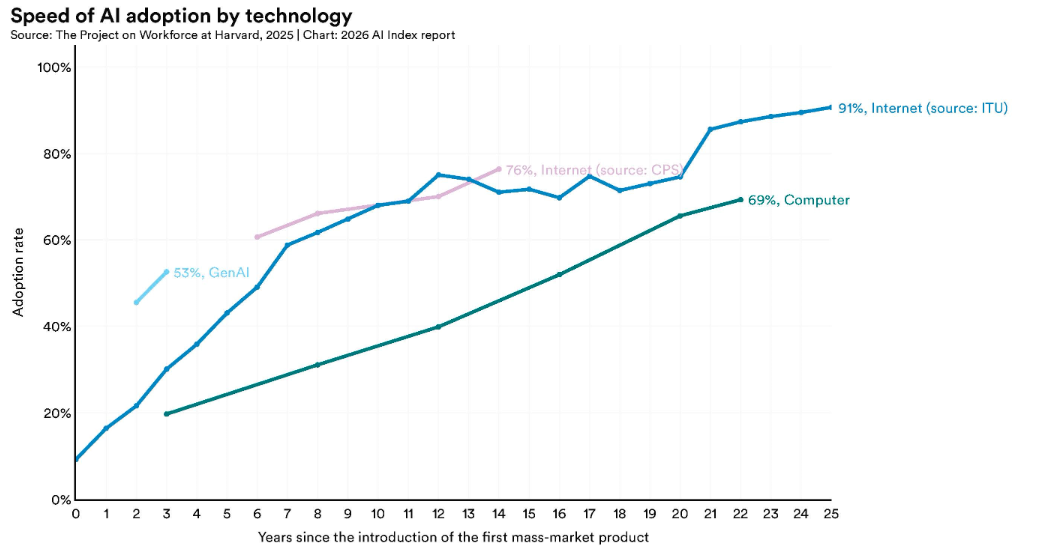
Source: Stanford HAI 2026 AI Index Report; data from The Project on Workforce at Harvard.
The market opening is clear: people want better AI, but they do not want to rebuild themselves every time the best model changes. The next consumer AI platform needs memory, identity, permissions, and payments that move with the user.
ChatGPT, Claude, Gemini, Grok, and DeepSeek have all shipped memory features. The intent is right, but the architecture is fractured. The memory layer underneath is shallow, siloed, and platform-owned. Four limits keep it from becoming real infrastructure.
Context is fragmented. OpenAI, Anthropic, and Google each hold a different piece of your history. The Economist has documented how the leading AI labs are tightening their hold on their best models, locking developers and users into proprietary ecosystems. To switch is to start over.
Your memory isn’t yours. Every conversation lives on a company’s server. You have a license to use it, not true ownership. In April, a federal judge ruled that AI chatbot conversations can be entered as evidence in court, stripping attorney client privilege when AI is involved. Major U.S. law firms have since told clients to assume nothing said to a chatbot is private.
Agents are isolated. The world is moving toward specialized agents, but they don’t share context. A research agent doesn’t know what a finance agent is doing. In financial services alone, non-human identities now outnumber human employees by roughly 96 to 1, and they have no portable way to prove who they are or who they work for.
You aren’t capturing the value. Today, you are the product. Your data trains the models. You get a one-time convenience, and they get a lifetime of value.
Anuma: the private AI that remembers
Anuma is the privacy-first AI app that combines the leading models into one experience. It keeps your memory encrypted and portable across models, powered by ZetaChain’s private memory layer. Anuma launched publicly on April 27th and crossed 60,000 total users.
Anuma lets you carry one encrypted memory across ChatGPT, Claude, Gemini, Grok, DeepSeek, Kimi, Qwen, Llama, Mistral, Gemma, and the rest without giving up context to any of them.
Four things make Anuma different from anything else on the market.
1. Your memory follows you. You should own your memory the way you own a wallet (with keys, not accounts). No platform should be able to revoke, censor, or hold your context hostage. It should travel with you across every model, app, and device, without permission from any single provider. Anuma’s encryption gives you privacy, and ZetaChain provides the blockchain ledger that gives you portability.
2. You decide who sees what. Once agents start acting on your behalf, “trust me” stops being enough. Anuma is being built to let you grant agents specific access like one-time read access to your travel history and revoke it instantly if you choose. The proof of permission will live on-chain where it is programmable, auditable, and revocable. Access will be logged so users can see and control what agents are allowed to do.
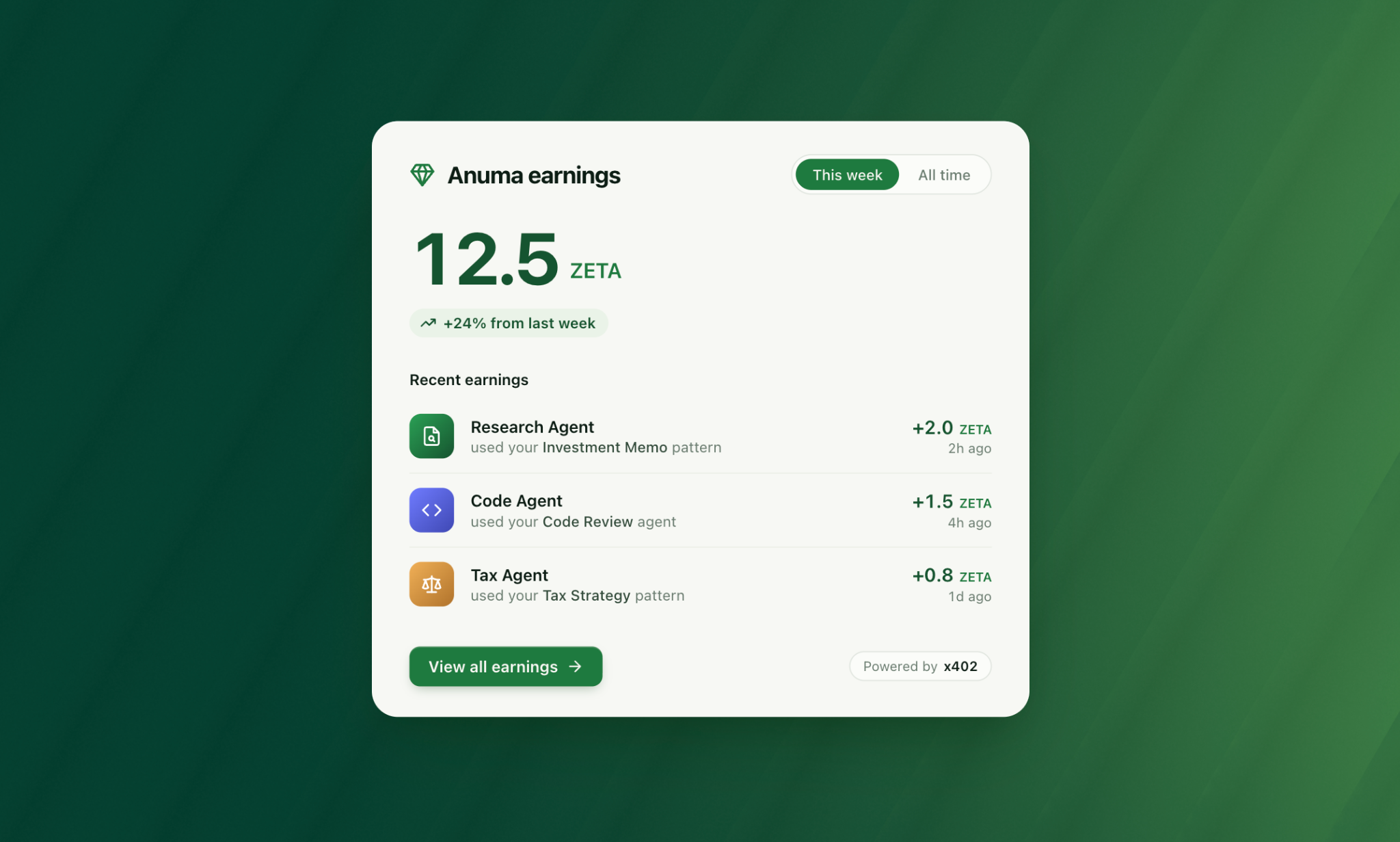
3. Your knowledge becomes an asset. Your memory, and the knowledge graph it builds across every model and project, becomes something you can selectively share, license, or monetize without exposing the raw data. Agents will be able to pay for the context they consume, allowing you to earn from the patterns you’ve built. ZetaChain is designed to settle these payments natively in ZETA via x402, the HTTP-native payment standard backed by Coinbase and Cloudflare. x402 adoption is rapidly growing, processing more than 170 million transactions in six months as Cloudflare reports more than a billion HTTP 402 responses every day.
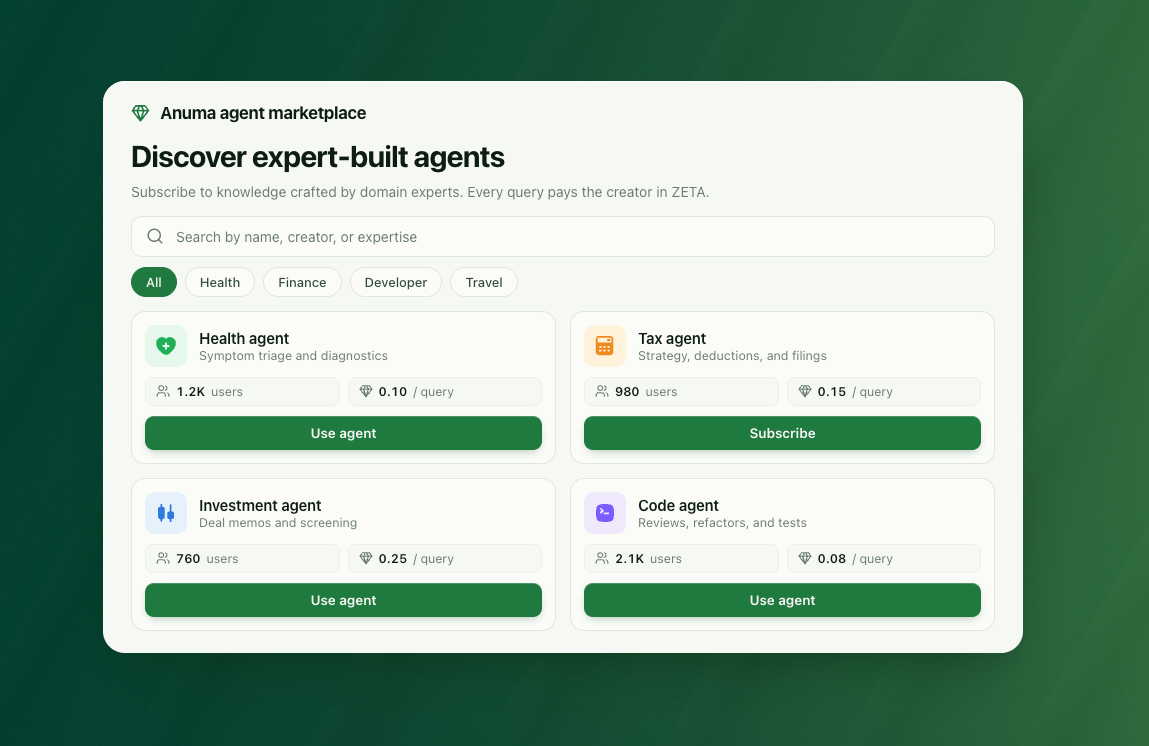
The big unlock is that your expertise can become something you own, control, and earn from. With Anuma’s Creator Tools, professionals like investors, doctors, lawyers, and developers will be able to package their expertise into agents and publish them to the Anuma Agent Marketplace, with the goal of earning when another user invokes their methodology. Anuma is the consumer app that demonstrates what the private memory layer underneath makes possible.
4. Use the right model for the job. When one model is not the right fit for a task, switch to another without losing context. Anuma’s Council Mode lets you ask the same question across models side by side and choose the answer that works best.
Building blocks of the AI consumer layer
ZetaChain is focused on five core components for the AI consumer layer: memory, permissions, identity, payments, and agents.
Memory. Your context lives inside an encrypted vault powered by ZetaChain and used first through Anuma. Preferences, projects, writing style, goals, files, and conversation history can follow you across connected models and apps, so you do not have to start from a cold conversation each time. As more apps connect to this layer, your memory can move with you while you stay in control. You can review, edit, export, or delete your vault at any time.
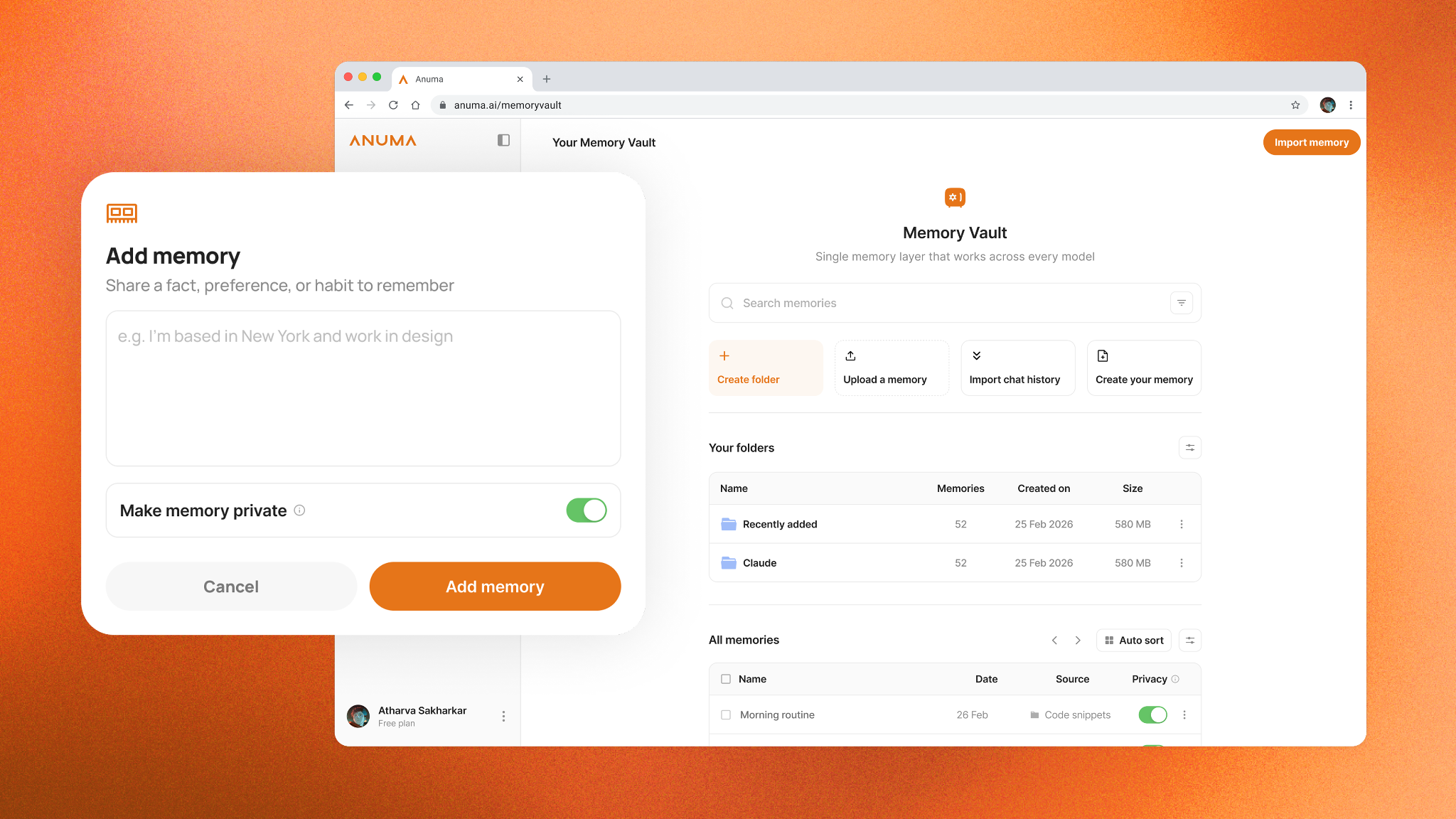
Permissions. Access control is being built to be programmable and specific, not a binary “on/off” switch. Users will be able to grant a coding agent read access to their codebase context, give a tax agent one-time access to last year’s receipts, and revoke either instantly. Access is designed to be logged on-chain.
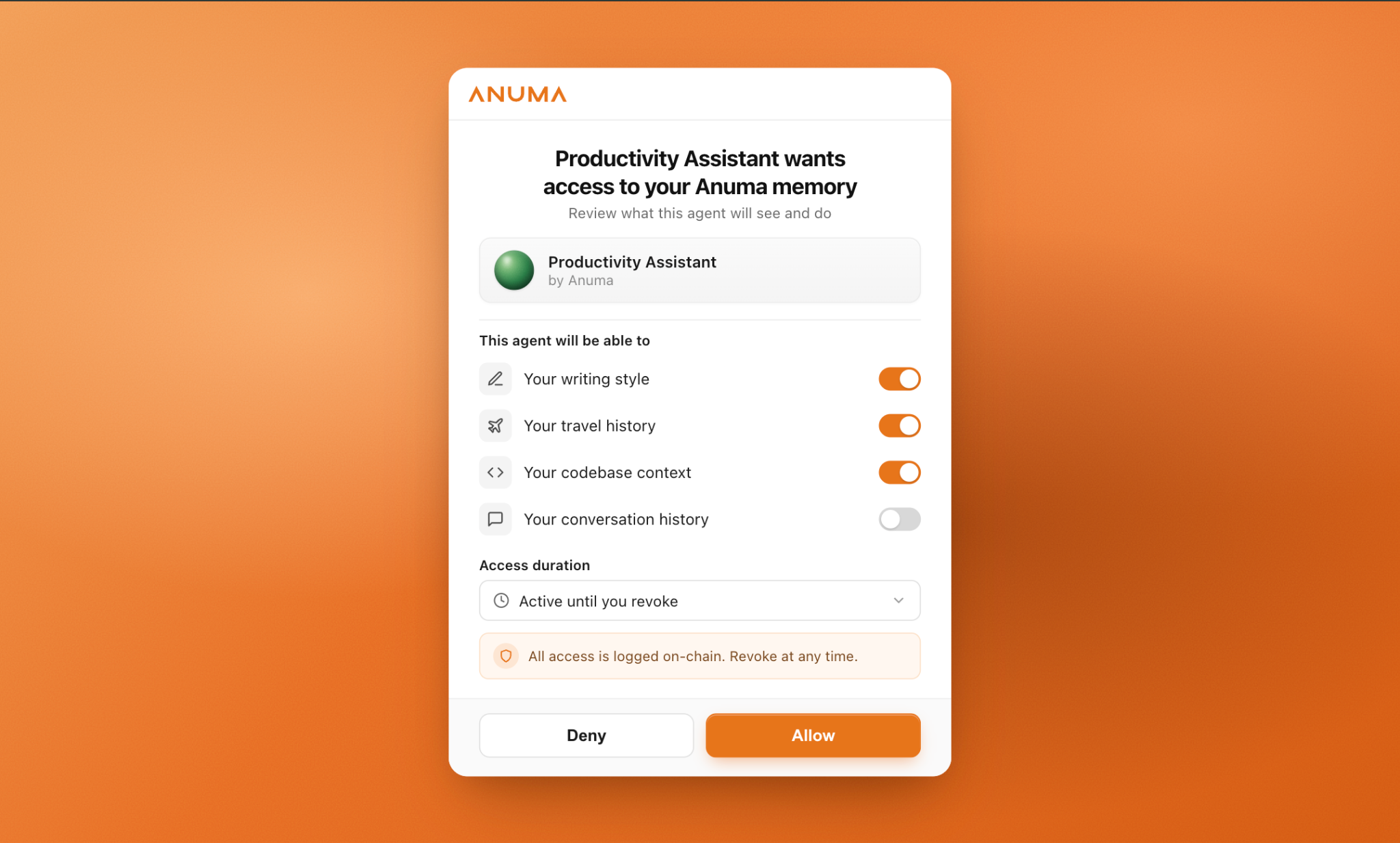
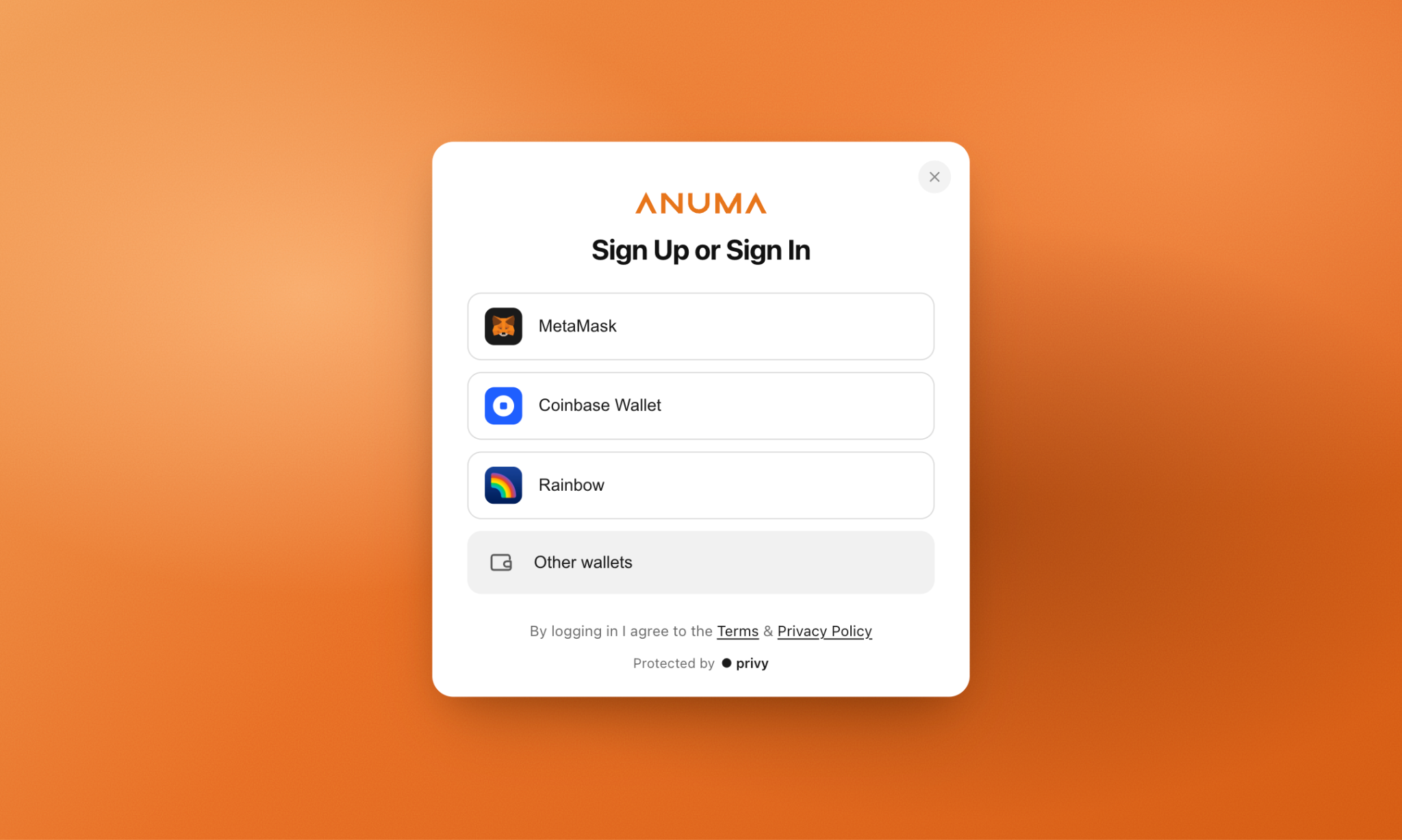
Identity. A wallet-derived key becomes your AI identity. This is one key with no separate platform accounts or fragmentation. Agents also get on-chain identity and are addressable, authorizable, and accountable.
Payments. Memory access, agent calls, and cross-model interactions are designed to settle natively on-chain via x402. When approved agents use permissioned access to your memory, payment can flow automatically. What used to be extracted can become metered, programmable, and returned to you by default.
Agents. Memory, permissions, identity, and payments all come together to enable agents that can work on your behalf across every model. These agents in Anuma are addressable, payable, and accountable, while you stay in control of what they see and do.
From private memory to the AI consumer layer
With private memory as the foundation, ZetaChain is building toward something bigger: an AI consumer layer where models, agents, apps, and data can work together around the user. With Anuma Private Computer, users will be able to create personal apps directly inside Anuma, refine them through conversation with AI models, and receive app suggestions based on their memory, goals, files, preferences, and history.
The user remains the decision maker. Agents and apps can work around your memory, but you decide what they see, what they do, and when access ends. That is the bigger thing ZetaChain is becoming: the neutral, open, user-owned coordination layer for consumer AI, powered by the private memory layer underneath Anuma.
What we’re sunsetting
To build this with the focus it needs, we are sunsetting our cross-chain interoperability features. Over the coming months we will wind down support for Bitcoin, Solana, Arbitrum, Base, BSC, Polygon, Avalanche, Sui, and TON. Withdrawals will remain open for a defined wind-down period so existing users can move funds out cleanly. Full timing and instructions are in the wind-down schedule.
Our original mission, starting in 2021, was solving blockchain interoperability. That mission was right for its time, but the biggest hurdle today is no longer moving money between chains. It is maintaining continuity of intelligence and ownership across every AI model, app, and agent we use.
We are focusing ZetaChain where coordination matters most, while remaining fully committed to users, creators, ecosystem partners, and long-term infrastructure.
ZETA: the token that powers Anuma
ZETA is the token that powers Anuma and the network underneath it. It has six core uses, each tied to a concrete piece of what we’re building.
Access. Lock ZETA to unlock the leading AI models and specialized expert agents through Anuma. One stake can unlock access across many models and agents.
Creator Incentives. When the memory patterns or agents you choose to publish are used by others, you can earn in ZETA without giving up control of the underlying private data.
Settlement. Memory access and agent calls inside Anuma are designed to settle via the x402 standard.
Decentralized cloud. ZETA is designed to power the encrypted, decentralized storage layer that backs your Anuma memory vault.
Gas. ZETA is designed to pay for on-chain memory updates and permission transactions.
Staking. Lock ZETA to help secure the network that powers Anuma and earn from its activity.
Every layer of the stack (memory, permissions, identity, payments, agents) has a corresponding ZETA integration. A detailed post on ZETA token utility will follow.
The AI Economy We’re Building For
AI is expanding from chatbots into models, apps, and specialized agents. Compute powers the scale, but memory, identity, permissions, and payments are what give users continuity across all of it.
This is the market ZetaChain is building for: not just better models, but the AI consumer layer where users own memory, control access, and move across apps and agents without starting over.
Goldman Sachs Research expects the largest hyperscale cloud companies to spend more than half a trillion dollars on AI capital expenditures in 2026, an estimate that has been revised higher every quarter.
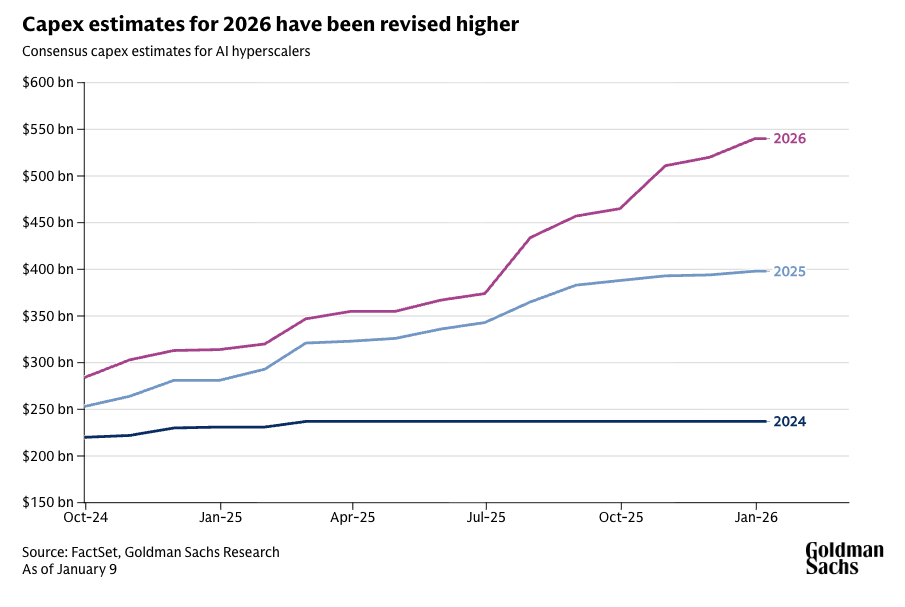
Source: FactSet, Goldman Sachs Research.
Gartner expects 40% of enterprise applications to include task-specific AI agents by the end of 2026, up from less than 5% in 2025. a16z calls blockchains the missing infrastructure those agents need.
ZetaChain’s conviction is that the next era of AI will not be defined by whoever ships the best model in any given month, but by the apps and infrastructure that give users ownership, control, and continuity across all of them.
Consumer AI roadmap
ZetaChain is building the AI consumer layer around Anuma: one private memory, one user-controlled identity, and one ZETA-powered network for models, apps, agents, and personal AI tools.
Live today
- Anuma app: the private AI app that remembers across leading models.
- AI identity: a wallet-based identity for your memory today, expanding to apps and agents over time.
- Private memory layer: encrypted context used first through Anuma.
- Multi-model AI: switch between leading models without losing your context.
- ZETA Access: lock ZETA to unlock private AI access.
Launching soon
- Anuma Private Computer: create personal apps inside Anuma, including memory-powered app suggestions based on your goals, files, preferences, and history.
- Anuma browser experience: bring your private memory into everyday browsing so Anuma can help across the sites, tools, and workflows you choose.
- Mobile apps: Anuma is coming to iOS and Android shortly after this announcement.
- Permissioned memory: grant apps and agents specific access to your context, then revoke it when you choose.
- Creator tools: package knowledge, workflows, and methodologies into agents others can use, with the goal of earning when they are invoked.
Under exploration
- Agent marketplace: discover expert-built agents that can work with approved context.
- x402 payments: memory access and agent calls are designed to settle through ZETA-powered payment rails.
- On-chain access logs: permission updates and agent activity are designed to become auditable and user-controlled.
If you’ve been watching ZetaChain grow over the years, we welcome you to continue following along as we build out the same coordination infrastructure idea into a much larger AI market.
Get Started
Stake ZETA. Secure the network that powers Anuma and unlock private AI access.
Try Anuma. The private AI that remembers. One memory. Every model. You control access.
Follow the roadmap. Memory, permissions, identity, payments, agents. X · Discord · Telegram
About ZetaChain
ZetaChain is the private memory layer for AI and the infrastructure behind the AI consumer layer. It powers Anuma and a user-owned foundation for memory, identity, permissions, payments, and agents across connected models and apps. Anuma is the first consumer AI product built on ZetaChain: a private AI app that remembers, combining leading models, encrypted memory, and user-controlled access in one experience.
Follow ZetaChain on X (Twitter) and join the conversation on Discord and Telegram.
Media Contact
Jonathan Covey
ZetaChain
jonathan@zetachain.com
Photos accompanying this announcement are available at:
https://www.globenewswire.com/NewsRoom/AttachmentNg/56099918-4da5-457e-b47a-1b2ffb76e4c8
https://www.globenewswire.com/NewsRoom/AttachmentNg/5b21db53-15eb-4279-896e-ec43875ea5ca
https://www.globenewswire.com/NewsRoom/AttachmentNg/73fda9b1-0846-4f02-95f1-5315e9a3d638
https://www.globenewswire.com/NewsRoom/AttachmentNg/7cfbc250-b97f-4f04-baf2-be62f235c5c6
https://www.globenewswire.com/NewsRoom/AttachmentNg/7c16fd13-38d0-4700-bc4d-a2ca7d56f818
https://www.globenewswire.com/NewsRoom/AttachmentNg/bc40e31e-2be2-49d7-90f3-a9dbba79a6e9
https://www.globenewswire.com/NewsRoom/AttachmentNg/67d4a73c-cf59-4b0d-bb19-f33760a51603
https://www.globenewswire.com/NewsRoom/AttachmentNg/9aadbcda-2f94-4ccb-af50-f2d5299c3352