

The climate summit bears the weighty responsibility of showcasing the universal devastation caused by any conflict.
As world leaders converge on glitzy Dubai to attend COP28, there could not be a better time and platform to shed light on the often underappreciated but significant impact of wars on the environment.
There is no denying the fact that currently the entire world is ensnared by a singular, global issue: the Israel-Hamas conflict.
While there was a brief moment of silence observed during COP28, it should be widely acknowledged that this act alone is not enough to effectively address or resolve the extensive environmental consequences arising from the ongoing conflict in the region.
Hamas’ Oct 7 attacks on Israeli villages, which killed 1,200 Israelis, were met with more than 50 days of unending Israeli strikes — both air and artillery — on the occupied Gaza Strip, a 41-square-mile strip of land home to 2.3 million Palestinians.
So far around 15,000 of them, including more than 6,000 children, have been killed. Thousands are said to be missing in the rubble. At least 50 per cent of the houses in the Strip have been flattened. And while the world may try to sweep the mounds of Palestinian corpses under the rug (or in this case, power-shovelled into mass graves), it cannot turn away from it even as it tries to focus on the environment.
Why the crisis should be at the forefront of COP28
Comfort Ero, president of the International Crisis Group, a renowned research organisation, previously said: “This is a fundamental test of whether nations can firewall climate diplomacy from immediate crises.”
But Ero and many others like him must understand that this present conflict, much like any other war, isn’t merely a staggering humanitarian crisis: it significantly compounds the environmental challenges, elevating its urgency atop the climate crisis agenda at any conference and especially at the COP28 currently under way in Dubai. Immediate expert intervention and focus of world leaders and their climate contingency, including climate experts, is vital to seek resolutions and some big decisions over the entire situation.
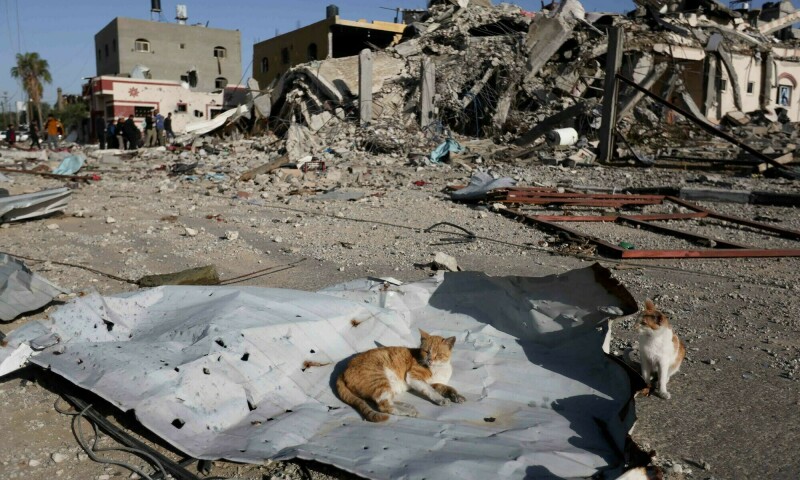
Neglecting this issue would be a grave oversight, and addressing it is paramount rather than simply turning a blind eye to the whole issue. The ongoing fighting has not only devastatingly impacted human lives, particularly in Gaza but has also profoundly affected the ecology of the besieged enclave. Entire neighbourhoods that we see in the distressing images coming from Gaza are utterly demolished, with every inch reduced to rubble and buildings charred, leaving an indelible mark.
Now imagine its green spaces, and its animals, which all encountered the same fate. This sentiment was articulated by an English professor, Refaat Alareer who lives in Gaza City.
While speaking to the New Arab during a brief truce, he said: “I took a walk in the western parts of Gaza City and the destruction Israel left behind is World War II level of destruction. The wanton attacks are indescribable. It’s like the tanks were playing Pac-Man and deliberately and systematically destroying homes, buildings, businesses, infrastructure, schools, mosques, and trees.”
“Israel is destroying Gaza in a way that will impact life for decades to come,” he added.
Indeed the wretched reality is that the entire ecosystem, including the flora and fauna, suffered drastic consequences, akin to the complete displacement experienced by its human counterparts.
The largest animal rights organisation globally, People for the Ethical Treatment of Animals (Peta), issued a statement on November 30, drawing attention to the dire conditions faced by animals — dogs, cats, donkeys, and others — in the Gaza strip. Peta expressed concern over the animals’ suffering due to starvation, dehydration and untreated injuries.
Use of dangerous chemicals on the environment:
Furthermore, according to some official reports, the Israeli military has also made use of extremely dangerous elements and chemicals, such as ‘White Phosphorus’, on Gaza in its brutal response, in order to take revenge on Hamas over its October 7 attack.
According to this same report, white phosphorus ignites when exposed to atmospheric oxygen and continues to burn until it is deprived of oxygen or exhausted. Its chemical reaction can create intense heat (about 815°C/1,500°F), light, and smoke, which has destructive effects on the environment and also plants and may remain within the deep soil for several years without any change.
Additionally, the US Agency for Toxic Substances and Disease Registry highlights that white phosphorus can slowly accumulate in the bodies of fish that live in contaminated lakes or streams.
If these reports are to be believed, there could be nothing graver than the endangerment of the environment in such a manner.
The ‘herbicidal warfare’ also continues
Moreover, amid the ongoing conflict, there could be the utilisation of ‘herbicidal warfare’ in Gaza that Israel has reportedly been doing between October and November of the year — this time exacerbating the already dire situation due to the ongoing conflict.
The proof of this grave exercise carried out by the Israeli military has been stressed in a detailed 2019 investigation conducted by Forensic Architecture, a research agency affiliated with Goldsmiths, University of London, which revealed that Israeli forces engaged in “unannounced aerial spraying of crop-killing herbicides”. This deliberate action resulted in the devastation of extensive agricultural lands that were once fertile, severely impacting the livelihoods of Palestinian farmers.
The report, as per The Hindu, says that the Israeli ministry clarified that the herbicidal combination deployed comprised glyphosate, oxyfluorfen and diuron, which according to the European Chemicals Agency are known to inflict severe damage on the local ecology and biodiversity, posing a grave threat to the delicate environmental balance in the region.
Significance of COP28 in UAE
The significance of COP28 is amplified as it is hosted by a Middle Eastern country, the UAE. Ignoring the ongoing fighting during this conference and failing to find a resolution could jeopardise not only the region’s climate progress but also render the gathering futile, wasting the efforts and resources of world leaders and nations.
We have seen that the conflict between Israel and Palestine has the potential to severely strain international relations between countries, as demonstrated by recent events where several Muslim nations severed ties with Israel, ceasing trade and future agreements. Like Turkiye, regarding which an Al Jazeera report said: “Gaza war pushes tumultuous Israel-Turkiye ties into ‘deep freezer’”.
And very much like this, Middle Eastern countries which are already envisioning future relations with Israel appear to be at potential risk.
Global agencies and possible shifts in priorities
In addition, the impact of COP28 goes beyond just bilateral relationships; it extends to global agencies such as the International Monetary Fund. Obvious assumptions could be and must be that prolonged conflict could lead to a reduction in climate budgets by such organisations, diverting funds towards addressing the crisis instead.
COP28 bears the weighty responsibility of showcasing the universal devastation caused by any war, impacting not just humans but also the world’s environment and biodiversity — affecting the air, oceans, and all living creatures.
It must emphasise the imperative of avoiding conflicts at all costs, given the alarming and dire state of our environment — already staggering and rapidly deteriorating.