

Ayesha Fiaz & Syed Ahmer Raza
Mukesh Meghwar walks slowly through the winding streets of his old mohallah in Kapri Mori, the Badin village where he grew up. Children pass him barefoot and carefree, just as he once did, their laughter echoing against mud walls patched with old posters. For a moment, he halts near a dilapidated cobbler’s shop, the very spot where his childhood unfolded.
He recalls the world he was born into, one where caste decided fate and the accident of birth set the limits of ambition. His father being the cobbler, mended shoes from dawn to dusk; his mother pieced together survival through odd jobs and borrowed faith. Their hut was small, their meals often smaller, and silence was sometimes the only thing that filled the evenings. However, even in those long afternoons of want, young Mukesh would watch other children walking to school in crisp uniforms, neat slates, and carefree laughter echoing through the alleys. He did not yet know the alphabet, but he already knew the weight of distance.
Meghwars in Kapri Mori were known only as cobblers and were not counted among those who studied, as education was a distant luxury. Mukesh, the eldest of six siblings, carried the quiet burden of both responsibility and hope. Each day started with the rhythm of the cobbler’s hammer and ended with the smell of glue and leather clinging to his hands. But something in him resisted the silence of routine. Late at night, when the village quieted, he would trace the printed letters on that crumpled newspaper, matching shapes to sounds learned by ear. His mother, seeing his fascination, once whispered, “If you learn to read, you might change your life.” That fragile dream, born beside a flickering lantern and a pile of worn shoes, slowly began to take root.
It was on an ordinary afternoon th”t a visiting teacher from the nearby government school noticed him standing outside the classroom window, mouthing alphabets under his breath. Instead of shooing him away, the teacher called him inside. He hesitated, glancing back towards the cobbler’s stall where his father bent over a torn sandal. When his father learned of the invitation, he was torn between pride and worry, as education was a luxury they could neither imagine nor afford. But his mother, with quiet defiance, gathered a few rupees she had saved from sewing work and bought him a used notebook and pencil. The next morning, barefoot yet resolute, he walked into the classroom. The wooden benches smelled of chalk and dust, and for the first time in his life, he felt he belonged somewhere beyond the cobbler’s stall.
Learning, however, was never easy. There were days when teachers overlooked him, when classmates mocked the patched clothes he wore or the smell of leather that never left his hands. But he endured. In the evenings, he returned home to help his father mend shoes, his fingers still sore from gripping pencils. Sometimes hunger gnawed so sharply that letters blurred on the page, but he refused to let go. “Education was my rebellion,” he says now with a quiet smile.
Mukesh did his FSc in 2005 and got admission to university in 2011, because he didn’t have money for education. There was a six-year gap in his High School and University admission. After Fsc, Mukesh was working as a sweeper, in a Govt. high school in Malkani Sharif Kapri Mori, where he secured position in academics and in speech competition on district level and division level. He worked as a tailor, worked on agricultural lands, worked as a laborer in construction, and ran a cart and sold toys to feed the family.
Years later, Mukesh managed to complete his early schooling through his meagre savings and moved to Jamshoro, where he earned degrees in psychology and law from the University of Sindh; becoming the first in his family to attend university and graduate with honors. There, he discovered not only new ideas but also the deep-rooted systems of caste and class that kept all the communities confined and divided by prejudice irrespective of religious background.
Among students from diverse religious, caste, and class backgrounds across the province, his world began to expand. He learned not only about the human mind, but also about the invisible forces and prejudices based on myths that had long kept individuals and communities bound by silence.
While pursuing his degree, he began writing for a small student paper. Soon after, with the help of a few friends, he co-founded Sandesh, the first Hindu-rights-based newspaper in Sindh, aptly named “The Message.” It was a simple publication printed on borrowed paper and distributed by hand, but it gave voice to the voiceless. “We wanted to show that our community exists and that we think, we write, we belong,” Mukesh recalls.
From reporting on bonded labour to highlighting cases of forced conversions, Sandesh became a lifeline for many marginalised voices. But Mukesh’s activism was not confined to words. He joined the Progressive Youth Forum (PYF) Pakistan as deputy general secretary, advocating for secularism, pluralism and social democracy. He later co-founded the Social Democratic Youth Network (SDYN), mobilising young people from minority and working-class backgrounds to engage in civic life. Between 2008 and 2012, he worked as a regional coordinator with Mehergarh: A Centre for Learning, in Hyderabad, an experience that taught him the language of development work: project design, implementation, monitoring and advocacy. During those years, he began to see how education could serve as a form of resistance, a way to claim space in a country that often denies it. That realisation would soon pull him back to where it all began.
When he returned to Kapri Mori, he found the same narrow lanes, the same rhythm of poverty and the same absence of schools for minority children. “The boys repaired shoes, the girls stayed home. Nothing had changed. I realised that waiting for the government was not an option,” he says.
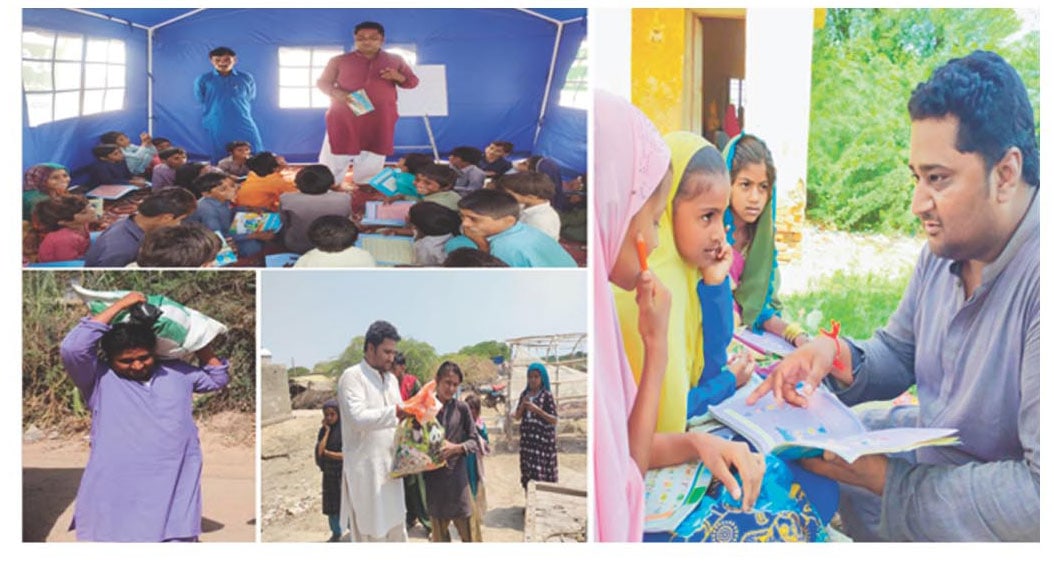
With only a few thousand rupees in savings and no land of his own, he built a makeshift jhopri, a hut of mud and palm leaves, and started teaching a handful of children from his neighbourhood. There were no chairs, no books, no blackboard. The first day, only seven children came. But the following week, ten more arrived. By the end of the month, the little hut was filled with laughter, chalk dust and the faint hum of hope. That jhopri was the seed that grew into what is now known as the Aman Educational System (AES), a community-run initiative dedicated to providing quality, inclusive education to marginalised children in rural Sindh. Its first branch, Aman Elementary School, now stands where the old hut once was: fourteen rooms built from the ground up, hosting more than 400 students.
The road to building a proper school was steep and the journey from a hut to the educational system was not without struggle. “We started with nothing. Construction cost more than two crores, and I had barely a few lacs. But people believed in the idea,” Mukesh says. With help from the Sindh Education Foundation (SEF), community donations, and friends from Pakistan and abroad, the dream took shape brick by brick. Mukesh even took personal loans to complete the construction. “If it were not for SEF, the school would never have been completed,” he admits. The Aman Educational System Is more than just a school; it is a movement. Mukesh and his small team go door to door during the annual enrolment campaign, convincing reluctant parents to send both sons and daughters to school. “At first, they laughed. They said, ‘Who will teach cobblers’ children?’ But now those same families proudly show their daughters’ report cards,” he recalls.
The most radical thing he did was to establish a co-educational system in a deeply patriarchal and feudal society. In a village where girls’ safety and honour are often used as reasons to keep them home, this was a revolutionary act. Parents feared sending daughters to school, worried about harassment or gossip. But Mukesh’s persistence slowly changed that mindset. “I told them education protects honour; ignorance destroys it,” he says.
Today, over a hundred girls from Kapri Mori and nearby villages study at the school. Many are the first in their families to hold a book. Some have gone on to secondary education, others dream of becoming teachers, nurses or officers. Their transformation, Mukesh says, is the school’s greatest success. But education is not his only focus. The Aman Educational System integrates digital learning tools and inclusive teaching methods for children who have never been exposed to structured education. “We want to bridge the gap. These children deserve not only literacy but also confidence, critical thinking and creativity,” he explains.
The school also encourages parents’ participation, organising community meetings to discuss challenges and share progress. For Mukesh, success is not measured in numbers or certificates, but in transformation. “When I see children who once herded goats now giving speeches in English, that is success. For a community long deprived of education, this is a milestone,” he smiles.
In 2014, Mukesh’s work earned international recognition when he was selected as one of the Emerging Leaders of Pakistan (ELP) by the Atlantic Council’s South Asia Center, a fellowship supported by the US Embassy Islamabad and the Meridian International Center. The programme brought together fifteen dynamic civil society leaders from across Pakistan, representing diverse ethnic and religious backgrounds.For Mukesh, it was his first visit abroad, a journey from Kapri Mori’s dusty lanes to the corridors of Washington, DC. “It felt unreal, as one day I was teaching under a thatched roof; the next, I was meeting officials at the State Department,” he says.
During his fellowship, he met policymakers, journalists, philanthropists and human rights advocates. He spoke about education as a tool for social transformation and the need to empower minorities through inclusion. “It was not about me. It was about showing that people like us, from small villages, from marginalised communities, have something to say, something to contribute,” he says.
The fellowship, he says, reiterated his belief that change begins with one person but survives through community. Upon returning to Pakistan, he expanded his work mentoring young activists, supporting women’s literacy programmes and collaborating with organisations working on bonded labour and gender justice. However, despite the accolades and achievements, Mukesh remains rooted in humility. Every few months, he returns to that same cobbler’s shop, now run by his younger brother, and sits for a while, inhaling the familiar scent of glue and dust. “It reminds me where I came from and why I can never forget,” he says softly.
He is now working to establish a second branch of the Aman Educational System near his village in Malkani Shareef, which will cater to elementary education for around three hundred students. In the next few years, he hopes to upgrade the system into a high school and eventually a university serving marginalised communities across Sindh. “Education should not stop at survival; it should lead to dignity,” he says.As the afternoon sun dips over the fields of Badin, he walks back through the narrow lanes of Kapri Mori. The village children wave at him, calling out “Sir Mukesh!” in excitement. He smiles, his eyes lingering on the cobbler’s shop one last time before turning towards the school, its painted walls bright against the fading light. For him, that walk is no longer a journey of distance but of return, to the place where a boy once dared to believe that a pencil could rewrite his fate.