
The Election Commission of Pakistan (ECP) sprung into action on Thursday after the top court directed it to confer with President Arif Alvi on the date for general elections.
A delegation headed by Chief Election Commissioner (CEC) Sikander Sultan Raja met the president at the Aiwan-i-Sadr in Islamabad. Attorney General for Pakistan (AGP) Mansoor Usman Awan was also present for the meeting.
Earlier in the day, Chief Justice of Pakistan (CJP) Qazi Faez Isa had directed the ECP to confer with Alvi on the poll date after the electoral body said that elections would be held on February 11.
“Let the ECP meet with the President of Pakistan today and the date for holding general elections in Pakistan be appointed,” the top judge said in a written order, a copy of which is available with Dawn.com.
He directed AGP Awan to arrange the meeting, provide Alvi with the court order and be available to render assistance. “We expect that the matter of appointing a date for holding general elections shall be settled, and this court will be informed tomorrow (Nov 3),” Justice Isa added.
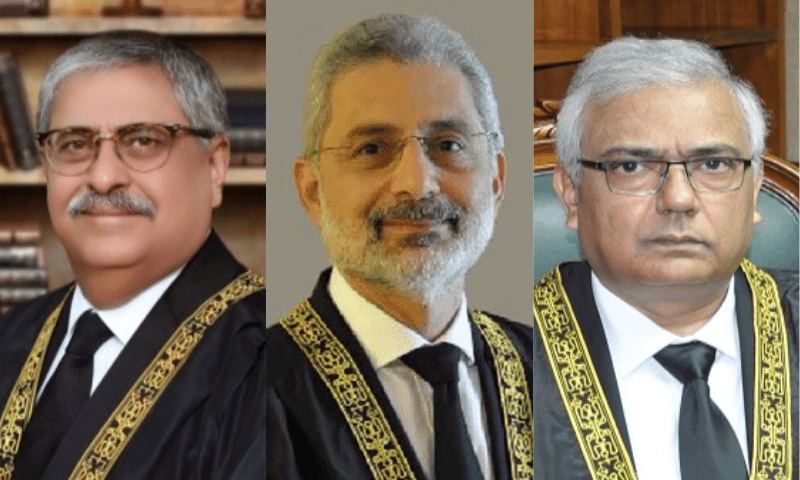
The order was issued after a three-judge bench comprising the CJP, Justice Amin-ud-Din Khan and Justice Athar Minallah heard a set of petitions calling for holding elections within 90 days after the dissolution of the National Assembly and the provincial legislatures.
At the previous hearing, the court had issued notices to the election commission and the federal government for their input on polls within 90 days.
During today’s hearing, Justice Isa sought a clear stance from the electoral body on polls to which the ECP lawyer said there was a 54-day schedule after the delimitation process — to be completed by Nov 30.
“All arrangements including the drawing of constituencies will be completed by Jan 29,” Sajeel Swati said, adding that the final list of constituencies will be published on Dec 5.
He told the court that the electoral body had been looking to hold polls on a Sunday for the ease of the public. “We have decided that elections will be held on Feb 11, which is the second Sunday,” the lawyer added.
CJP Isa asked the ECP if President Arif Alvi was taken on board in the matter to which Swati said “we are not bound to take the president on board”.
This drew the chief justice’s ire. “Both the president and ECP are Pakistanis. Why is the ECP hesitant to consult with the president?” he asked and then directed the electoral body to discuss the matter with Alvi.
After a half-hour recess in the hearing, Swati told the SC that the ECP would be consulting with the president today. “Knock his door even if he doesn’t call you,” Justice Isa said and then instructed AGP Awan to stay on board during the consultation.
Subsequently, the CJP, while dictating the order of the proceedings in the case, said that the election date given would have to be implemented. “SC wants polls to be held without any arguments,” the top judge said, adding that the court only wanted a solution to the issue and didn’t want to get stuck in any technicalities.
“The final date for polls will be announced from the Supreme Court,” Justice Isa announced, adding that after this petitions regarding any delays won’t be entertained.
Later, Secretary Omar Hamid Khan confirmed to Geo News that the consultation with the president will be taking place “shortly”.
‘Constitutional and legal decision’
In a media talk outside SC, PPP lawyer Farooq H. Naek said: “Whatever has happened [has happened]. The elections should have taken place in 90 days, but now that the date is in, parliamentarians should move a constitutional amendment to Article 254 to validate this date (Feb 11).
“So no one can say tomorrow that the elections were not held within the 90-day mandate.”
Article 254 of the Constitution states that “when anything is required to be done within a particular period but is not, the carrying out of that act or thing does not become invalid or ineffective just because it was not done within the prescribed period”.
When asked whether the president is bound to consult the ECP, Naek said: “My view is that the president of Pakistan is not at all obligated to consult the ECP [for the election date]. He has been granted authority and at most – if he has to consult anyone — under Article 48(1), he can consult the prime minister.
“And that letter that he wrote — in my opinion — was unlawful.”
Meanwhile, speaking to DawnNewsTV following the development, former ECP secretary Kanwar Dilshad said the ECP would complete its delimitations by Nov 30 and may issue the schedule by mid-December.
“This is a very good, constitutional and legal decision,” he said.
When asked whether this can be considered the definitive date, he said: “ECP is bound to follow the guidelines of the SC. It was a major decision to announce the date to the court and it would be impossible to walk back from it now.”
“Feb 11 is a Sunday and the weather will be better. Some political parties have raised concerns over the snow and fog. So by the first week of Feb, most of it dissipates,” Dilshad added.
He added that after the Feb 11 polls, Senate elections will likely be held on March 5-6. “And by my estimates, the president will be elected after March 15-16,” the former secretary said.
Meanwhile, PPP’s Shazia Marri termed today’s announcement a “victory of democracy, a victory of the Constitution”, saying that “the PPP is the only party that has been demanding an election date.
“As far as I’m concerned, this isn’t an announcement — it emerged during court questioning. I urge the ECP to announce the date properly,” she added.
Today’s hearing
At the outset of the hearing today, Naek appeared in the apex court and requested to become a respondent in the case. He was given a green light from the judges after PTI’s Barrister Ali Zafar said he had no objections to the request.
Zafar then began presenting his arguments and contended that polls should be held within 90 days. However, CJP Isa said, “Your request for polls within 90 days has now become ineffective.”
The PTI lawyer insisted that his argument was connected with a fundamental right, to which Justice Isa asked if the former just wanted elections now. Zafar replied in the affirmative.
“Will anyone oppose it?” the chief justice asked. In his reply, the PTI counsel said no. The CJP then asked Attorney General for Pakistan Mansoor Usman Awan if he had any objections to polls, to which the latter also replied in the negative.
Continuing his arguments, Zafar said Articles 58 (Dissolution of the National Assembly) and 224 (Time of election and by-election) could be read. “Without elections, neither can the Parliament run nor can laws be formed,” he contended.
He went on to say that there was a difference between giving a schedule for elections and announcing the poll date, adding that giving the election date was also mentioned in the Constitution.
“The law ministry believes that the president cannot give a date for polls,” Zafar stated. He highlighted that as per the 90-day deadline, elections should be held on Nov 7.
It must be noted President Dr Arif Alvi had written a letter to Chief Election Commissioner (CEC) Sikandar Sultan Raja on September 13 wherein he proposed that elections be held by November 6.
However, the Ministry of Law and Justice had Alvi had later informed Alvi that the powers to announce the poll date rested with the ECP, not the president.
During the hearing today, Justice Minallah asked why it took the president so long to write the letter to the ECP. On the other hand, the chief justice noted that the text of the said letter was “vague”.
“Did the president approach us for an opinion [on the matter] from the Supreme Court?” CJP Isa asked, to which Zafar said this was not the case.
At one point, the top judge asked the PTI counsel if he was trying to say that the president did not fulfil his constitutional responsibility. “The assembly was dissolved on Aug 9 but the president wrote the letter in September,” he said.
Meanwhile, Justice Minallah said, “The command of the Constitution is very clear that the president had to give the date [for elections], there is no disagreement in it.”
“Whoever wants to disagree can continue doing so,” Justice Isa stated, warning that the court could take a judicial notice as well. He also said that the letter could not be written on the “last day”.
For his part, Zafar said that in his opinion the president had fulfilled the responsibility.
Here, Justice Minallah said there wouldn’t have been any objections if the president had given the election date on the day the National Assembly was dissolved.
“What do you want from us now? Do you want us to direct the president to give a date? The president says he took advice from so and so. Can this court now issue a writ against the President?” CJP Isa asked.
He pointed out that machinery was involved in conducting polls. “Can the Supreme Court give the date for elections?” the chief justice asked.
Justice Minallah said that Article 98 of the Constitution was very clear on the court’s role in the matter. The said law pertains to the conferring of functions on subordinate authorities.
“Did the ECP ever say that the president should give the election date?” the judge further asked.
Zafar replied that the electoral body had said that the authority to give the poll date lay with the ECP. He added that there was a need to look at the SC’s role in the matter.
“Can we go against the president and give a date for polls ourselves?” Justice Isa asked, highlighting that the Constitution gives the apex court the authority to do so.
The PTI counsel said such an action had been taken before but Justice Minallah noted that the question currently under discussion was different.
The CJP said that holding elections was good and “not a problem”. Addressing the PTI lawyer, the chief justice said: “Your leader who is also the leader of the president […] why didn’t he call the president and tell him to announce the election date?”
Justice Isa also noted that the president had only mentioned the date in his letter that fell after the constitutionally stipulated 90-day period ended.
At one point during the hearing, Justice Khan said that Zafar’s argument actually was that the president had deviated from the Constitution.
“Prima facie the president, ECP and government are all responsible,” Justice Minallah said. “The question now is what will be the result of this,” he noted, adding that elections must be held on time.
The judge further said that every day after the prescribed 90-day period to hold polls “is a violation of the Constitution”.
As Zafar concluded his arguments, Supreme Court Bar Association chief Abid Zuberi, one of the petitioners, came to the rostrum. He said he agreed with Zafar’s arguments.
Zuberi mentioned the SC’s April 4 judgmententer link description here in which it had declared ECP’s decision to postpone polls to the Punjab Assembly as “unconstitutional” and had fixed May 14 as the date for polls in the province.
However, Justice Isa noted that the court was only concerned with general elections and wanted every institution to do its job. He also asked Zuberi if he wanted President Alvi to be charged under Article 6 of the Constitution.
“We only want timely elections,” the SCBA chief responded.
The CJP continued that Zuberi was moving toward the interpretation of the Constitution which the bench could not do. “The judgment you referred to pertains to the interpretation of the Constitution,” Justice Isa said, adding that nowhere in the world, except for Pakistan, court decisions could change the Constitution.
When PPP’s Naek came to the rostrum, he said the president shouldn’t have written the letter to ECP, highlighting that the president gave the date for polls after which the electoral body released a schedule.
“The president was responsible for giving a date to hold polls within 90 days,” the lawyer added.
Here, the CJP pointed out that 90 days had not passed yet while Justice Minallah asked if the PPP had objected to the census during the Council of Common Interests.
No, Naek replied. “Everyone, including the PPP, is responsible for delay in polls,” Justice Minallah said and then suggested to hear the ECP counsel first.
Election delay
The Election Commission of Pakistan (ECP) had earlier ruled out polls this year citing the need for fresh delimitation of constituencies.
Since the National Assembly was dissolved three days before the end of its constitutional term, Article 224 of the Constitution mandates that elections be held within 90 days of the dissolution of the assembly by November 7.
But at the same time, Section 17(2) of the Elections Act states that “the commission shall delimit constituencies after every census is officially published.”
Last month, the commission announced that elections would be held in January 2024 but stopped short of announcing a date.
The decision has garnered mixed reactions from political parties. The JUI-F has opposed the timing of polls due to “weather conditions”, while the PML-N threw weight behind the ECP.
The PPP and PTI, on the other hand, have called for the immediate announcement of the election date and assurance of a level playing field. Meanwhile, the caretaker government has expressed hope that the date for elections would be announced soon.