
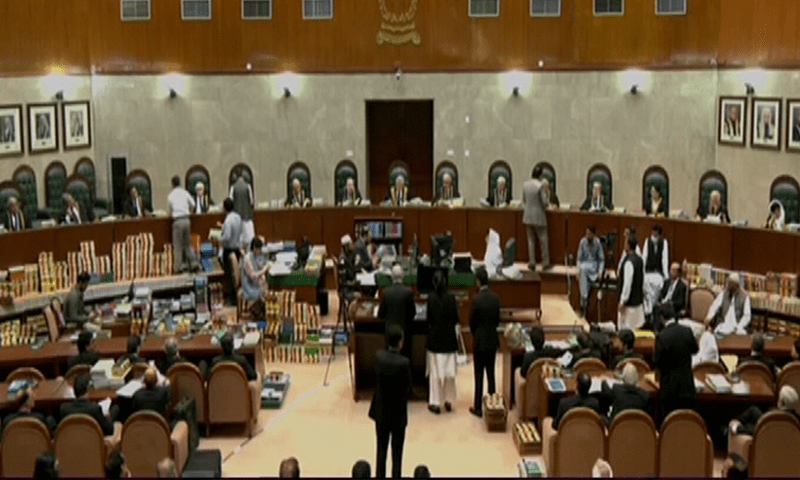
The full court has resumed hearing a set of petitions challenging the Supreme Court (Practice and Procedure) Act 2023 — which requires the formation of benches on constitutional matters of public importance by a committee of three senior judges of the court.
In keeping with the court’s directives, the hearing is being streamed live on television.
Headed by Chief Justice of Pakistan Qazi Faez Isa, the bench consists Justice Sardar Tariq Masood, Justice Ijazul Ahsan, Justice Syed Mansoor Ali Shah, Justice Munib Akhtar, Justice Yahya Afridi, Justice Aminuddin Khan, Justice Sayyed Mazahar Ali Akbar Naqvi, Justice Jamal Khan Mandokhel, Justice Muhammad Ali Mazhar, Justice Ayesha A. Malik, Justice Athar Minallah, Justice Syed Hasan Azhar Rizvi, Justice Shahid Waheed and Justice Musarrat Hilali.
In a pre-emptive move, the Supreme Court — then led by former CJP Umar Ata Bandial — in April had barred the government from implementing the bill seeking to curtail the chief justice of Pakistan’s powers once it became a law.
At the previous hearing, CJP Isa had questioned the many legal challenges to parliament’s legislative authority, saying there had been much nit-picking over laws enacted by assemblies, but in the face of martial laws imposed in the country, there was always a complete surrender.
“We pick errors whenever parliament made a law, but surrender ourselves completely when martial laws were imposed in the country,” Justice Isa said.
“This Courtroom No.1 carries pictures (of former CJPs) who obviated their oaths by validating martial laws, but nobody moves petitions to express opposition [to their action], except when parliament enacts laws,” Justice Isa quipped during a televised hearing. Justice Isa had intended to wrap up the case the same day, but it was adjourned till today due to time constraints.
Today’s hearing
At the outset of today’s hearing, Supreme Court Bar Association (SCBA) President Abid Zuberi said that Article 175(2) and Article 191 had been quoted in the Act. He read out Article 191 which states: “Subject to the Constitution and law, the Supreme Court may make rules regulating the practice and procedure of the Court”.
The lawyer contended that the “only authority that can make rules regulating the practice and procedure of the court is the honourable SC and not Parliament”.
He said that “subject to the law and the Constitution” did not mean that Parliament could legislate in this regard. “If rule-making power is made subject to legislation, then the rule-making power of the SC will become functus officio,” he said.
He further contended that constitutional grant of rule-making power was construed as a continuing power, “so there cannot be any limitations on that”.
However, CJP Isa stated that under the counsel’s arguments six words of the Constitution could be deleted “as rendered meaningless”. “I am reading it like that if I accept your contentions,” Justice Isa said.
Zuberi contended that “subject to” meant that it was restrictive in nature because a constitutional power, which was a continuing power, was being given to the SC.
The lawyer said that if the Constitution was giving the legislature power for rule-making, it used specific words. He referred to Article 154(5), which states: “Until Majlis-i-Shoora makes provision by law, the Council [of Common Interest] may make its rules of procedure”. He also referred to Article 6(3) and Article 151(2).
Justice Akhtar asked whether subsequent legislation could “displace” rules that were lawfully and constitutionally framed by the apex court.
“No, they cannot for the simple reason that it will become ad nauseam. For example, can now the SC make a law regulating its practice and procedure overriding Parliament’s? Where will we stop?” Zuberi contended.
At one point, CJP Isa remarked, “The day we hear this case, the weeks we hear this case, our institution exceeds our disposal. The day we don’t, our disposal exceeds our execution. If you think this is a never-ending hearing, this is the last day of the hearing.”
He urged the SCBA president to continue his arguments in the case, telling him to move on to the next point. He expressed displeasure with Zuberi submitting documents to the court during the hearing.
“This is most unfair. We had asked people to file […] We have told everybody to file […] And is this an easy thing to read? Could you not have done this before?” he asked Zuberi.
Moving on with his arguments, the SCBA president said that Article 175 gave Parliament the power to legislate but it also had to be read with Article 142(A) and Entry 55.
“Does Article 191 confer jurisdiction or does it confer power?” asked Justice Ahsan.
“I would say it confers power,” Zuberi said. He said that the most important word used in the provision was “regulate”.
“Article 191 is not a jurisdiction conferring article it is a power conferring article. And there is a distinction between jurisdiction and power,” Justice Ahsan remarked.
Continuing his arguments, the counsel said that the power exercised under Article 191 was a constitutional power which vested the SC to regulate its practice and procedure, adding that Parliament could not interfere in this regard.
He said that the words “subject to” meant that it was not an enabling provision but rather a restrictive provision.
“If you argue in context of Pakistan and why presumably the legislature enacted this law […] they are giving a right of appeal under Article 184(3). You [have not talked] about how Article 184 has been used. Either say it is being used correctly or incorrectly or sometimes being used correctly and sometimes incorrectly. Say something,” Justice Isa told the lawyer.
He said that the SCBA president had not brought a petition before the court and asked what his “anxiety” was with regards to the law. CJP Isa then asked about how Article 184(3) had been used.
“Human rights cell, is it mentioned in any rule or law? Put Parliament aside. Is there any mention in our own rules?” CJP Isa said. He went on to say that Article 184(3) as far as habeas corpus was concerned, there was mention of it in the rules.
“But the other powers used under Article184(3) were those mentioned in the rules or not?” he asked. Justice Isa said that Article 191 did not stated that the chief justice could make the rules or a human rights cell.
“Before the world raises a finger, I raise a finger on myself. Powers used under Article 184(3) in thousands of cases — some were of general public interest [but] some became personal — you are not explaining this,” CJP Isa said.
He said that how Article 184(3) had been used was a “reality of Pakistan”. He told the lawyer to either argue that it had been used correctly or to say it was not and then give a remedy.
“If a mistake has been made, then whose responsibility is it to find a remedy? The biggest responsibility is of this court. After that maybe Parliament. If we have made a mistake then we should rectify it. If Parliament has made a mistake then it should rectify it. If we don’t correct our mistake, then can Parliament?” Justice Isa said, remarking the the counsel was overlooking whatever had happened in Pakistan.
CJP Isa remarked that the SCBA president was representing a particular party, to which Zuberi said he was not. The lawyer stated that he was appearing on behalf of the bar association.
More to follow