

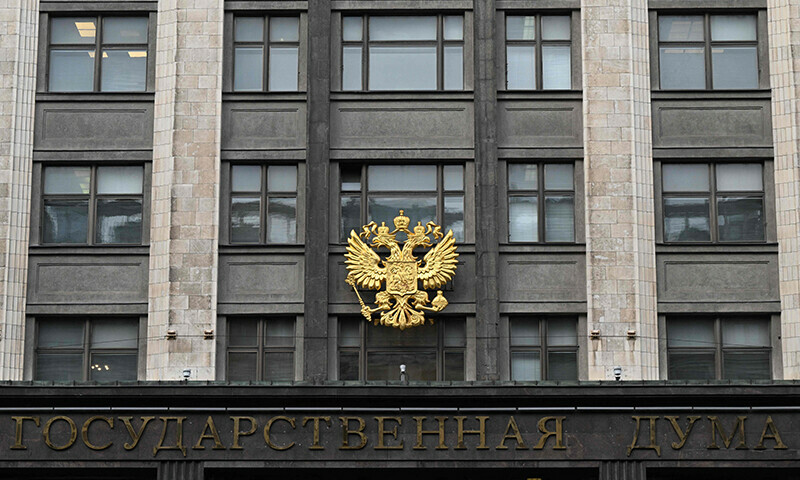
Russia’s parliament took the first step on Tuesday towards revoking ratification of the Comprehensive Nuclear Test Ban Treaty and its top lawmaker warned the United States that Moscow might even abandon the pact altogether.
Russia says the aim is to restore parity with the United States, which has signed but never ratified the 1996 treaty, and that it will not resume testing unless Washington does.
But arms control experts are concerned that Russia may be inching towards a test which could usher in a new era of big power nuclear — and which the West would perceive as a Russian nuclear escalation amid the Ukraine war.
Parliament’s lower house, the Duma, voted by 412 to zero, with no abstentions, to approve the withdrawal of the ratification in the first of three readings.
“Our vote is an answer to the USA — to their crass approach to their duties to maintain global security,” Speaker Vyacheslav Volodin, a member of President Vladimir Putin’s Security Council, told parliament.
“And what we will do next — whether we remain a party to the treaty or not, we will not tell them. We must think about global security, the safety of our citizens and act in their interests,” Volodin said.
Volodin said that the United States had asked Russia via the United Nations not to revoke ratification. He said Moscow’s move was a wake-up call for Washington after its failure to ratify the CTBT [Comprehensive Test Ban Treaty] for the past 23 years. Russia ratified it in 2000.
Putin said on October 5 that he was not ready to say whether or not Russia should resume nuclear testing after calls from some Russian security experts and lawmakers to test a nuclear bomb as a warning to the West.
No country except North Korea has conducted a test involving a nuclear explosion this century.
‘Slippery slope’
Swift passage of the deratification bill was guaranteed after 440 of the Duma’s 450 members attached their signatures to it as sponsors last week.
While Russia is revoking ratification, it has said it will remain a signatory to the CTBT and continue to supply data to the global monitoring system which alerts the world to any nuclear test.
Post-Soviet Russia has never carried out a nuclear test. The Soviet Union last tested in 1990 and the United States in 1992.
A resumption of nuclear tests by Russia, the United States or China could mark the start of a new nuclear arms race between the big powers who stopped nuclear testing in the years following the 1991 collapse of the USSR.
Andrey Baklitskiy, senior researcher at the United Nations Institute for Disarmament Research, said Russia’s deratification of the CTBT was part of a “slippery slope” towards resuming testing.
He noted that Putin had said in February that Russia must “make everything ready” to conduct a test in case Washington did so and that Defence Minister Sergei Shoigu had visited Russia’s testing ground in the remote northern archipelago of Novaya Zemlya in August.
CNN published satellite images last month showing Russia, the United States and China have all built new facilities at their nuclear test sites in recent years.
Nuclear test?
Baklitskiy said in a telephone interview he did not see a Russian test as imminent, but “the more you go in this direction, the less of a big decision you would have to make” to proceed with one.
For many scientists and campaigners, the extent of nuclear bomb testing during the Cold War indicated the folly of nuclear brinkmanship, which could ultimately destroy humanity and contaminate the planet for hundreds of thousands of years.
But the Ukraine war has raised tensions between Moscow and Washington to the highest level since the 1962 Cuban Missile Crisis just as China seeks to bolster its nuclear arsenal to accord with its status as an emerging superpower.
Putin has said he sees no need to change Russia’s nuclear doctrine — a document that outlines that Russia would only order a strike with nuclear weapons if it was attacked, or if the existence of the state was endangered by an attack with conventional weapons.
Since the CTBT, 10 nuclear tests have taken place. India conducted two in 1998, Pakistan also two in 1998, and North Korea conducted tests in 2006, 2009, 2013, twice in 2016, and 2017, according to the United Nations.