

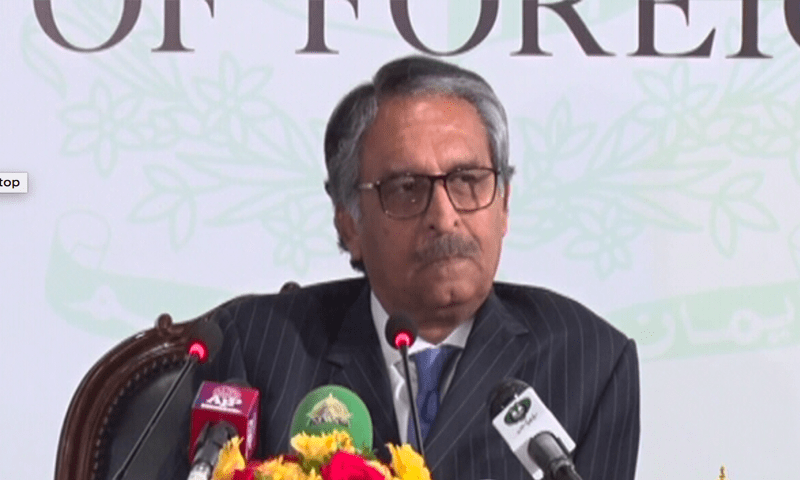
Interim Foreign Minister Jalil Abbas Jilani on Thursday asserted that Pakistan’s stance on the Israel-Palestine conflict “is and will remain” the same as it was in the past.
“There is no change in our policy regarding Israel … our policy is linked to the rights of Palestinian people,” he said.
Pakistan does not have diplomatic ties with Tel Aviv, and believes in a “two-state solution in accordance with the relevant United Nations and OIC resolutions as well as international law, with pre-1967 borders and Al-Quds Al-Sharif (Jerusalem) as the capital of Palestine”.
The foreign minister’s statement comes as Israel has increased efforts to stabilise ties with Saudi Arabia and other Muslim countries.
Last week, Israeli Foreign Minister Eli Cohen told journalists that during the United Nations General Assembly, he met leaders from several Muslim countries who had not recognised Israel yet.
He also suggested that “six or seven” Muslim nations were likely to normalise ties with Israel, following Saudi Arabia’s potential inclusion in the Abraham Accords. The agreement represents Arab nations willing to normalise ties with Israel, such as the United Arab Emirates, Bahrain, Morocco, and Sudan.
During a news conference in Islamabad today, the foreign minister was questioned on Pakistan’s ties with Israel. In response, he said: “Whenever we decide on the matter, we will keep our national interests on priority.”
FM Jilani stated that both he and the prime minister had clarified this in their speeches at the UNGA. “Palestinians must be given independent state status like that of pre-1967 and Pakistan reiterated this stance in all relevant meetings,” he said.
“Palestinians’ issue of right to self-determination is similar to that of Kashmiris. This is basically the part of our national interest.”
‘Ongoing dialogue with Afghanistan’
Questioned about Pakistan’s policy pertaining to Afghanistan amid the rise in cross-border terrorism, FM Jilani said the government had concerns regarding it and was engaging with Afghanistan on the matter.
“The presence of terrorists and stopping attacks from their soil is the responsibility of the Afghan government,” he said, highlighting that this was the neighbouring country’s bilateral commitment.
“In our recent meeting, there was a commitment that Afghan soil won’t be used against Pakistan. I hope the Afghan government will abide by their commitment and we hope there won’t be a repeat of incidents that we saw recently.”
Talking about the new policy regarding the crackdown on Afghan nationals in Pakistan, the foreign minister said: “The new policy approved by the cabinet does not only pertain to Afghan migrants, it is about all those who are residing illegally in Pakistan.
“No country in the world will allow you to live if you are residing there illegally. We are also doing that and we will strictly implement that policy. Afghan refugees who are legally residing here will not be asked to leave, but anyone be it Afghan or anyone, will have to go back to their respective country.”
‘Assassinations have become a global agenda for India’
Talking about Canada’s allegations regarding India’s involvement in the murder of a Sikh separatist leader on Canadian soil, Jilani said whatever happened in Canada was very unfortunate but added that Pakistan has been highlighting India’s involvement in such acts.
“India’s tactics of assassinations have been witnessed in all South Asian countries. Their espionage activities are also known and India has been supporting such actions.
“Unfortunately, assassinations have become a global agenda for India and there is much concern at the UN about it,” he said.
The foreign minister recalled that during his interaction with other world leaders at the UN, several countries expressed concerns over India’s actions.
“India’s fake mask has been exposed and its reality has become evident before the world,” he added.
In response to a question on Indian visa issues during the World Cup, the FM said the International Cricket Council must pressurise India to allow visiting spectators from other countries to visit.
‘No law violated by Russian purchases’
Referring to Pakistan’s recent purchases of Russian fuel, FM Jilani said these deals did not surmount breaking any international law.
“Pakistan has not really done anything which is different from other countries. I don’t think Pakistan by purchasing these items from Russia has violated any sanction law or any international law.”
The foreign minister further stated that the government wanted to remove all obstacles to the Pakistan-Iran gas pipeline and dialogue in connection with this was under way.
The construction of the 1,150-kilometre pipeline project, signed in 2013, was halted due to US sanctions on Iran. The project included a condition that Islamabad will pay billions of dollars in penalties if it abandons the project.