

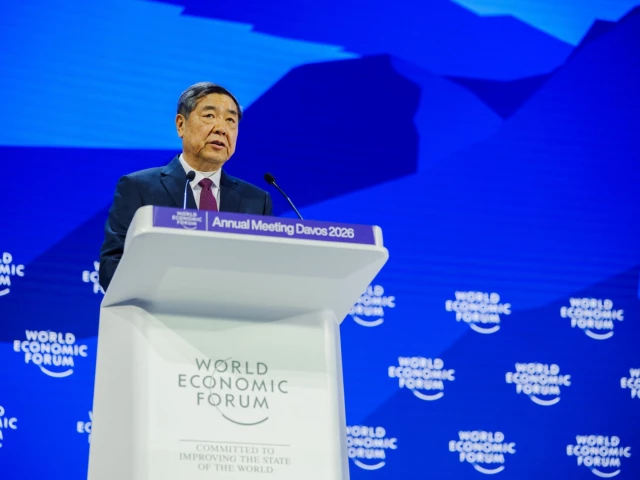
At WEF 2026, He Lifeng says unilateralism and geopolitical tensions are driving unprecedented global change
He Lifeng, Vice-Premier of the People’s Republic of China, during his Special Address at the World Economic Forum Annual Meeting 2026 in Davos on January 20, 2026. PHOTO: World Economic Forum
China’s Vice-Premier He Lifeng on Tuesday called for stronger commitment to free trade, multilateralism and dialogue, warning that rising protectionism and trade wars are fragmenting the global economy and threatening shared prosperity.
Delivering a special address at the World Economic Forum (WEF) Annual Meeting 2026 in Davos, Lifeng said unilateralism and geopolitical tensions were accelerating changes unseen in a century, undermining the multilateral trading system and disrupting global supply chains.
He cited World Trade Organization data showing that the share of global trade conducted under most-favoured-nation terms had fallen sharply, while the International Monetary Fund estimates economic fragmentation could reduce global output by about 7%.
“Tariff and trade wars have no winners,” Lifeng said, stressing that economic globalisation, despite its imperfections, remains an irreversible historical trend driven by cooperation and win-win outcomes.
Commitment to multilateralism
Lifeng reaffirmed China’s support for a rules-based, WTO-centred multilateral trading system, criticising unilateral trade measures that violate international rules and weaken global economic governance. He said China would continue to back reforms of multilateral institutions, including the WTO and IMF, to enhance fairness and representation for developing countries.
He highlighted China’s pledge not to seek new special and differential treatment in WTO negotiations and said Beijing welcomed mutually beneficial trade agreements, provided they complied with WTO rules and did not harm third parties.
China as market and partner
Addressing concerns over global growth and inequality, Lifeng said development should not be treated as a zero-sum game. He stressed that China does not seek trade surpluses and aims to become “the world’s market” as well as its factory, pledging to further expand imports and open its vast domestic market.
He said over the past five years, China has imported more than $15 trillion worth of goods and services and contributed about 30% of global economic growth. China’s economy, now exceeding 140 trillion yuan, remains resilient and innovation-driven, with average annual growth of around 5.4%, he added.
Dialogue over confrontation
On China–US relations, Lifeng said recent consultations had helped stabilise economic ties, underscoring that cooperation benefits both sides while confrontation leads to losses. Differences between countries, he said, should be managed through equal-footed dialogue rather than antagonism.
“China is a trading partner, not a rival,” he said, adding that China’s development should be seen as an opportunity rather than a threat.
Innovation and green transition
Lifeng also highlighted China’s focus on innovation, artificial intelligence and green development, noting that the country hosts the world’s largest renewable energy system and has committed to peak carbon emissions before 2030 and achieve carbon neutrality by 2060.
China, he said, is ready to deepen cooperation on AI governance, climate action and green finance, and invited global businesses to participate in its innovation-driven and low-carbon transition.
Concluding his address, Lifeng urged world leaders to uphold dialogue and cooperation, saying the future of the global economy depends on solidarity rather than division.