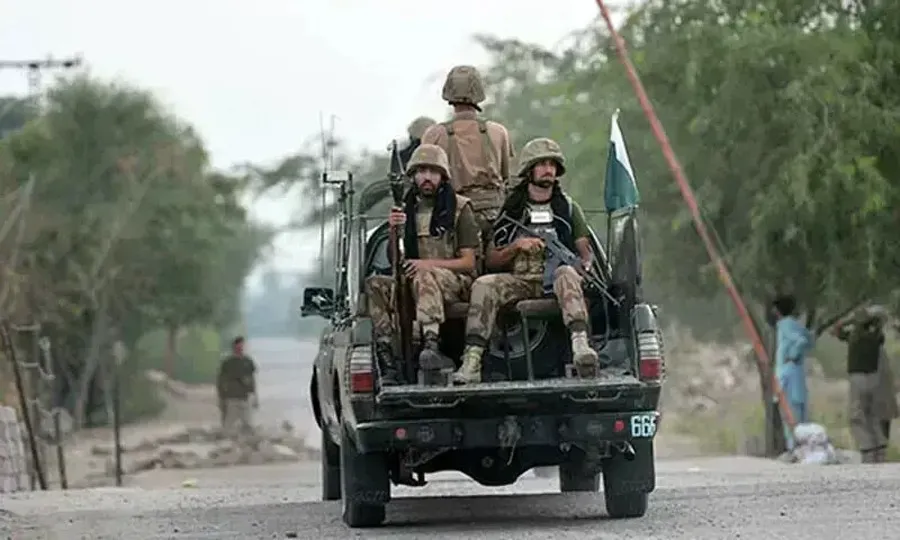

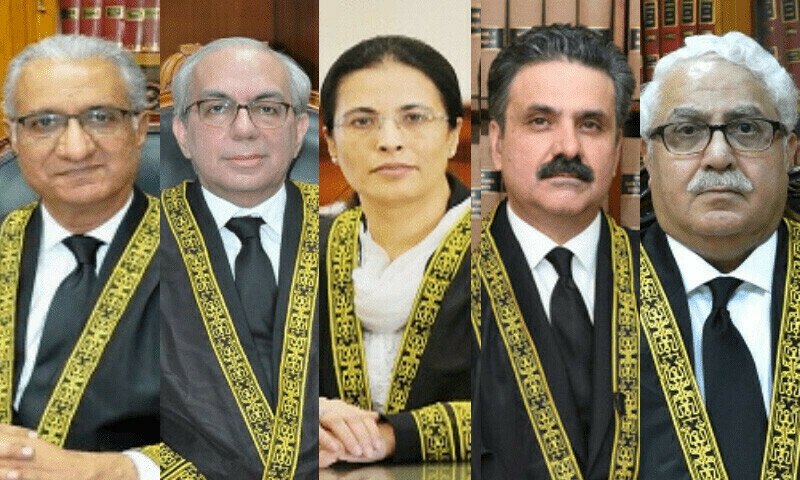
A five-member Supreme Court (SC) bench on Monday declared the military trials of civilians arrested in the wake of violent protests in the country on May 9 to be null and void.
The court announced its verdict in the case a few hours after it was reserved. Justice Ijazul Ahsan had headed the bench comprising Justices Munib Akhtar, Yayha Afridi, Sayyed Mazahar Ali Akbar Naqvi and Ayesha A. Malik.
In a 4-1 majority ruling, the court said that the trial of May 9 suspects would be conducted in ordinary courts. Justice Afridi had disagreed with the majority verdict.
The court also declared Section 2(1)(d) of the Army Act, which elaborates on persons subject to the Act, to be in violation of the Constitution. The court also declared Section 59(4) (civil offences) to be unconstitutional.
Section 2(1)(d) of the Pakistan Army Act states: “persons not otherwise subject to this Act who are accused of seducing or attempting to seduce any person subject to this Act from his duty or allegiance to government, or having committed, in relation to any work of defence, arsenal, naval, military or air force establishment or station, ship or aircraft or otherwise in relation to the naval, military or air force affairs of Pakistan” can be tried under the secrets act.
Section 59(4) states : “Notwithstanding anything contained in this Act or in any other law for the time being in force a person who becomes subject to this Act by reason of his being accused of an offence mentioned in clause (d) of subsection (1) of section 2 shall be liable to be tried or otherwise dealt with under this Act for such offence as if the offence were an offence against this Act and were committed at a time when such person was subject to this Act ; and the provisions of this section shall have effect accordingly.”
The court said that the cases should be tried in criminal courts in accordance with the nature of the crime.
However, the verdict can still be appealed before a full court by the state.
A six-judge bench, which included former chief justice of Pakistan (CJP) Umar Ata Bandial, had been hearing the petitions since June. However, after Justice Bandial’s retirement, the bench was reduced to five judges.
On Sunday, at least nine accused facing trials under the Army Act moved the apex court for early conclusion of their cases by the military courts. In their separate applications, the suspects pleaded that they had complete faith and confidence in the military authorities to provide justice to them and to other accused persons.
Following the violence on May 9 which targeted civilian as well as military installations, a total of 102 persons were taken into custody for their involvement in the attacks on military establishments, including the General Headquarters in Rawalpindi, corps commander’s residence in Lahore, PAF Base Mianwali, and an office of the Inter-Services Intelligence (ISI) in Faisalabad.
Petitioner hails verdict
Speaking to the media after the verdict was announced, Aitzaz Ahsan — who was one of the petitioners in the case — termed the verdict “very important”, adding that it would also strengthen democracy, Constitution and the justice system“.
He said that all institutions must now realise that the SC had declared that no one was above the law. “We were against military courts and we endeavoured against it. The verdict has shown that giving relief is the prerogative of the SC,” he said.
Ahsan said that reports had alleged that trials had begun even though the government had stated that this would not happen until the apex court was informed.
“The government informed the SC but after the commencement of trial. The government was supposed to inform before trials [began],” he said.
He said civilian institutions would gain confidence after the verdict and strive to improve their performance. He thanked the apex court for listening to the petitioners in the case and giving them a chance to speak.
He said that judges should be impartial and should not fear repercussions from their judgements. “In military courts, the judges are not independent. There is a colonel and he knows he can be transferred or expelled from the army,” he said.
Legal experts weigh in
Speaking to Dawn News after the verdict was announced, Barrister Asad Rahim Khan said: “It is an established principle that as long as civilian courts are functioning, trials of civilians should not be held in military courts.
“And today, the SC has upheld this principle,” he said.
He termed today’s decision “positive” for the Constitution and fundamental rights, adding that it would strengthen civilian courts.
Responding to a question on the implementation of the verdict, Barrister Rahim said there were no two opinions on the SC’s verdict and it should be followed as enshrined in the Constitution.
Former Supreme Court Bar Association (SCBA) president Ahsan Bhoon told Geo News that the decision was “absolutely correct” and in accordance with the Constitution.
Regarding the verdict being appealed, he said that this depended on the government. He said that an appeal could be filed after the court’s decision to uphold the Supreme Court (Practice and Procedure) Act.
“But my personal opinion is that this decision will be upheld even in appeal,” he said.
Today’s hearing
At the outset of today’s hearing, Attorney General for Pakistan (AGP) Mansoor Usman Awan came to the rostrum and said that he would present arguments on why a constitutional amendment was not required in the case at hand.
“A trial in military courts fulfills all the requirements of criminal courts,” he said. He said that the military trials of civilians had formally commenced. He said that the verdicts issued by the military courts would also detail the reasoning.
The AGP said that a matter concerning an attack on a restricted area or building could also go to military courts.
At one point, Justice Ahsan asked, “A constitutional amendment was required to try terrorists but not for civilians? I am trying to understand your argument.”
AGP Awan said that if the accused had a “direct link” to the armed forces, then a constitutional amendment was not required. He said that the suspects would be tried under Section 2(1)(d)(ii) of the Army Act.
He then noted that the court had raised a question about the framing of charges against the suspects. “All the requirements of a criminal case will be met in the trial under the Army Act,” he said.
He further said that the trial of May 9 suspects would be similar to how it is conducted in criminal courts. “The reasoning will be given in the verdict and the evidence will be recorded,” Awan said.
He said all the requirements for fair trial under Article 10-A (right to fair trial) of the Constitution would be fulfilled. He said that appeals against the verdict could also be filed in the high courts and subsequently the apex court.
During the hearing, Justice Ahsan asked about those who had been tried by military courts in the past. “Were the accused in 2015 civilians, foreigners or terrorists?” he asked.
The AGP replied that the suspects included both nationals and foreigners. He said that those tried in 2015 also included those who facilitated terrorists.
Justice Ayesha also asked the AGP how he would connect his arguments with Article 8(3) of the Constitution. “According to the law, a link to the armed forces in necessary [for trial in military courts],” she said.
Justice Ahsan remarked that the Constitution protected the fundamental rights of citizens.
Case background
The hearing of the case was put off indefinitely in August with ex-CJP Bandial saying that the court did not want to see Pakistan Army pointing their guns at civilians, since they were meant to defend the country and its people.
The observations had come when Attorney General for Pakistan (AGP) Mansoor Usman Awan emphasised that soldiers were equipped with sophisticated weapons and were trained to shoot, but they had exercised restraint on May 9.
Former CJP Jawwad S. Khawaja, senior counsel Aitzaz Ahsan, Karamat Ali, Zaman Khan Vardag, Junaid Razzaq, the Supreme Court Bar Association, PTI chief Imran Khan, Hafeezullah Khan Niazi, Lt-Col Inamul Rahiem, Naeemullah Qureshi etc have filed the petitions before the apex court.
Human rights groups and several politicians have criticised the trials of civilians in military courts, warning that they will undermine civilian supremacy.
After the Oct 11 upholding of the Supreme Court (Practice and Procedure) Act 2023, it is now a legal requirement that all cases moved under Article 184(3) involving interpretation of the Constitution should be heard by a bench consisting of not less than five SC judges.
And under Section 5 of the law, any decision by the five-judge bench could be challenged and any appeal in this regard could be filed within 30 days from the court order which will have to be fixed within a period not exceeding 14 days.
During earlier hearings, the SC had turned down the government request to constitute the full court consisting of all available judges.
Recently an application had been filed by Junaid Razzaq with a request to fix the military courts’ case as early as possible since he had been informed that the trial by military courts of civilians had commenced in violation of SC directions not to commence the trial before seeking prior permission from the apex court.
The applicant pleaded before the court that early hearing of the matter will be in the interest of justice, otherwise if the trial of his son — Azam Junaid — commenced and concluded in haste, the petitioner would suffer irreparable loss.