

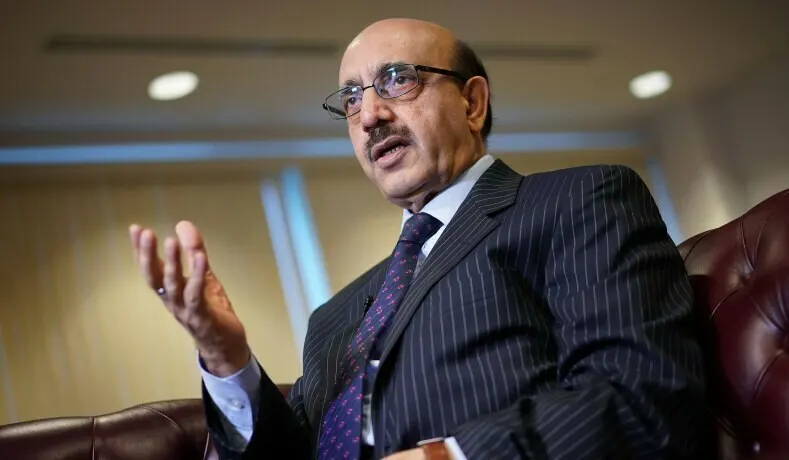
Ambassador Masood Khan, former President of Azad Jammu and Kashmir and former Permanent Representative of Pakistan to the United Nations as well as Ambassador to the United States, has described the first-ever face-to-face negotiations between Russian and Ukrainian representatives—held with active US mediation—as a significant but fragile step toward ending the Ukraine conflict, cautioning that unresolved territorial demands and shifting global power dynamics will ultimately shape the prospects for peace.
Speaking during a televised interview, Ambassador Khan said the trilateral talks held in Abu Dhabi, facilitated by senior US envoys, are symbolically and politically important, as they bring Russia and Ukraine to the table directly for the first time since the war escalated. He noted that extensive preparatory diplomacy had already taken place through separate engagements between US representatives and Presidents Vladimir Putin and VolodymyrZelensky, allowing negotiators to cover substantial ground ahead of the formal talks.
Ambassador Khan observed that while Ukrainian leadership has indicated that much progress has been made, the core dispute remains territorial. He explained that Russia’s position has hardened over time, with Moscow demanding full Ukrainian withdrawal from the Donbass region, including Luhansk and Donetsk, large portions of which are already under Russian control. In addition, Russia seeks recognition of its hold over Crimea and influence over parts of Zaporizhia, Kherson, and Kharkiv—demands that strike at the heart of Ukraine’s sovereignty.
He said Ukraine’s resistance to these demands has weakened under mounting pressure from President Donald Trump, who is keen to bring the war to a close. According to Ambassador Khan, Kyiv now faces an extremely narrow set of options, as continued US backing has become conditional, while European support, though politically intact, lacks decisive leverage without Washington’s endorsement.
He recalled that during the previous US administration, Ukraine enjoyed overwhelming diplomatic support at the United Nations, but that international consensus has eroded since President Trump returned to office, leaving Kyiv in a strategically vulnerable position.
He further noted that beyond territorial issues, Russia has placed broader strategic demands on the table, including a permanent bar on Ukraine and Georgia joining NATO, limits on NATO’s military posture near Russian borders, and restrictions on missile deployments and nuclear arrangements within the alliance. These, he said, are “tall and ambitious demands” that would be difficult for NATO and its members to fully accommodate.
Addressing Ukraine’s insistence on security guarantees, Ambassador Khan said Kyiv is seeking firm assurances from the United States and Europe to prevent future aggression if it accepts a negotiated settlement. While European states are willing to provide guarantees, he noted that Ukraine’s negotiating strength has diminished as transatlantic relations have become strained and President Trump has openly questioned NATO’s relevance and burden-sharing.
Ambassador Khan highlighted the sense of urgency surrounding the talks, pointing to the severe humanitarian toll of the war. He said large parts of Ukraine have been plunged into darkness due to attacks on energy infrastructure, millions have been displaced, and public pressure to end the conflict is intensifying. This, he added, explains Washington’s push to conclude negotiations swiftly, possibly within the next round of talks.
Turning to the wider international context, Ambassador Khan said President Trump’s approach reflects his broader dissatisfaction with the post–World War II international order and multilateral security arrangements. He argued that Trump’s criticism of NATO and Europe aligns, in part, with longstanding Russian grievances and has further complicated the strategic environment for Ukraine.
He said harsh statements from both Washington and Tehran, coupled with visible military deployments, suggest that pressure tactics are intensifying, even as diplomatic channels remain uncertain.
On Pakistan’s role in emerging global diplomacy, Ambassador Khan said Islamabad’s participation in the Gaza Board of Peace and its growing engagement with the United States reflect a broader expansion of Pakistan’s diplomatic responsibilities in a rapidly shifting global landscape. He emphasized that Pakistan’s decisions are shaped by strategic realities rather than optics, and that future outcomes will depend on how these new mechanisms operate in practice.
Concluding his remarks, Ambassador Masood Khan said the Ukraine talks represent a pivotal moment, but peace will depend on whether great power interests can be reconciled with the principles of sovereignty, security, and international law. “The war has created unbearable costs,” he said, “and while diplomacy is finally moving, the compromises required will test the resilience of Ukraine, the credibility of global institutions, and the direction of the emerging world order.”


