

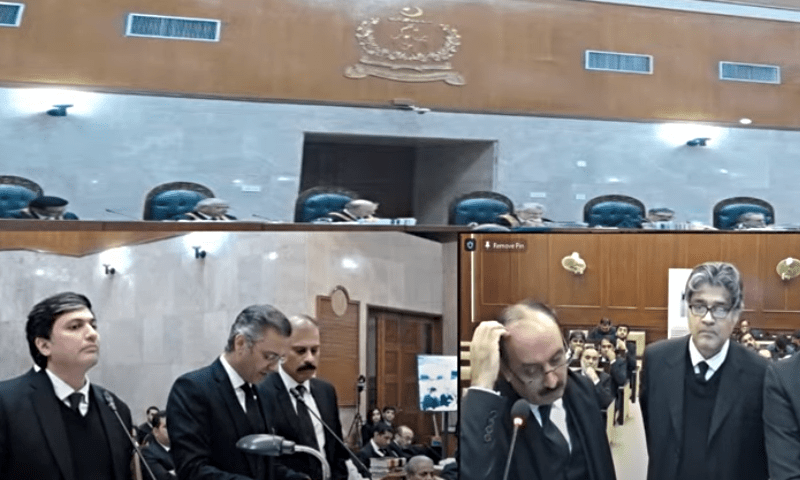
A seven-judge Supreme Court bench on Tuesday commenced hearing the issue of lifetime disqualification of parliament members.
Headed by Chief Justice of Pakistan (CJP) Qazi Faez Isa, the bench comprising Justice Syed Mansoor Ali Shah, Justice Yahya Afridi, Justice Aminuddin Khan, Justice Jamal Khan Mandokhail, Justice Muhammad Ali Mazhar and Justice Musarrat Hilali took up the case.
The proceedings are being broadcast live on the Supreme Court’s website.
The bench will determine once and for all the raging debate on whether aspirants disqualified under Article 62(1)(f) of the Constitution could contest polls in light of the amendments in the Elections Act 2017.
The law, which sets the precondition for a member of parliament to be “sadiq and ameen” (honest and righteous), is the same provision under which former prime minister Nawaz Sharif was disqualified in the Panama Papers case. Ex-premier Imran Khan was also disqualified under the same article in the Toshakhana case last year.
The legal dilemma arose in view of a 2018 Supreme Court judgment in the Samiullah Baloch case, when it shut the doors of parliament permanently for politicians disqualified under Article 62(1)(f) of the Constitution through a unanimous verdict, ruling that such ineligibility was for life.
The verdict was issued by former chief justice Mian Saqib Nisar, Justice Sheikh Azmat Saeed, ex-CJP Umar Ata Bandial, Justice Ahsan and Justice Sajjad Ali Shah.
But on June 26, 2023, an amendment was brought in the Elections Act 2017, specifying that the period of the electoral disqualification will be for five years, not for life.
The issue of electoral disqualification cropped up in the apex court again last month while hearing an election dispute.
Since the amendment to the Election Act has not been challenged, this matter may create confusion in the upcoming elections whether to rely on the SC judgment or the Elections Act. Such a situation is not conducive to democracy, the CJP had observed previously.
The hearing
At the outset of the hearing, Saqib Jillani, the lawyer for petitioner Imam Bakhsh Qaiserani came to the rostrum.
When inquired about his stance, Attorney General of Pakistan (AGP) Mansoor Usman Awan responded that he wished the court to revisit the law as there were “certain contradictions” in a previous judgment of Samiullah Baloch.
Stating that he supported the amendment limiting the disqualification to five years, the AGP urged the court to also review its previous ruling on Nawaz’s lifetime disqualification.
Awan then read out an SC order from 11 Dec 2023.
The CJP then asked who were the respondents in favour of lifetime disqualification, to which petitioner Sanaullah Baloch, advocate Khurram Raza and Usman Karim responded in the affirmative.
However, Qaiserani’s counsel said he was against it, supporting the AGP’s stance.
When asked if he wanted the amendment to the Election Act to be maintained or for the SC ruling, he said he would support the law as it was legislated by the federal government.
CJP Isa then inquired about the stance of the provincial advocate generals, to which they responded that they supported the AGP’s argument.
The AGP also read out Articles 62 and 63 of the Constitution, which pertain to the conditions for qualification and disqualification of parliament members. He contended that both articles are applied when nomination papers are submitted.
The CJP then observed that a few of the requisite were “related to facts and were easy” while others were more difficult to fulfil, such as those about one’s character.
He remarked, “It is also a provision to have good knowledge of Islam; I don’t know if people would be able to pass this test or not.”
The chief justice went on to note that the Constitution does not mention the period of the disqualification, the gap which he said courts had fulfilled.
Here, Justice Shah asked the AGP whether the period provided in the Elections Act was of greater importance than the Constitution.
He observed that it was a matter of interpretation of Article 63, adding that if one were to commit serious sedition, he could still contest elections while someone sentenced for an “ordinary crime” could not.
CJP Isa then stated that the amendment to the Elections Act had not been challenged so it could be followed as it was made after the older ruling. At this, Awan said doing so “could give an impression that a legislation was overwriting the Supreme Court’s decision”.
He argued that the Supreme Court had ignored a point in the Samiullah Baloch case by not considering that the declaration remained in the field in both, Article 62(1)(f) and criminal cases.
The chief justice wondered what the differences between Articles 62 and 63 were and “how someone else’s character could be determined”. “Your supporter will say you have an exemplary character [whereas] your opponents would say you have the worst,” he remarked.
“According to Islamic teachings, no one can be said to have an exemplary character,” the CJP said, adding that even Quaid-e-Azam would have been disqualified according to the qualification provisions.
“No Muslim can even imagine saying the words ‘sadiq and ameen’ for themselves,” CJP Isa noted, adding that if supposedly objections were raised to his nomination papers on the basis that his character was not good, then he would not challenge it.
“We all sin and therefore pray for forgiveness when someone dies,” he said. “If all these conditions were present earlier, even Quaid-i-Azam would have been disqualified.”
At one point, Justice Shah asked if lifetime disqualification seemed inappropriate for trivial matters seemed inappropriate. “In serious crimes like murder and treason, one can contest elections after some time,” he noted.
“Will the constitution have to be amended to overturn the decision of the Supreme Court?” the judge further asked. “Can what is written in the Constitution be changed by legislation? The question is whether it’s possible to change the Constitution through sub-constitutional legislation.”
Here, CJP Isa highlighted that the Election Act had been implemented and no one had challenged it yet.
The AGP clarified that as long as the judicial decisions were present, the declaration of lifetime disqualification would remain in place.
“Article 62 does not mention the period of disqualification. It was only given by the court,” Justice Isa said. “We are sinners and seek forgiveness from Allah Almighty,” he added.
Justice Shah also inquired how the court could give a declaration against someone. “Will the character of a person be good if he becomes pious after 20 years? If a person said something against the country earlier would he still be able to contest elections?” he asked.
The CJP also wondered, “If a person repents and becomes a scholar or a hafiz, will he remain disqualified for life for his bad character?”
He further noted that under Article 63(1)(g), a person was disqualification for five years for violating the national integrity and ideology. “Can any man swear that he is of good character?” he asked.
For his part, AGP Awan said the purpose of declarations in the 18th Amendment was to provide the right to appeal against decisions of returning officers.
Subsequently, the bench asked Advocate Makhdoom Ali Khan, the lawyer of Jahangir Khan Tareen, to come to the rostrum.
More to follow



1710175205-0/image-(9)1710175205-0-640x480.webp "Alibaba launches AI platform for enterprises as agent craze sweeps China | The Express Tribune")