A fact-finding mission of the Human Rights Commission of Pakistan (HRCP) has suspected that Jaranwala rioters were not a “spontaneous or random crowd”, but were a part of a “larger campaign of hatred against local Christians”.
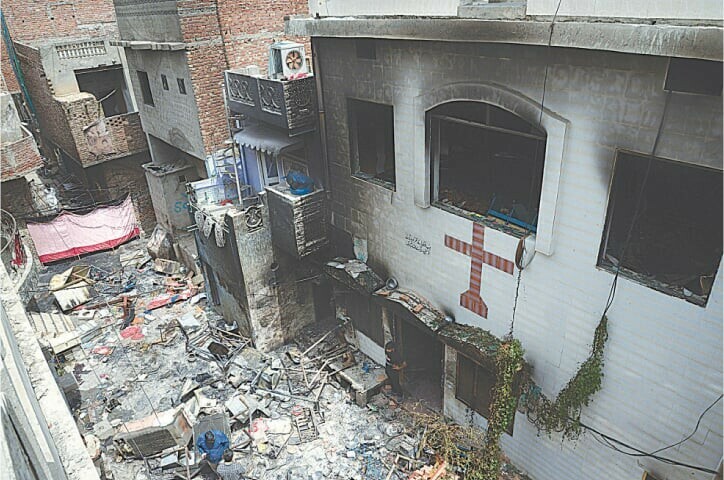
On August 16, a violent mob of hundreds ransacked and torched nearly two dozen churches, and attacked the residences of members of the Christian community and the office of the local assistant commissioner in Jaranwala.
According to estimates compiled by Faisalabad’s district administration, at least 22 churches ransacked by mobs suffered damages to the tune of Rs29.1 million whereas 91 houses which bore the brunt of violence suffered losses to the tune of Rs38.5m.
As per police and local sources, the violence erupted after some locals alleged that several desecrated pages of the Holy Quran were found near a house at Cinema Chowk in Jaranwala, where two Christian brothers resided.
A day after the incident, Punjab caretaker Chief Minister Moshin Naqvi said that “both main accused” in the case were arrested and in the custody of the Counter Terrorism Department.
Many more arrests have been made in connection with the incident since.
In a fact-finding report published today, the commission said police officers in Jaranwala had confirmed that some “Muslim religious groups have raised issues that have created communal tension in the near past”.
“The mission has also learnt that several videos made during the attacks in different localities of Jaranwala are in circulation, showing members of a particular religious political party inciting the crowd to violence.
“Other factors reported above indicate that there could be larger political and social motives behind the attack,” it said.
The fact-finding mission comprised HRCP chairperson Hina Jilani, Centre for Social Justice executive director Peter Jacob, senior Women’s Action Forum member Neelam Hussain, and historian and rights activist Dr Yaqoob Bangash.
According to the report, several witnesses stated that those who committed the arson were not from the city itself but had come from adjoining villages.
“One person attested that a tractor trolley full of people as well as several persons on motorbikes had arrived from a village, transporting men who then burnt down a church and houses, thus giving more credibility to the notion that the attack was premeditated.”
It highlighted that the HRCP mission’s inspection of the damage by fire points towards “planned arson and deliberate desecration of religious symbols”, even though the looting of homes may have been more opportunistic.
The report also said that some Muslim residents of Jaranwala helped evacuate residents of the neighbourhoods that came under attack. “In Cinema Basti, neighbours from the Shia community came to victims’ aid the day their neighbourhood was attacked,” it revealed.
Role of police
On the role of the local police, HRCP said 0information gathered by its mission raised concerns with respect to the “timeliness of the response as well as weaknesses in the strategy employed by law enforcement personnel to restrain the crowd and limit the spread of its mischief and violence”.
“It appears that the local SP (superintendent of police) was unable to assess the seriousness of the situation and did not fully apprise himself of the situation that was brewing outside while he was closeted with those who were in negotiations focused on demands for the arrest of the persons accused of blasphemy. It is unfortunate that he remained uninformed of the announcements from mosques and of crowds coming into town from outlying villages.
“It is our considered opinion that there was an inexplicable holding back on the part of the police despite clear evidence of the level of violence that merited the use of force proportionate to the havoc that these crowds were creating. Neither tear gas nor any other methods to restrain or disperse the mob seem to have been deployed in any of the affected localities,” it stated.
The report also highlighted the 10-hour delay in the arrival of Rangers in the area, saying that it “gave the mobs enough time to go on a rampage against churches, houses and one cemetery”.
Furthermore, HRCP said it found the transfer of Jaranwala’s Christian assistant commissioner after the attack “highly objectionable”.
Noting the arrests made in the aftermath of the violence, the commission said “local political leaders who incited and led the violence have yet to be booked”.
Recommendations
Providing a list of recommendations, the HRCP called on the authorities to review blasphemy laws so that they could not be misused against minorities and demanded that they provide punishment for making false accusations.
“The mission urges the Punjab government to take measures to implement the recommendations of the judicial inquiry held after the communal riots in Gojra in 2009 so that there is no impunity for organised Muslim religious groups that openly declare their intentions of violent action against religious minorities.
“The government must also take stern action against any instances of hate speech against any community,” the report emphasised.
After the 2009 massacre, in which seven Christians in Gojra were burnt alive over blasphemy allegations, a tribunal had recommended reviewing five provisions of the blasphemy law.
The HRCP further said in its report that the government needed to take urgent measures to swiftly compensate the Christian community in Jaranwala, rebuild the damaged neighbourhoods, take action against hate speech and make efforts to build inter-faith harmony.
“The administration must publicly clarify that the transfer of the assistant commissioner, a Christian, was not due to any fault on his part but was done to protect him and his family,” the HRCP further demanded.
“The directive of the 2014 Supreme Court judgment calling for a separate police force to be created to protect religious minorities’ places of worship must be implemented urgently, and the financial and human resources needed to do this made available without any further delay,” the report added.