
Federal ministers accuse PTI-led KP govt of failing to cooperate in anti-terror fight
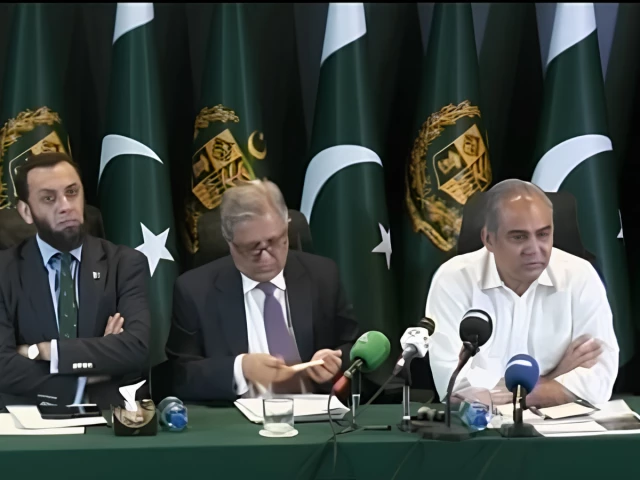
Federal ministers Azam Nazeer Tarar, Mohsin Naqvi, Attaullah Tarar address a press conference on K-P emergency. Photo: Screengrab
ISLAMABAD:
The federal government on Sunday levelled a series of allegations against the PTI-led Khyber Pakhtunkhwa government, accusing it of failing to cooperate in the fight against terrorism and alleging a “nexus” with terrorist groups, as it defended its decision to impose an emergency in the province.
President Asif Ali Zardari signed off on Prime Minister Shehbaz Sharif’s recommendation to impose emergency rule in K-P amid a deteriorating security situation and the provincial government’s deliberate disengagement from the fight against terrorism.
Speaking at a press conference alongside Interior Minister Naqvi, Information Minister Attaullah Tarar and other officials, Law Minister Azam Nazeer Tarar said President Zardari had declared an emergency under Articles 232(1) and 234(1) of the Constitution.
Azam said Naqvi would explain the circumstances that led to the decision.
Explaining the background to the decision, he said it had not been an easy step and that he had personally remained involved in back-channel contacts to secure cooperation from the provincial government.
“I would certainly like to explain the background. Today has not been an easy day,” Naqvi said, adding that efforts had continued for a month to bring the K-P government on board.
He said he had personally remained in contact with the provincial government during the process, while discussions were also taking place over the planned long march and other matters.
He said all of the Pakistan Tehreek-e-Insaf’s demands, including meetings and medical treatment, were being addressed even before the party’s planned long march. Talks with opposition leaders had also been scheduled before PM Shehbaz visited New York, but no final response had been received from them, he added.
He said the government had decided to form a committee and arrange a meeting on September 15 or 16, but received no response. Despite that, he said, contacts continued.
Naqvi said a meeting had also taken place between the president and the prime minister, during which he suggested bringing the K-P government on board.
He added that a draft was revised four times the following day, but when the matter appeared to have been finalised, the government learned that a new draft had arrived.
Naqvi said the government had made repeated attempts to reach an understanding with Pakistan Tehreek-e-Insaf (PTI) leaders, with the final contact taking place at 11.45pm the previous night. “I told them that even at that point, something could still be done, but there was no response,” he said.
He said the government had proposed a paragraph during negotiations but received no reply. He added that Jamiat Ulema-e-Islam-Fazl (JUI-F) chief Maulana Fazlur Rehman had also met the prime minister.
Naqvi said the government had never demanded that PTI call off its planned sit-in, adding that its primary concern had been terrorism. “Our issue was only terrorism,” he said, adding that the government had remained in contact with PTI leaders and had itself initiated contact with the party on previous occasions.
He said the condition to postpone the long march had come from the Pakistan Peoples Party (PPP), not his ministry. Naqvi said the security situation in K-P had deteriorated significantly.
The interior minister said the security situation in 12 districts of the province had deteriorated to the extent that residents could not venture outside their homes after sunset. A senior Election Commission official had been martyred, police personnel were being targeted in repeated attacks, and Customs officials and security forces were also coming under attack, he added.
He also referred to the death of an Election Commission official the previous day, citing it as an indication of the security challenges facing the province. The interior minister said he had held several meetings with K-P chief minister, during which terrorism had been the main subject of discussion.
According to Naqvi, he had asked CM Afridi about plans to strengthen police in affected districts. He said the chief minister had cited a lack of funds, to which he had responded that the federal government would provide the required resources. Naqvi further claimed that provincial representatives had agreed during negotiations that emergency measures should be introduced in certain districts.
He said the government had struggled to secure public support for its position and claimed that provincial representatives had reservations about having photographs of meetings released publicly. Naqvi said he had never asked them to pose for photographs or make them public.
The minister said the federal government could not continue losing security personnel to terrorism while the provincial government failed to take ownership of the fight. “Terrorism cannot be fought alone under any circumstances; it requires a collective effort,” he said.
Naqvi said the federal government and the K-P government had jointly drawn up a plan to strengthen the police in five districts initially, gradually withdraw the Frontier Constabulary and army, and provide all required funds.
However, he said, no progress had been made at the provincial level despite the passage of four months.
“The foreign policy of the federation and a province cannot be different,” he said, adding that the provincial government’s dealings with the Taliban were no secret.
He said terrorist incidents had increased by 195 per cent and fatalities by 113pc over the past year and a half. He also criticised the provincial government for taking credit for the Rs20 billion budget allocated to the police while debating the definition of a terrorist.
Naqvi said the federal government had been left with no alternative but to take the decision to protect the state if security personnel were to continue being killed daily and the provincial government refused to take ownership of the fight against terrorism.
Naqvi described the emergency as a difficult decision taken after repeated attempts to avert the situation. He claimed that 518 police personnel had been killed over the preceding 18 months.
He said the situation could have been different if the provincial government had agreed to the proposals the previous night, adding that the federal government had been compelled to take the measures.
Law minister blames lack of cooperation for K-P emergency
Law Minister Azam said the prime minister had briefed President Zardari on the circumstances outlined by the interior minister. He said the K-P governor had submitted a report to the federal government as part of his constitutional responsibilities.
He said the federal government had decided to impose an emergency in the province under Articles 232 and 234 of the Constitution after a reported 196 per cent increase in terrorist incidents over the past two to two-and-a-half years.
Addressing the presser, Azam said the federal cabinet had held a detailed meeting lasting more than two hours, during which relevant institutions presented their reports. He said the K-P governor had also conveyed information to the federal government that was “very alarming”.
The minister said the governor had fulfilled his constitutional responsibility under Article 234, which provides for action when a provincial government’s functioning results in a constitutional breakdown and the government’s writ is no longer visible.
He said the provincial government had been prioritising politics instead of addressing the protection of people’s lives and property, the province’s well-being and Pakistan’s interests.
Azam said reports presented to the federal cabinet showed that reported terrorist incidents had increased by 196 per cent over the past two to two-and-a-half years. The frequency of attacks had risen from one incident every two to three days to around three incidents, he added.
He said the number of people martyred or injured, along with damage to installations and vehicles, had also increased significantly.
The minister said one of the conditions was that the provincial government should fight terrorism with commitment alongside the federal government and the armed forces. However, he said, the trend of attacks showed that the armed forces, K-P police and innocent civilians were among the main targets.
“Instead of coming together and proceeding with resolve, there was reluctance,” he said.
Azam said the federal government and the president had acted within the bounds of the Constitution, whose provisions had been incorporated by the framers of the 1973 Constitution to ensure that the federation and its constituent units functioned together.
He referred to Article 149(4), which, he said, empowered the federal government to issue directions to provinces in matters concerning peace and tranquillity and the safety of the country. Failure to implement such directions could also have consequences, he added.
The minister also referred to Article 232, which provides for the imposition of an emergency in circumstances involving internal threats to provincial security or the threat of foreign aggression.
“What is happening on the border with our neighbouring country — the border is on fire — and what is happening internally in the country is not hidden from you,” he said, adding that both conditions had arisen.
He said efforts had continued to resolve the situation, including an attempt on Saturday, but the circumstances remained unchanged.
“Against this background, after detailed discussions, the president, on the advice of the prime minister, exercised his powers under Articles 232 and 234 to impose an emergency in Khyber Pakhtunkhwa,” he said.
Azam explained that Article 232 dealt with the imposition of an emergency, while action under Article 234 was generally referred to as governor’s rule. However, he said, the situation was so grave and exceptional that the requirements of both constitutional provisions had been invoked.
Referring to the first proclamation issued by the president, the minister said it cited a rise in extremist activities and terrorist attacks to an unprecedented level of violent intensity, posing a grave threat to the lives and property of people in K-P.
He added that the proclamation also noted that the effects of the situation were spreading to other parts of the country.
Azam further said the Sydney-based Terrorist-Affected Countries Index had, for the first time, ranked Pakistan as the country most affected by terrorism.
He questioned how the country could attract foreign investment and sustain economic activity amid such security conditions.
“On one side, we talk about running the economy and attracting foreign investment, but who will come in this situation?” he asked.
He said the president had declared the emergency on the prime minister’s advice. Azam also said the provincial government had been rendered inactive under the measures and that the governor had been directed to exercise his constitutional powers.
He said an 11-member advisory committee had been formed and a secretariat established for 12 districts, from where reports would be sent directly to the federal government.
According to Azam, a council had also been established, with the additional chief secretary to oversee its functioning. He added that officials holding relevant positions had been rendered inactive and that the military had been deployed under Article 245 of the Constitution.
Tarar alleges PTI links with terrorists
Separately, Information Minister Attaullah alleged that the PTI’s links extended to terrorist groups and that the party was not serious about eliminating terrorism.
He claimed that the PTI-led provincial government had a deep nexus with terrorists, pushing the province’s administrative situation to the brink of collapse.
Attaullah said reports from the Intelligence Bureau and law enforcement agencies had described the situation in the province as extremely alarming.
He alleged that political parties other than the PTI had faced terrorist attacks in Khyber Pakhtunkhwa and claimed that the relationship between terrorists and the PTI had reached the stage of power-sharing.
According to the information minister, terrorists had been given safe access to the province and had also received financial resources.
He said the provincial government had a constitutional responsibility to protect the lives and property of ordinary citizens, questioning whether it was unable or unwilling to discharge that duty.
Attaullah alleged that the same elements responsible for destroying peace in the province, killing civilians and targeting hospitals, mosques, police stations and security personnel had been empowered by the K-P government.
He claimed that a formula for sharing authority between terrorists and the PTI-led provincial government had been taking shape, beginning in the southern districts and gradually spreading across the province.
Recalling a visit to a hospital in Kohat, he claimed injured people had asked him to help them get rid of the PTI government, warning that it would destroy them and saying they wanted to fight the terrorists.
The information minister questioned why terrorists had been given a free hand in the province. He said maintaining law and order and ensuring public safety and security were the provincial government’s responsibilities.
He alleged that the PTI government had not only facilitated terrorists but had also made them partners in provincial administration.
According to Attaullah, the alleged nexus had resulted in several districts being handed over to terrorists, who continued to target civilians and mosques and bomb hospitals.
He described the Taliban as elements operating on foreign funding and seeking to push Pakistan towards destruction.
“If someone receives foreign funding, kills our citizens, damages their lives and property, and a provincial government sits with them, facilitates them and makes them partners in government affairs, what could be a greater constitutional crisis?” he asked.
The minister said the provincial government’s mandate was to protect citizens and ensure security and law and order, but it had instead introduced a controversial police-related bill that, he alleged, sought to create a pathway for people associated with terrorist groups to join the police force.
He questioned why direct appointments at the deputy superintendent of police (DSP) level were being made, alleging that the objective was to accommodate terrorists and their supporters in the police force.
The province was being gradually pushed towards destruction, he said, claiming that there was incontrovertible evidence to support his allegations.
Questioning the performance of the K-P cabinet, Attaullah said its members might be seen on television talk shows, but the chief minister’s performance in governance needed to be examined.
He questioned how much time the chief minister had devoted to governance and whether he understood the requirements of running a government and improving the province’s prosperity.
Ataullah said the province had now been freed from what he described as the group responsible for its deteriorating situation.
Responding to a question, he said the PTI-led provincial government had been removed through constitutional means. He held the party responsible for the deaths of thousands of people in K-P, alleging that its policies were based on support for the banned Tehreek-i-Taliban Pakistan (TTP) and the banned Tehreek-i-Taliban Afghanistan (TTA).
He also alleged that the PTI government’s conduct in K-P reflected aspects of the Taliban’s policies towards women, with women’s rights being violated in the province.