

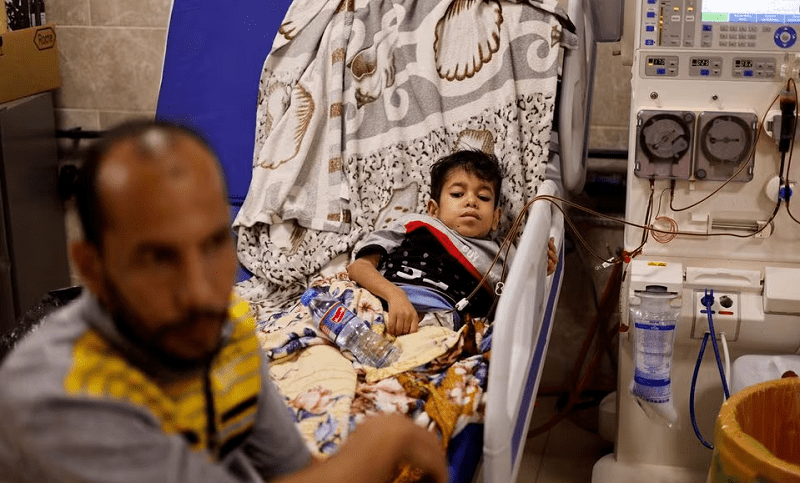
Tahreer Azzam, a nurse at Makassed Hospital in east Jerusalem, has been caring for young, desperately-ill Palestinian patients for 16 years.
But amid Israel’s relentless bombardment in Gaza since Oct 7, she now struggles to find them.
Usually, around 100 patients from Gaza receive care each day for complex health needs such as treatment for rare cancers and open heart surgery, at hospitals like Azzams, as well as in the occupied West Bank, Israel and other countries, according to the World Health Organisation (WHO).
That came to a halt after Oct 7, when Hamas broke through the Gaza border fence, killing nearly 1,400 people inside Israel and taking some 240 hostages.
In response, Israel imposed a complete siege on Gaza, bombarding the coastal enclave and launching a ground offensive. More than 10,000 Palestinians, including over 4,000 children, have been killed, according to health officials in Gaza.
Azzam and her colleagues have been trying to reach their patients ever since, including checking Facebook to see whether they are still alive.
“We saw a post announcing that one of our child patients had been killed in the strikes. He had been at the department only a week before. He was six years old,” she told Reuters in an interview.
The WHO is pushing for the most vulnerable among the chronically ill to be allowed out for treatment. Other countries have offered to take in patients, including Egypt, Turkiye and the United Arab Emirates.
Before the war, around 20,000 patients per year sought permits from Israel to leave the Gaza Strip for healthcare, many of them requiring repeat trips across the border.
Almost a third are children. Israel approved around 63 per cent of these medical exit applications in 2022, according to the WHO.
Gaza’s own healthcare facilities have been stretched under a 16-year Israeli-led blockade and repeated rounds of fighting.
In previous wars, the crossing would close for a day or two, but then the patients were able to return. This is the first time there is such a comprehensive ban on movement and Gaza patients cant make it out, said Osama Qadoumi, the supervisor at Makassed Hospital.
“The longer we wait, the worse some patients will get. Many people will die merely because they have no access to treatment,” Qadoumi added.
Chronic conditions
The concern is not just about the most complex cases. There are 350,000 patients with chronic conditions in Gaza, including cancer and diabetes, as well as 50,000 pregnant women, according to data from United Nations organisations.
Previously, the majority could get medical care in Gaza, but now the UN says the territory’s fragile health system is close to collapse, battered by airstrikes, a surge in the number of trauma patients, and rapidly diminishing supplies of medicines and fuel.
A trickle of aid has been allowed in, while about 80 patients were allowed out.
“We always talk about trauma and rightly so,” said Dr Richard Peeperkorn, WHO representative for Gaza and the occupied West Bank, in a press conference last month. “But we have to think about the 350,000 patients.”
Some needs are particularly acute. About 1,000 patients in Gaza need kidney dialysis to stay alive, but 80pc of the machines are in local hospitals under evacuation orders, the WHO said.
Gaza’s only cancer hospital is no longer functioning. Israel’s military has told civilians to evacuate northern Gaza, where some of the hospitals are located, as it pursues a campaign to dismantle Hamas. The army claims Hamas hides its command centres under hospitals. Hamas denies this.
While the fighting rages, some 400 patients and their companions who left Gaza for treatment before the war have been stranded in east Jerusalem and the West Bank, the WHO said. Many struggle to contact their relatives, with scant cellular service and electricity in Gaza.
“I haven’t been able to tell them how the surgery went,” said Um Taha al-Farrah, who brought her 6-year-old granddaughter Hala to Makassed Hospital on Oct 5 for her third spinal surgery at the unit. Halas mother was denied a permit to accompany her to hospital.
When Halas father rings, they manage to speak for a minute or two before the line drops out. “They ask How is Hala? I say Thank God, and that’s it,” said Um Taha.
Hala misses her parents, and her home. She holds up a drawing of an ice cream, a rabbit and a little girl. “I love mom and dad,” reads a speech bubble by the figures mouth.
“I don’t know who is left of my family. I’m sure they are not telling me everything,” said Um Taha.