

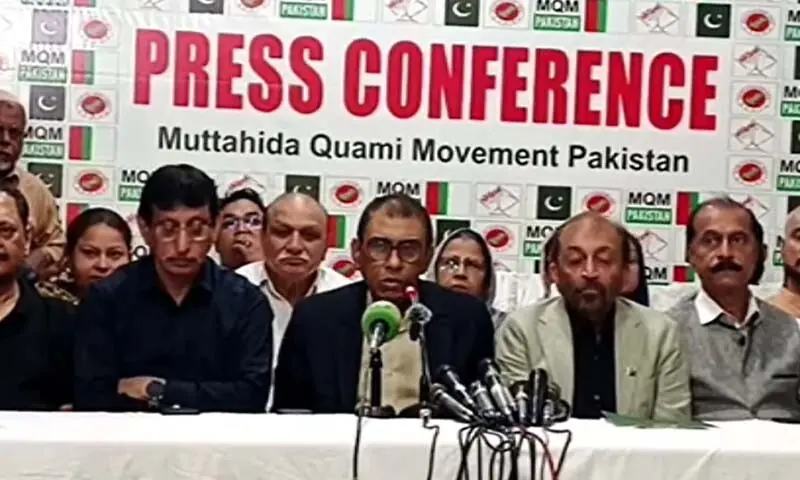
Former premier Shahid Khaqan Abbasi and MQM-P leaders Dr Farooq Sattar and Khalid Maqbool Siddiqui on Saturday backed the creation of additional administrative units in the country.
On Thursday, Naqvi urged all political parties to “settle” various national-level issues, including the question of creating new provinces.
Addressing the Pakistan Economic Summit 2026 being held in Islamabad, Naqvi said there was “only one solution” to improving the country’s overall condition: “You will have to take [the matter of] administrative units, provinces or whatever you may call it, to the public.”
Addressing a press conference in Karachi today, MQM leader Dr Farooq Sattar said that, due to immense population growth, additional administrative units were essential to ensure proper governance.
“No country in the world has seen population growth as fast as ours,” he said. “We need to manage and administer that, but how will we do that without additional administrative units?”
Sattar noted that, with such a large population, questions arose about how administrations would be able to address fundamental issues and ensure effective service delivery.
“Two things have become clear: we need administrative units. Enough is enough,” he declared.
“The ad-hocism we have seen for around 80 years must end. [Interior Minister] Mohsin Naqvi presented a clear administrative framework for Pakistan’s future in his speech, which is welcomed by citizens from all walks of life.”
“Pakistan’s economy is tied to its political and administrative structure.”
“We need curative treatment, not symptomatic treatment,” he stated.
Sattar added that the door needs to be left open for Gen-Z to play a representative role in Pakistan’s political, economic and social landscape.
“Political parties should move in this direction, as they are of the opinion that the system is infertile; it cannot ensure people’s prosperity or progress, build national consensus or strength, or guarantee the country’s security,” he stated.
“If we want to avail ourselves of these benefits, Pakistan must walk among the world with its head held high; the youth have to stand on their feet; we have to look the world and the IMF (International Monetary Fund) in the eye and talk to them. New administrative units are essential for this; without them, we will not move forward.”
Speaking before Sattar, Education Minister Khalid Maqbool Siddiqui noted that the conference addressed by Naqvi was an economic one, not a political one.
“We understand that there are no higher administrative units other than districts and divisions within a province. With One Unit, provinces were dissolved, but they returned after the end of the One Unit scheme in a different form,” he said, addressing the press conference.
“This issue of the limits of administrative units never existed, nor was it part of Pakistan’s politics. Are these [units] so sacred that we cannot talk about them? When nobody spoke about them, we did,” Siddiqui added.
He also stated that no matter which province people live in, they are still living within Pakistan, noting that the state itself is indivisible.
“The Constitution demands the division of provinces. But because of the pressure from a growing population, the procedures outlined in 1973 can no longer be enforced. This is why the MQM submitted an amendment bill in the National Assembly; it was not opposed and has been supported by the standing committee,” Siddiqui said.
“This MQM demand, which is in accordance with Pakistan’s population growth, is an administrative necessity and addresses the country’s economic issues,” he added.
“Our voice is being echoed by others. Today, we thank you all for highlighting this need during the month of Pakistan’s independence.”
Siddiqui said the party further believed that the current system of democracy, “where benefits never reach the people”, was not needed.
Ex-PM Abbasi says system needs to be changed
Former prime minister and Awaam Pakistan convener Shahid Khaqan Abbasi also addressed a press conference at the National Press Club in Islamabad, stating that the current state of affairs could not continue for much longer, but noted that the government was beginning to realise it.
“I am grateful to my interior minister for acknowledging after four or five years that the country is not running,” he stated. “It should have been discussed in parliament or the cabinet. The country knows it is not running, but it has finally dawned on the rulers.”
Abbasi added that the military’s spokesperson had acknowledged this during his press conference on Friday and that reform was the only way to keep the country functioning, but “there are always people who do not want meaningful change”.
“This is a matter of interests; if we talk about reforms in this country, then those whose interests do not align with reforms will oppose them,” he added. “The country is not being run well; we do not have money, and we are not ready to undertake reforms.
“Reforms are needed in this country; otherwise, the situation will get worse. Your debts, costs and taxes will continue to increase.”
Abbasi noted that simply creating new provinces would not solve the issue, but that the entire system needed to be changed.
“After 78 years, we don’t know how to buy flour. Our farmers have been ruined, and today we are even importing wheat by spending precious dollars,” he said, alleging that those in power were more interested in purchasing official vehicles and aircraft than addressing the hardships faced by ordinary citizens.
He stressed that constitutional supremacy and the rule of law were necessary for political stability and economic growth.
“Without the rule of law, investment will not come, and without investment there can be no sustainable economic progress,” Abbasi said.
Various political parties have demanded the creation of more provinces or administrative units to ensure better governance.
The MQM-P — an ally of the PML-N-led ruling coalition — has been demanding that Karachi be designated a province separate from Sindh.
However, the PPP, which rules Sindh and is also an ally of the PML-N government at the Centre along with MQM-P, has strongly opposed the suggested move.
On the other hand, the PPP and the PTI have long advocated for a South Punjab province.
A day prior, Inter-Services Public Relations chief Lt Gen Ahmed Sharif Chaudhry commented on Naqvi’s remarks about the need for new administrative units in Pakistan: “We have been saying this earlier also as a primary stakeholder in security that good governance is essential for the security and stability of Pakistan.”
“Now our population is 240-250 million people, and we still have four provinces. We have to see whether this is serving the purpose of good governance. That debate has to be sensibly held by politicians, by those in power, even those who have previously been in power, and those who are responsible to the people of Pakistan,” the DG ISPR said, adding that it had to be done according to the will of the people of Pakistan.
Later on Friday, PPP Secretary-General Nayyar Bokhari said that the party’s Central Executive Committee (CEC) will deliberate on creating new administrative units, which should be created through the mechanism provided in the Constitution rather than by executive order.
“The Constitution of Pakistan has clearly laid down the complete procedure. Without a two-thirds majority in the relevant provincial assembly, the National Assembly and the Senate, neither the creation of new provinces nor any alteration in provincial boundaries is possible,” he told Dawn.
“New provinces cannot be created through an executive order. They can only be created through a constitutional decision of parliament,” he added.
Additional reporting by Ikram Junaidi
