

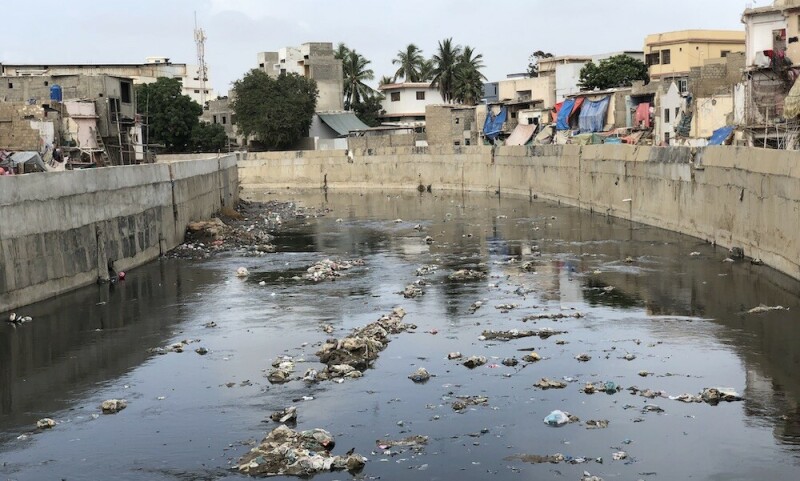
Tens of thousands of people in Karachi have been living amidst the rubble of their homes after an ill-thought-out ‘anti-encroachment’ drive to clear the city’s three main water drains. Was this massive displacement even worth it?
Two years since her home was demolished by the authorities, the tide seems to have turned for Fatima — or so she thinks.
The 35-year-old, who lives in Thorani Goth in Orangi, is ecstatic because she and her husband, Mohammad Tasleem, have finally received the remaining Rs180,000 from the Sindh government they had been waiting for. This money is part of the interim compensation they were to be given in four tranches last year. The government had also thought that these residents would be provided with another home by 2022. This, however, did not come to pass.
The first thing Fatima and Tasleem did with the money they got was to “pay off the Rs80,000 we owe to our relatives.”
The remaining amount, narrates the mother of four, will allow them to move to a bigger place. She says they were tired of living in the small, “dark and dingy room” they took refuge in when their home was demolished and they moved in with Tasleem’s three brothers. For the past two years, this one room home has doubled as a kitchen, a bedroom for six and Fatima’s intermittent workspace, when she does her garment-related work.
But moving to a bigger place seems unlikely when the couple subsequently does some quick back-of-the-envelope calculations. “I don’t think that would be possible,” Tasleem says, given the increase in prices of quarters, electricity, gas and water. “We cannot afford to live like we used to, in our house two years ago,” which she says is just “a 10-minute walk from this house”.
The razed house that Fatima and Tasleem previously resided in did not face the Orangi nullah, nor was it initially marked for demolition. Nevertheless, theirs was among the nearly 7,000 homes that were demolished (some partially, others fully) back in April 2021 as part of an anti-encroachment drive initiated by the government on the orders of the Supreme Court of Pakistan. The drive was to clear all illegal structures along three choked stormwater and sewage drains — the Manzoor Colony, Orangi and Gujjar nullahs, in Karachi.
It must be stated here that determining the legality of many of these constructions is rather tricky. The reality is that government officials often work in collusion with property developers as well as mafias in katchi abadis [informal settlements], and the former often look the other way when such constructions happen.
Some residents will tell you that they built or bought their homes knowing that they were illegal constructions built on encroached land. At the very least, all of the residents will tell you that they were well aware these homes would be flooded on a regular basis, yet they continued living there. According to them, if they could afford to live in better localities, they would. As a result, many people were allowed and given the necessary documentation to build structures on a land which should not have been used for such purposes.
Lives uprooted
While it is hard to guess exactly how many people were impacted by the massive ‘anti-encroachment’ drive, lawyer Abeera Ashfaq, who has relentlessly worked for those affected by this for the last two years, estimates it to be “many more people” than the government says because more homes were demolished than the official figure of 6,932.
In some structures, she says, multiple families were resident. Moreover, there were tenants and sub-letters who were never even recognised as affectees, because they did not have “proper title [leases] or had imperfect titles and were simply living there and were thus dispossessed.”
But not all who continue to bear the losses were residents.
Mohammad Iqbal Siddiqui, who works as an accountant in a private company, and his four brothers had rented out five shops to kabarriwalas (junk dealers) at Makhdoom Shah Colony (popularly known as Zero Point) in Orangi.
“We did not get a single rupee of compensation, as our name was not on the list when these were being made,” says Siddiqui. “At that time, the authorities were only focused on putting down names of households whose homes were razed.”
He adds that there were some shop-owners who were smart enough to get their shops declared as residences and got their names on the list. “Now the land has been levelled and a road built on it,” he says, “so we don’t have anything to show, except for the official leases on stamp papers.”
Along with the monthly rent of Rs30,000 that has been lost, Siddiqui says that they had planned to sell the property. “The property was valued at sawa do crore [Rs22.5 million] back in 2021 when a buyer had approached us, but we were sure we could sell it for more, so did not show that much interest. Now this has slipped like sand from our fingers.”
After the deluge
A year before the homes along these nullahs were demolished, in August 2020, it had rained in Karachi like it never had in almost 90 years. Up to 484 millimetres (19 inches) of rain was recorded by the Pakistan Meteorological Department, with 231 mm falling in a single day.
A large part of the city was submerged, the city’s transportation system was severed, and people were stranded on the roads for hours. Up to 47 deaths due to drowning, electrocution, as well as house and wall collapses were reported. With the power company forced to shut down power, Karachi was without electricity for 50 hours.
The common refrain was that Karachi had flooded because of the encroachments that had throttled the waterways. The then chief minister of Sindh, Syed Murad Ali Shah, going around town to inspect the various choked arteries of the city, reportedly censured the residents for “building houses in the belly of the river” and declared that the “city is sinking because of your encroachments.”
This diagnosis was challenged by some urban experts, who pointed out various other issues that led to the city being submerged. But the Supreme Court announced that difficult decisions needed to be taken. And so, on August 12, 2020, it ordered homes, shops, or anything coming in the way of the three major natural stormwater drains — which criss-cross the length and breadth of city, taking also the city’s sewage into the Arabian Sea via the Malir and Lyari rivers — to be annihilated.
According to research conducted by the Orangi Pilot Project’s late director Perween Rehman, there are 48 big drains, but the official figures state there are 38 big and 514 small drains that flow into the three big ones. It is important to know how many stormwater drains there are in Karachi to ensure that they remain clean and free from encroachments.
Eight months after the urban flooding in Karachi, in April 2021, the drive began to remove encroachments from along the Karachi nullahs. The announced plan was to rehabilitate these nullahs within three months, with the help of the National Disaster Management Authority (NDMA). The work is still far from over. Furthermore, despite repeated requests, the NDMA has not disclosed how much this undertaking has cost thus far. Inevitably, this figure is bound to have increased from the initially quoted figures, since the prices of construction material and fuel have skyrocketed.
Struggling to make ends meet
Along with losing their homes and peace of mind, many Karachi residents have lost their only means of livelihood. When Fatima and Tasleem’s home was bulldozed, his paan shop was also razed along with it.
“My husband had been running this shop for over 30 years and earning well,” says Fatima. It took him over two years to find work as a gardener in a factory, where he is promised Rs19,000 per month. She adds: “Life has not been easy, and there have been days when my kids went to sleep on empty stomachs. You can’t go around telling this to everyone, but many among us are in the same boat.”
Like Tasleem, Mohammad Adnan, had set up an embroidery centre in his 120-square-yard house in Mohammad Shah Colony, in Orangi. “He was putting Rs25,000 per week in the common kitty,” of the joint family household, says his wife Saera. But after the house came down, the families went their separate ways and into smaller rented quarters, she says. Her husband had to sell the dozen addas (big wooden frames used for doing embellishments on fabric) and is now working in a factory nearby.
She misses the joint family system, where all 12 members lived like one big family. “I don’t think life will ever be the same,” she says. Despite living under one roof, all of them have received the compensation amount, most of it will be used to pay off the loans they incurred during the last two years.
“My father-in-law got sick, then died,” says Saera, “and my mother-in-law had to get her cataract operated upon and we took quite a bit of loan for healthcare.”
The counsel for the affectees, Faisal Siddiqui, puts the blame for the “hasty order” on the then Chief Justice of Pakistan, Justice Gulzar Ahmed, arguing that he was “unwilling to listen to reason or reflect on the consequences or explore alternative solutions.”
Article 184(3) of the Constitution, aimed at protecting fundamental rights such as the dignity of people, property, a fair judicial process, and protection of livelihoods, was misapplied, leading to “far-reaching consequences for the affectees,” Siddiqui adds.
Fighting urban flooding?
The Sindh government sought technical help from the academia for a foolproof plan for the cleaning up of drains and removal of encroachments. Experts from Karachi’s NED University of Engineering and Technology’s Department of Urban and Infrastructure Engineering (UIE) were tasked with carrying out surveys and proposing solutions so Karachi never floods again.
Using GIS mapping, flooding projections and drones, these experts studied the old maps and redesigned the nullahs and, through a computer simulation, came up with projections of how much flooding could happen in future.
The first nullah that was tackled was the Manzoor Colony (MC) nullah. The MC nullah’s width, which varied between 100 feet and even 200 feet till 1987, was found to be between eight to 14 feet when work began in 2021. This needed to be widened, if not to its original width, to at least a reasonable size to allow sewage to flow easily at a certain velocity.
“Our finding was that if we widened and deepened the nullahs, keep them and the adjoining floodplains free from encroachments, keep the nullahs clean and stop throwing solid waste into them, Karachi will not flood the way it did in 2020,” says Dr Adnan Qadir, chairman of the UIE department.
Interestingly, NED also carried out a drone survey of Manzoor Colony and found that only 238 structures (marked with the help of satellite imagery) needed to be razed, of which only 56 would be damaged beyond 30 per cent, much less than the 1,148 (992 houses and 156 commercial enterprises) earmarked for razing by the Karachi Municipal Corporation (KMC) survey. The findings of NED’s survey were ultimately accepted by the KMC.
In addition, making a 15-foot-wide road (12 feet for the road and three feet for the pedestrian pavement) along both sides of the MC nullah was suggested, under which a new sewerage line was proposed to be laid. The roads were constructed for the right of way and to provide for cleaning machinery to be able to navigate easily for future cleaning and dredging.
All this work has been carried out as per the recommendations of the experts from the NED.
However Jawed Kumbho, President of the Ittehad Welfare Association — an NGO working in Manzoor Colony, and who was at the forefront when the demolition of structures along the nullah and its widening and cleaning was being carried out — says: “The three feet pavement that was built for pedestrians has been encroached upon by shopkeepers whose shops are situated a little further away from the demolition area. This has led to pedestrians walking on the road, which is in a perpetual state of traffic jam, as it is narrower than what we had before the nullah was widened.”
The problem of garbage
He also says that people continue to throw solid waste in the open nullah, and it will go back to its original filthy self in a few years if this continues.
Mohammad Yunus, the head of the Urban Resource Centre (URC), says, “Cleaning of the nullahs is a good thing no doubt, but it is a temporary relief,” adding that Karachi will continue to flood repeatedly because of the waste that is thrown in the nullahs.
Karachi generates an estimated 13,000 tonnes of garbage every day. Without a proper solid waste disposal system, the nullahs will be filled up again in no time. The city also produces around 475 million gallons per day (MGD) of wastewater, of which an untreated amount of 420 MGD goes into the Arabian Sea, according to a 2019 WWF-Pakistan report.
Of the three effluent treatment plants, only between 55 to 70 MGD get treated at one of the treatment plants at Mauripur, because the other two remain non-functional due to administrative and financial reasons, informs a Karachi Water and Sewerage Board (KWSB) official, on the condition of anonymity. The KWSB is tasked with managing the sewerage system within the city. “Under normal rains, the existing system of stormwater drains can work efficiently if solid waste dumping is controlled,” the official adds.
That is why urban planner and architect Fazal Noor says it is paramount that the city has sewage treatment facilities. This is imperative because solid waste is thrown into nullahs and that causes blockages in the flow of water. Noor recommends the formation of a separate department to oversee maintenance and operation of nullahs with the help of the community.
Kumbho says that if a system can be developed whereby solid waste is picked up from one’s doorstep, it may stop people from throwing their garbage in the nullah. “But I doubt if people will be willing to pay for this service,” he remarks.
Pointless demolition?
According to Noor, “The onus should always be on the government to find technical solutions to a city’s problems so that harm to the people is minimal.” It does not matter if the solutions are prolonged as long as the process is participatory, transparent and focused on the needs of the lesser-resourced urban residents.
Noor says that government officials allow people to set up homes and shops and, after the latter have put in all their sweat, blood and money into them, officials jump into the fray whenever an opportunity arises — like they did this time — on the pretext of cleaning the nullahs, thus robbing working-class families of their leased homes.
Interestingly, Noor’s team also found that 18 smaller nullahs are also connected to the Manzoor Colony nullah and carry sewage and floodwater from 34 settlements, including six formally planned, middle- and high-income housing schemes. There were 21 points where the network was blocked with garbage, debris and collapsed infrastructure. In fact, of the 18 gates at the outfall (where the nullah sewage falls into the sea), 15 were choked. “These smaller nullahs needed to be cleaned up as well to allow the free flow of water to the sea,” says Noor.
“Unless the exit points are clear, the water will flow back,” states architect Arif Hasan, pointing specially to the outfall in Phase 7 of the Defence Housing Authority, where the Manzoor Colony nullah pours out into the sea, and which has not yet been addressed.
The Manzoor Colony drain’s width is too narrow at the outfall and needs widening,“ says Mohammad Toheed, associate director at the Karachi Urban Lab at IBA. Like Noor, he says that cleaning the three nullahs was not enough to deal with the problem of urban flooding, instead proposing, “We need to clean and desilt the other four dozen or so major nullahs and ensure the maintenance of the culverts as well as the drains.”
Along with removing encroachments on and along the waterways, and a city-wide solid waste management plan, it is important to stop uncontrolled land reclamation because it is leading to a sea-level rise, says Toheed.
He further adds that, through the use of GIS mapping, the government can come up with a “vulnerability plan for low-lying areas, which can deepen our understanding of the risks of the poor urban communities to natural hazards, thereby coming up with policy responses for urban resilience.” Sadly, what remains missing, he argues, is the “willingness to carry out these exercises” and the awareness of their value.
Dreaming of compensation and resettlement
Meanwhile, when the Supreme Court ordered the removal of encroachments along the nullahs, it also ordered the government to compensate and rehabilitate the dispossessed and the displaced. The former CJP’s directive to the Chief Minister of Sindh was “to ensure that the affectees of the above nullahs are rehabilitated…in all manners, preferably within a period of one year.” Somehow, the order seemed half-hearted compared to his much firmer stance ordering the removal of encroachments.
Furthermore, the compensation was for those whose homes were demolished between 30 to 100 percent, based on the drone survey carried out by the NED University.
“We find it hard to understand why those whose homes were demolished up to 10 percent or 20 percent, or even 29 percent, cannot be compensated according to the damage,” says Arsalan Anjum, a member of the Orangi Nullah Mutasireen [Affectees] Committee.
He further claims that the drone survey was inaccurate, arguing, “The drone’s eye missed homes where rooftops of two homes were conjoined, which is often the case in such settlements.” In the absence of door-to-door visits, the surveyors did not know multiple families often lived independently but on different floors of the same home.
It took the affectees, and some 40 civil society organisations, two years of relentlessly knocking on the doors of justice to finally get the court’s attention and get the promised sum of Rs 360,000.
Now, with the caretaker chief minister taking a personal interest, there is a possibility that these people will also be given homes. Justice (retd) Maqbool Baqar says, “You will soon see their problems resolved, to some extent at least. Resettlement of the affectees is very close to my heart, and this is the very first issue I took up.”
On August 18, 2023, the Supreme Court finally took matters into its own hand and heard the petition filed by the affected against the former chief minister, for not complying with the court’s earlier directives of paying the promised amount. The court ordered the release of the unpaid amount within the next 30 days.
While many affectees see this as a “big win”, architect Hasan questions the basis of this “ridiculously small sum”, adding, “We don’t know on what basis this Rs 360,000 was calculated. It was unfair to begin with.”
With the inflation rate at 27.4 percent in August, and food, fuel and power prices skyrocketing, Ashfaq also says the compensation was “too low”. She even told the judges in their appearance last month at the Supreme Court registry that this sum should be increased, “but they weren’t interested” in listening to this demand, she says.
Hopes and fears
The only silver lining since the demolition, for Roshan Ali, 55, and others who are still living along the nullah, is that their homes will not be flooded when it rains because the nullah has moved 30 feet away, with a road now in between.
Living in a partially demolished home, along with her family of eight, Roshan admits that her home had partially encroached on the nullah land. She also says that, whenever it rained, the drain would overflow and flood her home. She recalls, “For days we would be wading in chest-deep filthy water, trying to salvage our belongings.” Last year was the first that her home stayed dry.
But there is currently no provision for the wastewater to exit her home. According to Roshan, “Before the demolition, the wastewater went directly into the nullah through a pipe, but now that the drain is at a distance, we have dug a pit, into which all the wastewater drains. This is a temporary arrangement. We are told all houses will be connected to the main sewerage line soon.”
As for providing permanent new homes to the affected in lieu of their damaged houses, the government has two options before it, but no decision has been made so far. It will either release the amount to each of the 6,932 affected families for the purchase of land (80 square yards) and its construction, according to the market value of the piece of land from where they were dispossessed.
Or, it will hand over a plot measuring 80 square yards to each of the affected households in another part of Karachi (most probably in the Malir Development Authority) and pay for the cost of construction of the house, in accordance with the standards set out by the Pakistan Engineering Council.
According to Mayor Murtaza Wahab, the top court had suggested the Sindh government take the amount it needs to rehabilitate these people from the Rs460 billion that property developer Malik Riaz was fined for back in 2019, and which is in the possession of the court.
But not everyone is happy with the government’s resettlement plan.
“Our home was built on a 120 square-yards plot,” points out Roshan, “how can you move me to a place smaller than what I already have?” But, if she is forced to move, she says she wants to move nearby, saying, “I have always lived here and got married here. This is the only world I know.” This is the common refrain from most of the affectees.
The lack of confidence in the government’s relocation plans stems from the fact that the government has not held any meetings with the affectees nor have they discussed any sure-shot plan.
Ostensibly, the government wants people living in areas prone to flooding to move to safer places available in the city, but Hasan is wary of the roads being made parallel to the drains, which connect to two expressways — the Lyari Expressway and the Northern Bypass.
“These are important connections and will become valuable and prime property for any property tycoon to develop,” he points out.
Based on his experience, he also has a pessimistic view of how things will pan out. “Previous such demolitions, evictions and resettlement promises show us that those evacuated will return and rebuild, and the corrupt local government will [again] look the other way. The cycle will continue.”
Header image: The Gujjar nullah flows much more smoothly after the cleanliness drive. — Image provided by author