

“We do not want our money to contribute to more fighting,” says 14-year-old Jana Abdullah.
In a convenience store in Bahrain, 14-year-old Jana Abdullah carries a tablet as she shops, checking a list of Western brands to avoid as Israel continues its bombardment of Gaza.
Jana and her 10-year-old brother, Ali, used to eat at McDonald’s nearly daily but they are among many across the Middle East now boycotting products they believe support Israel.
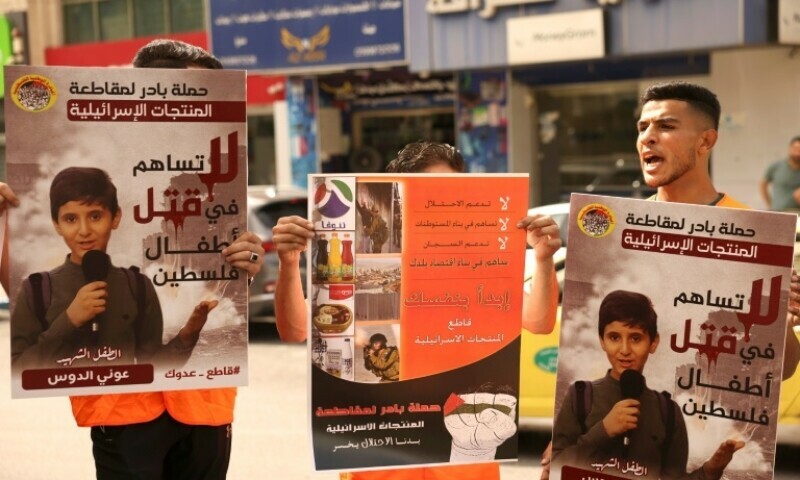
With the campaign spreading on social media including TikTok, children as well as their parents are shunning major brands such as Starbucks, KFC and Carrefour.
“We have started to boycott all products that support Israel in solidarity with the Palestinians,” Jana tells AFP.
“We do not want our money to contribute to more fighting,” she added, searching for local replacements.
The movement has gradually swelled since Hamas launched a surprise offensive on Israel on October 7, killing more than 1,400 people, mostly civilians, and kidnapping more than 200, according to Israeli officials.
Since then, Israel has relentlessly bombarded Gaza and sent in ground troops in an assault that killed more than 9,700 people, mostly women and children.
Across the region, Arabs angered by the Israeli attacks have turned against brands associated with Israel’s allies, notably the United States.
The boycott has been accompanied by calls for Arab states to cut ties with Israel, while pro-Palestinian rallies have taken place weekly in major capitals.
Turkiye and Jordan have recalled ambassadors to Israel, Saudi Arabia announced a pause in normalisation talks and Bahrain’s parliament said trade ties had been halted, although there was no government confirmation.
Grim billboards
Led by tech-savvy youth, the boycott campaign includes browser extensions, dedicated websites and smartphone apps that identify proscribed products.
One Google Chrome extension, PalestinePact, blurs items advertised online if they are included in the list.
More traditional methods are also in use. Beside a four-lane highway in Kuwait City, giant billboards show images of blood-stained children in bandages.
“Did you kill a Palestinian today?” the grim slogan asks, jabbing at consumers who are still using the targeted goods.
According to Mishari al-Ibrahim, a Kuwaiti activist, Western support for Israel’s Gaza offensive “strengthened the spread of the boycott in Kuwait”.
“It created a mental image among Kuwaitis that the West’s slogans and what it says about human rights do not apply to us,” Ibrahim said.
McDonald’s has found itself a prime target. Last month, the US fast food chain’s Israel franchise announced it had given thousands of free meals to the Israeli army, sparking uproar in the region.
McDonald’s Kuwait, a separate entity, responded by pledging more than $160,000 to relief efforts in Gaza and said it “stands with Palestine” in a statement on social media.
McDonald’s Qatar also pledged $275,000 to relief efforts in Gaza and stressed in a statement last month that it was separate from the Israeli branches.
‘Pay for bullets’
In Qatar, some Western outlets have been forced to close after their owners shared pro-Israel content online.
The Doha branches of Pura Vida Miami, a US cafe, and French pastry company Maitre Choux both shut in October.
In Egypt, a home-grown soda brand long ignored by much of the population has come into vogue because of the boycott.
Spiro Spathis, founded in 1920, said it recently received more than 15,000 applications in a hiring round prompted by the growing demand.
However, the boycott could have a deep impact on Egypt’s economy, the Federation of Egyptian Chambers of Commerce has warned.
“The impact on the Egyptian investors and tens of thousands of workers will be profound,” a statement said, stressing that local branches are owned by Egyptian franchisees.
Meanwhile in Jordan, where social media posts have warned consumers not to “pay for bullets”, Abu Abdullah is closely inspecting a bottle of flavoured milk at a grocery store in the capital, Amman.
“Ah, this is made in Tunisia,” he said, his four-year-old son Abdullah standing beside him.
“This is the least we can do for our brothers in Gaza,” he said.
Header image: Palestinians hold posters demanding a boycott of Israeli products during a rally in the occupied West Bank city of Hebron. — AFP