
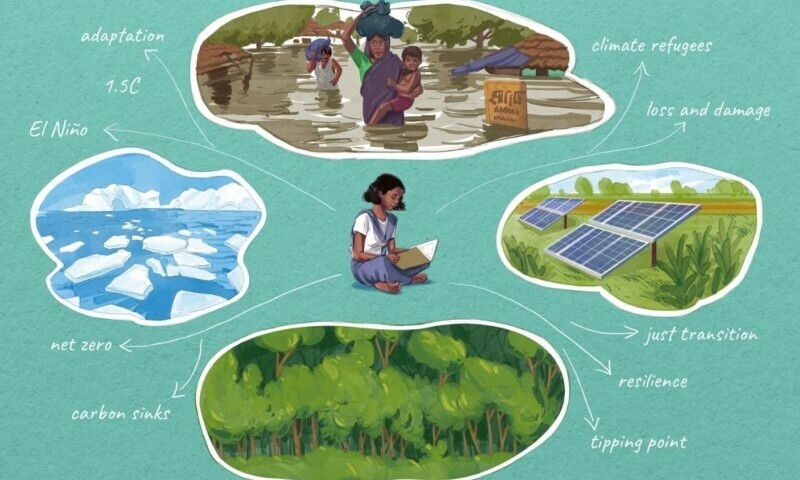
To help demystify and open up conversations on climate change, The Third Pole has compiled this glossary of key terms, available in five languages.
As the world warms due to climate change, threatening millions of lives and livelihoods, nothing is more urgent than clear communication about the changing climate and its consequences. But too often, discussions around climate change are heavy on jargon and technical terms, excluding the wider public from conversations of life-altering importance.
However, we cannot abandon precision and scientific rigour. A solid understanding of the key concepts relating to climate change is essential for the public to understand what is happening to our environment — and to think critically about how governments and powerful interests respond. The Third Pole has therefore prepared this climate change glossary, a guide to key terms in the climate conversation. We hope this will help to broaden understanding of climate change, and help those most impacted to add their voices to the debate.
This guide is available in English, Hindi, Nepali, Urdu and Bengali and will be regularly updated as new terminology enters conversations on climate change. Words in bold are terms that are explained elsewhere in this glossary.
123
In 2022, the average global temperature was 1.15 degrees Celsius warmer than before the Industrial Revolution, thanks to anthropogenic climate change. As temperatures rise above this level, the threats posed to people, wildlife and natural systems escalate, thanks to more frequent and intense heatwaves, floods and droughts, disrupted rainfall patterns and rising sea levels, among other impacts.
To prevent such a scenario, the world’s governments pledged in 2015 to keep global warming below 2C, and to ‘pursue efforts’ to limit warming to 1.5C, with the signing of the Paris Agreement. The difference between 1.5C and 2C is critical. A world with 2C of warming would experience far more damaging, irreversible impacts from climate change, and would pass many dangerous climate tipping points.
A report by the Intergovernmental Panel on Climate Change (IPCC) notes that greenhouse gas emissions will have to peak by 2025, and be reduced by 43 per cent by 2030, if warming is to be kept within 1.5C.
Despite pledges, the world is not on track to achieve this. According to an IPCC report released in March 2023, warming is likely to exceed 1.5C this century, even under a low greenhouse gas emissions scenario.
A
‘Adaptation to climate change’ refers to the actions people and governments can take to reduce the harmful impacts of global warming on the environment, society, public health, and the economy. Meaningful adaptation to these impacts requires practical solutions tailored to each country, region and community.
Adaptation measures in South Asia could include developing and rolling out new varieties of drought-resistant crops; designing better flood defences to protect coastal cities or riverine communities; improving early warning systems for climate change-related disasters; and restoring natural ecosystems like mangroves, which can act as buffers against extreme weather. For more information on climate adaptation, read here.
Anthropogenic means something caused by humans. Historically, the Earth’s climate has changed slowly over thousands of years. But since the 1800s, human activities like burning fossil fuels and cutting down forests have changed the balance of gases in the atmosphere, leading to a drastic increase in global temperatures. These are examples of the anthropogenic causes of climate change.
B
The variety of life found in a particular area is called biodiversity. This includes the animals, plants and microorganisms which interact with each other in an ecosystem, creating a network of life.
Protecting biodiversity is crucial for the survival of all life on Earth, including humanity, as the ecosystems we depend on to provide food, water and clean air can only function if a diverse variety of species is present in sufficient numbers. But biodiversity is currently under threat because of human activities, with up to 1 million plant and animal species estimated to be in danger of extinction.
Some of the main causes of biodiversity loss are changes in land use, such as deforestation and transformation of natural habitats for agriculture or mining; hunting and over-exploitation; invasive species; and climate change, among others.
Biofuels are liquid, solid or gaseous fuels that are produced from plant material and animal waste. Sugarcane, corn and soybeans are among the major sources currently used to produce biofuels. The energy produced with these fuels, or by burning biomass directly, is called bioenergy.
Advocates say that biofuels like bioethanol and biodiesel could help decarbonise the transport sector by offering a low-carbon alternative to fossil fuels. Total global demand for biofuel is set to increase by 22pc between 2022 and 2027. However, experts have warned about the impacts of dedicating land for biofuels, which could otherwise support food production and biodiversity. Critics argue that burning biofuels is not actually a low-carbon way to produce energy, and that figures that show biofuels to have a lower carbon footprint than fossil fuels may not account for all carbon released.
When carbon generated during the production of bioenergy is captured and stored, and therefore does not enter the atmosphere, this is called BECCS (bio energy with carbon capture and storage). In theory this would mean energy is produced with a negative carbon footprint. Only a few BECCS projects are currently operational worldwide, and critics question the costs relating of diverting large areas of land to production of bioenergy, which could otherwise be used for food production or biodiversity.
Biomass is any organic matter that comes from plants, animals and microorganisms, including organic waste from agriculture, forestry and other industries. Biomass can be burned directly to produce energy, or converted into biofuels.
C
Carbon credits and carbon offsets are the two main types of carbon trading. Carbon credits are essentially tokens issued by governments to companies which represent future carbon emissions. Companies which emit less than their ‘allowance’ — and so end up with excess carbon credits — can then trade them on a carbon market. This is supposed to incentivise companies to reduce their emissions.
Carbon offsets are created by companies. If a company does something that removes carbon from the atmosphere, such as planting trees, it may count this as a carbon offset, and trade it with other organisations who wish to ‘neutralise’ the polluting impact of their processes. Individuals can also ‘offset’ their carbon emissions, generated by high-carbon activities such as flying, by donating to carbon removal projects, such as forestry programmes or renewable energy development.
Carbon trading is controversial. Critics argue that in practice carbon markets allow rich countries, companies and individuals a way out of actually reducing their emissions, as they can simply spend to continue polluting, and that they are hard to manage effectively. The real carbon removal benefit of carbon offset projects has also been questioned, with some commentators arguing that their positive climate impact is inflated.
Carbon capture and storage (or CCS) is a process that directly traps carbon dioxide generated through industrial processes and injects it underground to prevent it from reaching the atmosphere. Carbon capture, utilisation and storage (CCUS) goes one step further by using the captured carbon in production of goods such as alcohols, biofuels, plastics or concrete.
Some commentators argue that carbon capture technologies have a significant role to play in climate change mitigation, by reducing the climate impact of industries which cannot easily stop use of polluting fuel or materials. The IPCC assumes that CCS technologies will have an important role to play in scenarios in which climate change is kept to within 2C.
But others argue that CCS and CCUS technologies could have the effect of delaying the transition away from fossil fuels, and that much of the technology is uneconomical and untested at scale. In July 2023, the European Union and 17 countries including Germany, France and New Zealand said that reliance on carbon capture technology should be limited as it is not a substitute for phasing out fossil fuels.
Carbon dioxide equivalent (CO2e) is a term used to conceptualise the effect of different greenhouse gases using one single metric. A smaller amount of a gas which contributes more strongly to the greenhouse effect, such as methane, could have a CO2e many times larger than the same quantity of carbon dioxide.
Carbon markets, also known as emissions trading schemes, are agreements through which countries or businesses buy and sell permits to emit carbon dioxide, often known as carbon credits.
Under a carbon trading market, a nation or company that reduces its carbon emissions to below a certain agreed level can sell the leftover emissions ‘allowance’ — in the form of carbon credits — to others that are still polluting beyond these limits. In theory, this provides a financial incentive to reduce emissions.
Carbon dioxide removal (CDR) refers to processes through which carbon dioxide is captured out of the air so that it does not act as a greenhouse gas. When this carbon is stored long-term, this is called carbon sequestration.
Carbon sequestration happens naturally, with biological processes storing huge quantities of carbon dioxide in the soil, the ocean, forests, grasslands and other natural ecosystems. It can also be achieved through human-made processes, via carbon capture and storage technologies.
CDR and carbon sequestration are regarded as essential tools in climate change mitigation. The IPCC states that “CDR is required to limit warming to 1.5C”, especially in “difficult to decarbonise sectors, such as industry, long-distance transportation, and agriculture”. CDR is also a key feature in most national net-zero plans.
Carbon sinks are natural and artificial reservoirs that store carbon dioxide. Carbon sinks play a crucial role in regulating the proportion of greenhouse gases in the atmosphere. Healthy forests, oceans, soil, peatlands and wetlands are all natural carbon sinks. Carbon Capture and Storage (CCS) technologies can act as artificial carbon sinks.
#Circular economy
In a circular economy, resources are reused and recycled in a way that minimises waste and maximises resource efficiency. In contrast to a ‘linear economy’ model in which resources are extracted, used and then discarded, a circular economy ensures that used materials are put back into the production chain, creating a closed ‘loop’ of resource use.
CFCs (or chlorofluorocarbons) are gases composed of the elements carbon, chlorine and fluorine which have been used in solvents, refrigerants and aerosol sprays. In the 20th century, CFCs were determined to be responsible for the depletion of the ozone layer, a region of the Earth’s atmosphere that traps ultraviolet radiation from the sun, shielding living creatures from its harmful effects.
Use of CFCs has been phased out worldwide as a result of the landmark Montreal Protocol, agreed in 1987.
The United Nations defines climate change as long-term shifts in temperatures and weather patterns. Human activities such as the burning of fossil fuels and deforestation have generated greenhouse gases, which have raised global average temperatures.
The impacts of climate change are immense, including more frequent and intense extreme weather events, rising sea levels, disrupted rainfall patterns, and melting ice in polar and mountain regions.
The impacts of climate change are disproportionately experienced, with many of the countries and communities who have contributed the least to global emissions being the most vulnerable to the consequences, and least able to adapt. The climate justice movement argues that the people, companies and countries that have benefited the most, economically, from carbon-fuelled development have the greatest responsibility to pay for the effects of that growth, and to help those most affected by the impacts of climate change.
Climate refugees is a term used by some activists and commentators to describe people who are forced to leave their home due to the impacts of climate change, such as flooding or sea level rise.
There is no formal definition of a climate refugee, and the definition of a refugee used by the United Nations — “people who have fled war, violence, conflict or persecution and have crossed an international border to find safety in another country” — would not cover someone who lost their home in a cyclone or to a rising sea.
In the world of climate change, ‘COP’ refers to the Conference of the Parties to the UN Framework Convention on Climate Change (UNFCCC). This annual meeting brings together the 198 members of the convention, first signed in 1992, to discuss global action on climate change.
At climate COPs, country representatives discuss issues such as how to reduce the greenhouse gas emissions that cause the planet to warm; adapting to the impacts of climate change; and financial support for developing countries to move away from fossil fuels and become more resilient to the impacts of climate change.
The last COP, COP27, was held in Sharm el-Sheikh, Egypt, in November 2022. COP28 will be held in Dubai, United Arab Emirates, from 30 November to 12 December 2023.
The term cryosphere refers to the areas of the planet where most of the water is in a frozen form: the polar regions and high mountains. In the Hindu Kush Himalayas, the world’s highest mountain range, frozen water exists in the form of glaciers, ice caps, snow, permafrost, and ice on rivers and lakes.
D
Deforestation is the cutting down of forests by humans, both for timber and to make space for activities like agriculture and mining. A major threat to both biodiversity and our climate, deforestation releases huge quantities of greenhouse gases into the atmosphere.
Desertification is a process of land degradation in which fertile and biodiverse land in dry or semi-dry areas loses its productivity — essentially turning into a desert. This can be driven by human activities like deforestation and overgrazing, as well as the effects of climate change.
E
An ecosystem is a biological community of living organisms, including animals, plants and microorganisms, together with the physical environment in which they interact with each other such as water and soil. Ecosystems can be huge — like entire forests — and can encompass many smaller ecosystems.
El Niño is a climate pattern in which the surface water of the east-central tropical Pacific Ocean warms to significantly above average. This affects rainfall patterns and weather across the world, raising temperatures globally during its duration. El Niño is part of a phenomenon called the El Niño-Southern Oscillation (ENSO); the opposite cooler phase is called La Niña. El Niño events do not occur on a regular schedule, but on average appear every two to seven years.
Emissions refer to gases and other substances which are released into the atmosphere as a result of human activities such as manufacturing, energy production and transportation. Emission of greenhouse gases like methane and carbon dioxide since the 1800s have led to global warming.
The energy sector has traditionally been heavily reliant on fossil fuels, and this is the primary cause of climate change. A shift from coal, oil and natural gas towards renewable energy sources like solar and wind, which do not result in major carbon emissions, is referred to as the energy transition.
F
Flash floods are intense and sudden floods, triggered by events like heavy rainfall in a short period of time, or the rapid melting of snow or ice. Flash floods can cause serious damage as they can happen with little to no warning, leaving people unable to evacuate or take necessary precautions.
In the Indian Himalayas, 17 major flash floods have occurred since 1986. Scientists say that more intense forest fires are a major reason for a rise in flash floods in the Himalayas over the past 20 years.
Fossil fuels include coal, oil, and natural gas, which all formed from the remains of plants and animals that died millions of years ago. They are therefore not renewable in human timespans. The burning of fossil fuels, largely for energy production, releases huge quantities of carbon dioxide and other greenhouse gases into the atmosphere and is the single biggest cause of climate change.
G
Glaciers are slowly flowing masses of ice — like frozen rivers — found in the polar regions and in high mountains. They are formed over centuries as snow falls on land and gets compressed into thick masses of ice. Their movement is primarily driven by the force of gravity acting on the weight of the ice itself.
As climate change warms the world, glaciers are now melting faster than they can be replenished by snowfall. The impacts of melting glaciers can be seen in sea levels, water cycles and weather systems far away from the glaciers themselves. Read more about the melting glaciers of the Himalayas here.
Many use the terms ‘climate change’ and ‘global warming’ interchangeably. But while global warming refers to the increasing surface temperature of the Earth, ‘climate change’ also encompasses other changes in patterns like wind and rainfall. Human activities that have increased the levels of greenhouse gases in the atmosphere are the major drivers of global warming.
Some media outlets prefer the term ‘global heating’ over ‘global warming’, to better reflect the severity of the crisis.
A Glacial Lake Outburst Flood or GLOF is a sudden release of water from a lake formed by meltwater from a mountain glacier, which is held back by ice or a moraine (rocks and sediment carried along by the glacier). These floods can be prompted by an earthquake, avalanche or the accumulation of too much meltwater. GLOFs are often extremely destructive, and are a growing threat in the Himalayan watershed.
Green energy refers to energy that comes from renewable sources like wind or the sun. Unlike fossil fuels, production of green energy does not result in major carbon emissions. There is debate over the extent to which some renewable energy — especially hydropower — can be truly termed ‘green’, given substantial impacts on rivers and related ecosystems.
Since hydrogen does not exist naturally as a gas in usable quantities, pure hydrogen is produced artificially through methods such as electrolysis — a process that splits water into hydrogen and oxygen. When these processes are powered using clean energy sources such as solar or wind power, this is called green hydrogen. Hydrogen produced using energy from fossil fuels is called grey hydrogen. Read our explainer to find out more.
Carbon dioxide, methane, nitrogen oxide, CFCs, HCFCs and HFCs are all referred to as greenhouse gases, because their presence in the atmosphere traps the sun’s heat, warming the air around the Earth like the glass walls and roof of a greenhouse. This is the greenhouse effect.
Human activities like burning fossil fuels are increasing the proportion of greenhouse gases in the atmosphere. This is strengthening the greenhouse effect, trapping more heat, and causing the Earth to become warmer.
Greenwashing, a term coined by environmentalist Jay Westerveld in 1986, is a practice in which companies and organisations create an illusion that their products or services are environmentally friendly, when in fact they might actually be damaging to the environment. A company engaging in ‘greenwashing’ may be seeking to exploit customers’ desires to purchase environmentally-friendly products, or to deflect negative public and political pressure over environmentally damaging practices without significantly changing their actions.
H
Habitat fragmentation occurs when a large area of continuous habitat — such as a forest — is broken up into multiple smaller patches that are isolated from one another. This is a major threat to biodiversity, as many species are unable to survive in smaller patches of habitat. When small populations are isolated from each other, this can also prevent the exchange of genes between unrelated individuals, which is essential for healthy populations in the long term.
The Hindu Kush Himalaya (or HKH) is a term used to refer to the mountainous region of South and Central Asia which spans both the 800 kilometre long Hindu Kush mountain range (from Afghanistan to Tajikistan), and the Himalayas themselves (from Pakistan to Myanmar).
A 2023 assessment of the Hindu Kush Himalayan region by the International Centre for Integrated Mountain Development (ICIMOD) describes vast changes happening in the region due to climate change: glaciers are melting more quickly, snowfall days are dwindling, and permafrost is melting. The impacts on states, societies, and biodiversity in South Asia and beyond will be immense. Read more about the report here.
Hydrocarbons are the fundamental components of fossil fuels such as coal, petroleum and natural gas. Chemically, hydrocarbons are organic compounds composed of carbon and hydrogen atoms. Burning hydrocarbons for power generation or as fuel in transportation releases carbon dioxide and other greenhouse gases into the atmosphere, contributing to climate change.
Hydrochlorofluorocarbons (HCFCs) are chemical compounds that contain hydrogen, chlorine, fluorine, and carbon atoms, which were developed for use in refrigeration, air conditioning, foam-blowing and aerosols. They are potent greenhouse gases, and are being phased out under the Montreal Protocol because they harm the ozone layer.
Hydrofluorocarbons (HFCs) are gases that are used in air conditioning, refrigeration and other industries, which were introduced to replace CFCs and HCFCs as they do not deplete the ozone layer. However, they are potent greenhouse gases and can contribute significantly to climate change when they are used.
Under the Kigali Amendment to the Montreal Protocol, agreed in 2016, world governments have agreed to phase down the production and use of HFCs.
I
The Industrial Revolution was a significant period in Europe and North America, beginning in the 18th century, which saw a transition from agrarian economies to those characterised by technological advancements and industrial manufacturing.
Most of the energy used in these new processes was generated using fossil fuels: coal, initially, and then oil and gas. This greatly increased carbon dioxide levels in the atmosphere, marking the start of anthropogenic climate change.
The Intergovernmental Panel on Climate Change, or IPCC, is a scientific body created in 1988 by the World Meteorological Organization (WMO) and the United Nations Environment Programme. Its goal is to inform governments about the latest climate science and explain what impacts climate change will likely have on the world in the coming decades.
Currently, the IPCC has 195 member countries and brings together scientists from all over the world who contribute voluntarily to its work. The IPCC doesn’t produce original research. Instead, hundreds of scientists examine the available scientific literature and distil it into comprehensive Assessment Reports. These reports delve into what drives climate change, what its consequences on the ground may be, and how mitigation (limiting climate change) and adaptation can help protect people from the worst impacts.
J
Shifting to a low-carbon economy is essential to keep emissions in check and limit climate change. But decarbonising means major changes to industries — like fossil fuels — which employ millions of people.
A ‘just transition’ is one in which the social and economic implications of this change are adequately addressed. This includes ensuring that the rights of workers and the needs of communities are protected, and that support and opportunities are provided for those whose jobs must change.
K
The Montreal Protocol — the global agreement signed in 1987 to protect the ozone layer — was amended in 2016 during a meeting in Kigali, the capital of Rwanda. The Kigali Amendment aims to phase down the production and use of hydrofluorocarbons (HFCs), potent greenhouses gases which are used as substitutes for ozone-depleting substances such as chlorofluorocarbons (CFCs) and hydrochlorofluorocarbons (HCFCs).
The Kyoto Protocol was an international agreement, adopted in 1997, that aimed to reduce greenhouse gas emissions to address climate change. The agreement came into force in 2005 and was signed by 192 parties (although United States never ratified the treaty). The Kyoto Protocol set binding emission-reduction targets for industrialised countries, based on historical emissions and other circumstances.
In 2015, the Kyoto Protocol was superseded by the Paris Agreement as the main international treaty for coordinating global action against climate change.
L
La Niña is the opposite phase of El Niño in the El Niño-Southern Oscillation (ENSO). During La Niña, cooler-than-average sea temperatures are noted in the central and eastern equatorial Pacific. Like El Niño, it affects patterns of rainfall and atmospheric pressure worldwide.
The impacts of climate change include more frequent and intense floods, heatwaves, and rising sea levels. In many cases, adapting to these changes is impossible: lives are lost, land rendered infertile, and habitats changed permanently. The social and financial impacts of climate change that cannot be avoided or adapted to are referred to as ‘loss and damage’.
Loss and damage can be economic, such as loss of livelihoods or lower agricultural yields due to unpredictable weather patterns. It can also be non-economic, such as the loss of cultural traditions, indigenous knowledge, and biodiversity — which can be hard to measure.
Who pays for loss and damage resulting from climate change is a key and contentious issue in global negotiations on dealing with climate change.
M
As climate change leads to rising sea levels and more frequent and intense extreme weather events such as floods, heatwaves and droughts, many people around the world are being driven to leave their homes in search of a better living environment. This is often called climate migration. As temperatures increase and the effects of climate change escalate, climate migration is expected to increase significantly in coming decades.
Actions taken to reduce the proportion of climate change-causing greenhouse gases in the atmosphere are referred to as climate change mitigation. Mitigation measures include reducing emissions by shifting to renewable energy sources; capturing and storing emissions from industrial processes; and improving natural carbon sinks like forests and ocean ecosystems.
The Montreal Protocol on Substances that Deplete the Ozone Layer is an international environmental agreement, signed in 1987, which aims to protect the ozone layer by phasing out the production and use of ozone-depleting substances (ODS), including chlorofluorocarbons (CFCs) and hydrochlorofluorocarbons (HCFCs). These chemicals, commonly used in refrigeration and air conditioning, damage the ozone layer which protects life on earth from the dangerous effects of the sun’s radiation.
The Montreal Protocol is often regarded as the world’s most successful international environmental agreement. Studies have estimated that without the treaty, the ozone layer could have collapsed by 2050.
N
Under the 2015 Paris Agreement, countries are required to prepare an outline for their efforts to reduce national emissions and adapt to the impacts of climate change. These commitments are referred to as Nationally Determined Contributions (NDCs).
NDCs are submitted every five years, and successive NDCs are supposed to be more ambitious than previous ones (the so-called ‘ratchet mechanism’). Combined, these national targets should amount to a coordinated global effort to reduce the severity and impact of climate change.
Natural gas is a fossil fuel used in electricity generation, heating buildings, cooking, and industrial processes. It is mostly composed of methane, along with smaller amounts of other hydrocarbons such as ethane and propane. It is extracted from underground reservoirs through drilling wells.
Compared to coal and oil, natural gas releases lower levels of carbon dioxide and air pollutants when burned. Some have advocated for use of gas a ‘bridge’ or ‘transition fuel’, to help support the process of transitioning from fossil fuels to renewable energy. But many experts contend that this argument is a red herring, and could impede investment in cheaper and less-polluting renewable energy.
The International Union for Conservation of Nature (IUCN) defines nature-based solutions as “actions to protect, manage and restore natural or modified ecosystems, which address societal challenges, effectively and adaptively, providing human wellbeing and biodiversity benefits.”
In a climate context, nature-based solutions could include protection and restoration of ecosystems which act as carbon sinks. Mangrove forests are a good example of how nature-based solutions can help with both climate change mitigation and adaptation: they can shield communities from coastal storms floods, while also storing carbon.
Net zero is a state in which total greenhouse gas emissions entering the environment are equal to the carbon being removed from the atmosphere. This is also referred to as climate neutrality. In 2018, the Intergovernmental Panel on Climate Change marked 2050 as the deadline by which the world must reach net zero if the Paris Agreement target of limiting global warming to 1.5C is to be possible.
According to a report by Net Zero Tracker, a London-based collaboration of non-profit and research organisations, around 128 countries and territories including the UK, the United States, India and China have set a net-zero target. More than one-third of largest public trading companies in the world have also set net-zero targets. Many governments and companies with net-zero targets have been criticised for their failure to set clear and timely pathways to reaching these targets.
O
About 30pc of the carbon dioxide released into the Earth’s atmosphere is absorbed by the ocean. As levels of carbon dioxide in the atmosphere increase, so too does the carbon dioxide in seawater. This changes the chemical composition of the oceans, making seawater more acidic, a process known as ocean acidification.
Ocean acidification can severely affect marine biodiversity, such as by affecting the process through which animals like oysters and other shellfish build their shells. Coral reefs are also seriously threatened by more acid oceans. This in turn could have severe impacts on populations and economics which depend on the ocean as a source of income and diet.
Ozone is a gas molecule made up of three oxygen atoms. The ozone layer is a part of the Earth’s stratosphere, where 90pc of ozone in the atmosphere is found. This ozone layer is important for life on Earth as it absorbs some of the sun’s harmful ultraviolet radiation.
Research in the 1970s found that the ozone layer was being depleted, with potentially serious risks for life on earth. The gases responsible for the depletion of the ozone layer, including CFCs and HCFCs, are being phased out under the global environmental agreement the Montreal Protocol. Due to the success of this agreement in limiting use of these chemicals, the ozone layer is now on track to recover.
P
The Paris Agreement is a landmark international agreement which aims to limit global average temperature rise to “well below 2 degrees Celsius above pre-industrial levels”, and to ‘pursue efforts’ to limit warming to 1.5C. The Agreement was finalised in 2015, and has been signed and ratified by almost every country in the world.
Under the Paris Agreement, countries present plans to reduce emissions and adapt to the effects of climate change (known as Nationally Determined Contributions or NDCs), and are supposed to review these commitments every five years. The agreement also covers provision of financial support to developing countries to deal with the impacts of climate change, and management of global carbon markets.
Particulate matter refers to the mixture of solid particles and liquid droplets found in the air. Some particulate matter comes from natural processes, and it is also generated by human activities such as burning fuel and construction.
Some particulate matter can cause significant health problems for people, especially particles that are so small they can penetrate deep into the body when inhaled. Of particular concern are particles with a diameter of less than 2.5 micrometres, known as ‘PM 2.5’.
Any ground that stays completely frozen for at least two years straight is called permafrost. Made up of soil, sand, rock and organic material held together by ice, permafrost is found in the polar regions, and also covers around 40pc of the surface area of the Hindu Kush Himalayan region. Climate change is causing the melting of permafrost. If global average temperatures rise to 2C above pre-industrial levels, it is estimated that the extent of permafrost would fall by more than 40pc.
The loss of permafrost would cause dramatic changes to hydrological cycles and ecosystems in polar and mountain areas. Melting permafrost could also result in the release of huge amounts of greenhouses gases, in turn speeding up warming and driving more melting.
R
Renewable energy refers to energy produced using sources like wind power, water, solar radiation and the natural warmth of the Earth. Unlike fossil fuels, the production of energy using renewable sources generally does not release greenhouse gases into the atmosphere. They are known as renewable because, unlike fossil fuels dug from the ground, they are not a finite resource.
A transition from fossil fuels to renewable sources in production of energy is an essential part of efforts to limit climate change. In 2020, the share of renewable energy in global electricity production reached 29pc.
While hydropower is a form of renewable energy, the building of dams can have significantly negative effects on river systems, their ecology and the lives of people who depend on them. It is therefore not always regarded as an environmentally friendly form of energy production.
Climate resilience refers to the ways in which communities are able to cope with the impacts of climate change, including recovering from extreme weather events linked to climate change. Whereas ‘adaptation’ refers to a permanent alteration in a system in response to changes in the climate, resilience suggests a recovery back to ‘normal’ after a climate change-related disaster.
S
The Sustainable Development Goals are a set of 17 interconnected goals set by the United Nations in 2015, which are supposed to be achieved by 2030. They provide a detailed framework for addressing the world’s most pressing social, economic, and environmental challenges.
The Sustainable Development Goals most closely linked to climate change include those on ‘affordable and clean energy’, including an increase in percentage of renewable energy worldwide; taking urgent ‘climate action’ to limit the extent and impacts of climate change; and goals to protect life on land and in the oceans.
T
The region encompassing the Hindu Kush Himalaya mountain range and the Tibetan Plateau is often known as the ‘Third Pole’ because its ice fields contain the largest amount of frozen water outside the polar regions. This region is the source of 10 major river systems that provide irrigation, power and drinking water to nearly 2 billion people — over 24pc of the world’s population.
In the context of climate change, a tipping point is a threshold which, once passed, triggers a major, irreversible and self-perpetuating change in the climate. Researchers have identified 16 such climate tipping points so far, and say that some may even have already been passed, making major shifts such as the collapse of Greenland’s ice cap and the melting of permafrost inevitable.
A key example is the Amazon rainforest in South America, the world’s biggest rainforest and one of the world’s most biodiverse ecosystems. The Amazon has a huge impact on the climate, including by creating rainfall and stabilising temperatures in the region. But close to a fifth of the Amazon rainforest has been cut down or degraded, meaning there are fewer trees to generate the rain the forest relies on. This risks creating a vicious cycle, with reduced rainfall threatening the surviving forest. According to some scientists, a tipping point at which the cycles the forest depends on would collapse will be reached when deforestation reaches 20-25pc. After this, large areas would turn into a grassland within a few decades.
U
The Urban Heat Island effects refers to a phenomenon in which the temperature in urban areas is significantly higher than the surrounding region. Causes include artificial surfaces like concrete and roads absorbing heat; the warmth produced during burning of fuel and other human processes; and an absence of vegetation. The urban heat island effect can exacerbate the severity of heatwaves in urban areas.
V
The impacts of climate change are felt disproportionately by different communities. Vulnerability to climate change differs based on factors such as geographical location, socioeconomic status and social marginalisation.
Additional inputs from Aron White
This article was originally published on The Third Pole and has been reproduced here with permission.