

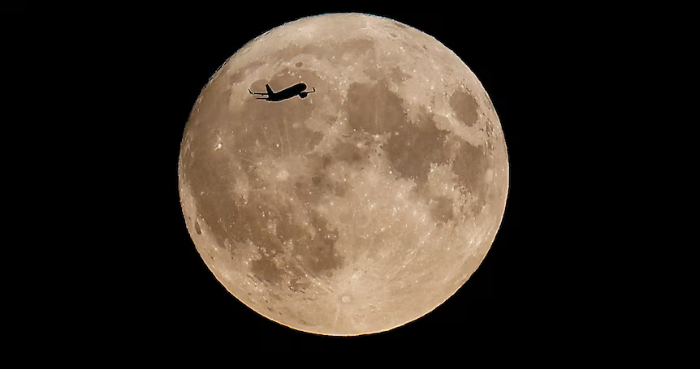
The Beaver Supermoon, the largest and brightest moon of 2025, will rise on Wednesday at 18:19 PST in Pakistan.
At its closest point, the moon will be 356,980 km (221,817 miles) from Earth, making it 7.9% larger and 16% brighter than a typical full moon, according to the Pakistan Space and Upper Atmosphere Research Commission (SUPARCO).
It is the second in a series of three consecutive supermoons (October, November, December 2025), visible worldwide, including Pakistan.
A Beaver supermoon happens when a full moon aligns with its closest approach to Earth—perigee—in its elliptical orbit. When near, the moon appears slightly larger and brighter.
The statement also noted that the moon’s distance from Earth varies between perigee (closest) and apogee (farthest), and during a full moon at or near perigee, it becomes a supermoon.
Supermoons typically appear three or four times annually, though the exact number varies depending on how the moon’s closest approach to Earth (perigee) aligns with the full moon phase. While new moons can also align with perigee (“super new moons”), the focus is usually on the more visible full supermoons.
A full moon at perigee can be up to 14% larger and 30% brighter than one at apogee; however, this difference is often too slight to be noticed by the naked eye.
Exceptionally close alignments of Earth and moon, resulting in the biggest and brightest supermoons, are rare and momentous.