

Record-breaking Artemis II mission unveils new details of the moon’s shadowed hemisphere
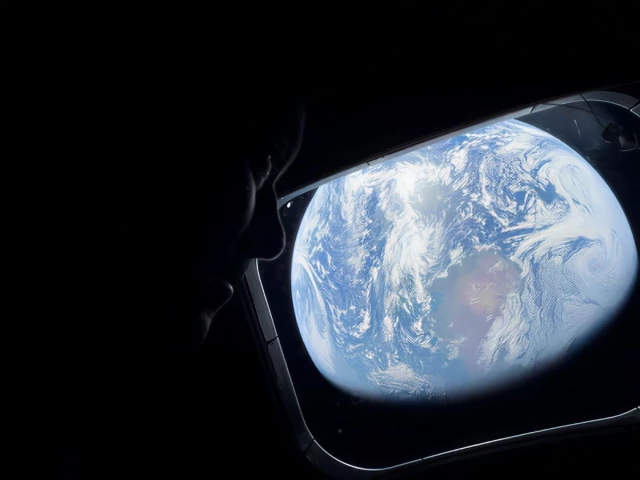
NASA astronaut and Artemis II Commander Reid Wiseman peers out of one of the Orion spacecraft’s main cabin windows, looking back at Earth, as the crew travels towards the Moon April 2, 2024.PHOTO: NASA
The four astronauts of NASA’s Artemis II mission flew deeper into space on Monday than any humans before them, as they cruised through a rare flyby of the shadowed far side of the moon that revealed a lunar surface under cosmic bombardment.
The six-hour survey of the normally hidden hemisphere of Earth’s only natural satellite was highlighted by the astronauts’ direct visual observations of “impact flashes” from meteors pelting the darkened and heavily cratered lunar surface.
About two dozen scientists packed a conference room adjacent to mission control at NASA’s Johnson Space Centre in Houston to record the lunar phenomena witnessed by the Artemis crew in real time as their Orion spacecraft, about the size of an SUV, sailed around the moon roughly a quarter million miles (402,000 km) from Earth.
The six-hour flyby, which swooped to within 4,070 miles of the lunar surface, came six days into a spaceflight marking the world’s first voyage of astronauts to the vicinity of the moon since NASA’s Cold War-era Apollo missions more than half a century ago.
Six of those missions landed two-man teams on the moon between 1969 and 1972 – the only 12 humans ever to walk on its surface.
Read: Artemis II crew becomes farthest-flying humans
Artemis, a successor to the Apollo program, aims to repeat that achievement by 2028, ahead of China’s first landing, and to establish a long-term US lunar presence over the next decade, including a moon base to serve as a proving ground for potential future missions to Mars.
While designed as a crewed dress rehearsal for future lunar excursions, Artemis II generated a wealth of new material for lunar scientists to study, including meteor impact flashes recorded during Monday’s flyby that were reminiscent of sparks and streaks of light described by some of Apollo’s astronauts.
The Artemis II crew, riding in their Orion capsule since launching from Florida last week, began their sixth day of spaceflight as they awoke on Monday to a pre-recorded message from the late NASA astronaut Jim Lovell, who flew aboard the Apollo 8 and Apollo 13 moon missions.
“Welcome to my old neighbourhood,” said Lovell, who died last year at age 97. “It’s a historic day, and I know how busy you’ll be, but don’t forget to enjoy the view… good luck and Godspeed.”
Hours later, the crew consisting of US astronauts Reid Wiseman, Victor Glover and Christina Koch, along with Canadian astronaut Jeremy Hansen, made spaceflight history by venturing farther from Earth than any humans have before, at 252,756 miles.
The previous record, roughly 248,000 miles, was set in 1970 by Apollo 13 after a nearly catastrophic spacecraft malfunction cut short that mission, forcing Lovell and his two crewmates to use the moon’s gravity to help return them safely to Earth.
Read More: Artemis II astronauts race toward historic moon record—but their toilet woes spark a meme frenzy
En route to the far side of the moon, the Artemis astronauts spent some time assigning provisional new names to lunar features that previously lacked official designations.
In a radio message to mission control in Houston, Hansen suggested one crater be dubbed Integrity, after the name given to the crew’s Orion capsule, and that another be named in honour of Wiseman’s late wife, Carroll, who died of cancer in 2020.
“A number of years ago, we started this journey, our close-knit astronaut family, and we lost a loved one,” Hansen said of the mission commander’s late spouse, his voice choking with emotion as he described the position of her lunar namesake. “It’s a bright spot on the Moon, and we would like to call that Carroll.”
Hansen later said the crew had viewed a number of lunar features that “no human has ever seen before, not even in Apollo.”
As Orion hurtled around the moon’s far side, the astronauts photographed a rare moment in which Earth, dwarfed by their record-breaking distance from the planet, set and rose with the lunar horizon as they swung around the moon, a striking celestial reversal of the rising and setting moon typically seen from Earth.
Because the moon rotates at the same speed as it revolves around the Earth, its far side always faces away from our planet, and only the Artemis and Apollo astronauts have ever gazed directly on its surface.
Monday’s lunar flyby plunged the crew into darkness and a 40-minute communications blackout as the moon blocked them from NASA’s Deep Space Network, a global array of massive radio communications antennas the agency has been using to talk to the crew.
Following the flyby, US President Donald Trump congratulated the four crew members on an audio link from the White House as they appeared on camera by live satellite feed from space.
“Today, you’ve made history and made all America really proud, incredibly proud,” Trump said. “You’ve really inspired the entire world. Really, everybody’s watching.”
Koch told Trump that one of her most unforgettable moments of the flyby was “coming back from the far side of the moon and having the first glimpses of planet Earth again.”
Asked by the president how they felt when all communication with Earth was cut off as Orion flew behind the moon, Glover answered, “I said a little prayer, but then I had to keep rolling.”