

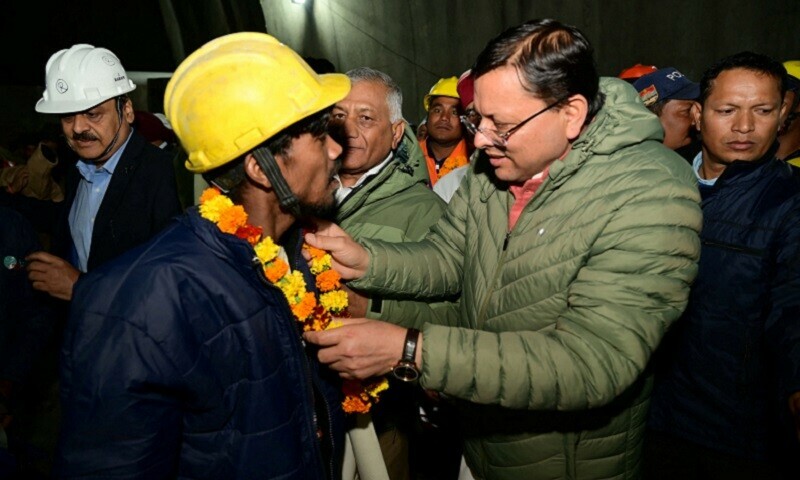
After 17 days trapped inside a collapsed Himalayan road tunnel they were building, Indian workers described the horror of their ordeal, and the hopes and prayers that kept them strong.
“We were really scared, every moment felt that death was standing nearby,” rescued worker Deepak Kumar told AFP on Wednesday.
“We were not sure whether our lives would be saved or not.” The men were welcomed as heroes after being hauled through 57 metres (187 feet) of steel pipe on stretchers specially fitted with wheels late Tuesday, the culmination of a marathon engineering operation.
Draped in garlands of orange marigolds, they were greeted with wild cheers.
“The world is again beautiful for us,” rescued worker Sabah Ahmad told AFP, describing the heartache of hearing his wife’s “worried and hopeless” voice while he was trapped.
“I know it was a difficult moment for those inside and more difficult for families outside,” said Ahmad, who comes from Bihar, one of India’s poorest states.
“But at last we have come out, and it is the only thing that matters.” His wife Musarrat Jahan, speaking to AFP by phone from Bihar, said that “no words” could explain how happy she felt.
“Not only my husband got a new life, we also got a new life,” she said. “We will never forget it”.
‘Lost hope’
Previous hopes of reaching the men were repeatedly dashed by falling debris and the breakdown of multiple drilling machines, and the men spoke of how hard it had been to keep their spirits up.
“It was not easy,” Kumar said. “After three or four days inside the collapsed tunnel, and the rescue team had failed to reach us, the reality is that our confidence and faith were at a low level.”
Most of the trapped men are migrant workers who left home to find employment, working on the Silkyara tunnel in northern Uttarakhand state, hundreds of kilometres (miles) from home high up in the bitterly cold Himalayan foothills.
Rescue teams later set up a telephone exchange to allow families far from the site to call in.
“I told my family, ‘I am fine and healthy, do not worry, everything will be all right, we will come out soon’”, Kumar said.
“But while I was saying these words to them, sometimes I felt strongly that I will never be able to see my parents.” Guriya Devi, wife of rescued worker Sushil Kumar, told AFP that the family had “passed through horrible times, and sometimes we lost hope”.
Chamra Oraon, 32, from Jharkhand state, described the horror he felt when he heard a thud and debris began to fall deep inside the mountain road tunnel on November 12 — and the terror as the rock fall blocked the only route out with tonnes of rubble.
“I ran for my life but got stuck on the wrong side,” he told the Indian Express newspaper.
“As it became clear we would be there for a long time, we grew restless, hungry. But we prayed silently for help.” Subodh Kumar Verma told AFP how the first 24 hours in the tunnel were the worst, when they feared they could starve to death — if their air did not run out first.
“We faced problems related to food and air for 24 hours there,” Verma said.
But morale was boosted after rescue teams managed to connect a thin pipe through to them, bringing in oxygen.
Initially, it was only small packets of puffed rice and seeds, but days later, the tube was widened to be able to send proper meals of lentils and rice, packed into plastic bottles and sent down the chute.
“After food items were sent through pipes things improved,” said Verma.
“When we ate the first morsel, we felt someone above had reached out to us,” Oraon told the Express.
But keeping busy while waiting for rescue was tough, with the workers playing games on their phones — which they could charge as power had remained.
“We immersed ourselves in Ludo on the phone,” Oraon said.
“We spoke among ourselves and got to know each other”.
‘Knights in Mining Armour’
Though trapped, the men had plenty of space in the tunnel, with the area inside 8.5 metres high and stretching about two kilometres in length.
Arnold Dix, president of the International Tunnelling and Underground Space Association, who had been advising the engineers, said he had heard the men had been keeping busy “playing cricket” as they waited for rescue.
That finally came on Tuesday. After a giant earth-boring drill was snapped by metal girders buried in the rubble, a team of miners dug the final section by hand using a so-called “rat-hole” technique inside a narrow tube.
Indian media dubbed the diggers “rock stars”.
“Knights in Mining Armour”, the Times of India called them. “Ace of Spades”.