

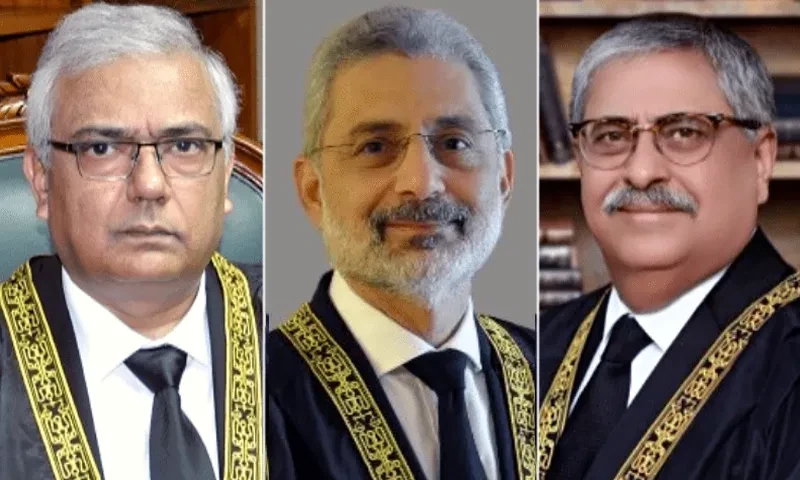
Chief Justice of Pakistan Qazi Faez Isa on Thursday said that if the court’s verdict on the 2017 sit-in by the Tehreek-i-Labbaik Pakistan (TLP) at Islamabad’s Faizabad had been implemented, future “serious incidents” could have been averted.
“If this verdict was implemented at that time, then serious incidents would not have taken place later,” the CJP observed while hearing a set of review petitions challenging the apex court’s verdict.
A three-member bench — including Chief Justice of Pakistan Qazi Faez Isa, Justice Aminuddin Khan and Justice Athar Minallah — took up the pleas.
During the hearing, the defence ministry through the federal government, the PTI and Ijazul Haq — son of former military dictator Ziaul Haq — joined the Intelligence Bureau and the Pakistan Electronic Media Regulatory Authority (Pemra) to withdraw their pleas, prompting the CJP to ask “why is everyone so afraid to speak the truth”.
Attorney-General for Pakistan (AGP) Mansoor Usman Awan, who was representing the federal government, assured the court that the decisions of the Faizabad judgement would be implemented.
Hafiz Ahsaan was present as Pemra’s counsel while the MQM’s lawyer did not appear before the court.
Accepting the plea of Awami Muslim League (AML) chief Sheikh Rashid’s counsel to adjourn the hearing, the Supreme Court adjourned it till November 1 and directed the respondents’ counsels to submit a written response by October 27.
Authored by Justice Qazi Faez Isa years before he took oath as the chief justice of Pakistan (CJP), the searing judgement had instructed the defence ministry and the tri-services chiefs to penalise personnel under their command who were found to have violated their oath.
It had also directed the federal government to monitor those advocating hate, extremism and terrorism and prosecute them in accordance with the law.
Adverse observations were also made against several government departments for causing inconvenience to the public as the 20-day sit-in paralysed life in both Islamabad and Rawalpindi.
Pleas were subsequently moved against the verdict by the Ministry of Defence, the IB, the PTI, Pemra, the Election Commission of Pakistan (ECP), the Muttahida Qaumi Movement (MQM), Rashid and Ijazul Haq.
However, earlier this week, the IB and Pemra approached the apex court, seeking the withdrawal of their review petitions in the case, stating that they did not wish to pursue the matter further.
Meanwhile, Rashid, via Advocate Mehr Khan Malik, had also requested the Supreme Court to adjourn the hearing.
His plea had stated that since the AML chief’s counsel, Amanullah Kanrani, had taken over the charge of the law minister for Balochistan, he was not in a position to appear before the apex court.
Prior to the hearing, when asked by a reporter if the PTI intended to withdraw its plea as well, Barrister Ali Zafar replied in the affirmative: “We do not wish to pursue the review petition.”
The hearing
At the outset of the hearing, CJP Isa observed that Rashid’s counsel had been appointed as a minister, therefore he should have arranged another lawyer in his place.
He then noted, “I want to make a few things clear. This is a regular bench, not a special bench. Review petitions are immediately fixed [for hearing] but these were not fixed for four years.
“One of the judges who pronounced the verdict has retired, therefore, this case was not fixed before that bench,” he clarified.
At this point during the hearing, AGP Awan informed the court that the federal government wished to withdraw its review petition.
Upon the CJP inquiring if there was a reason to do so, the AGP responded, “There is no specific reason. We only want to withdraw the review petition. The federal government does not want to defend the case.”
The top judge then asked,“ Why does [the government] want to withdraw [the plea] now?
“First, it was said that there were mistakes in the verdict. Now, at least tell the reasons for withdrawing it,” he added.
To this, the AGP replied that the government at the time of filing the review pleas was different. CJP Isa then asked why the attorney general did not submit a written application for the withdrawal, to which the latter responded that he was “giving his statement”.
Here, the Pemra counsel informed the court, “I am also withdrawing my review petition.” The CJP asked on whose directions he was doing so and remarked, “Comments are made on YouTube channels.”
At this point during the hearing, the PTI’s Barrister Zafar also informed the court that the party did not wish to pursue its review plea.
CJP Isa asked the lawyer if he had the authority to withdraw the petition and observed, “If you want to become a respondent [in the case], the court will allow you.”
However, Zafar responded, “No, we do not want to become a respondent in this case.”
At this point during the hearing, a former Pemra chairman came to the rostrum.
CJP Isa reiterated, “Previously, it was said that the verdict is full of mistakes. Now, are the mistakes no longer there in the verdict?” Is there any reason to withdraw the review petitions?
“The ones who have remained in authority make speeches on TV and YouTube. They say ‘we were not heard’. Now we are sitting here to listen [so] come and speak.”
The top judge then observed that the court would keep Pemra’s petition pending, adding, “So that no one says tomorrow that we were not heard.”
Here, the advocate-on-record, on behalf of Rashid, requested the apex court to continue pursuance of the petition.
The chief justice then directed the advocate to inform the court in the next hearing if he wanted to hire another lawyer or if he wanted to present cover arguments.
At this point during the hearing, Ijazul Haq’s counsel appeared before the court.
The CJP noted, “We only said on the ISI’s report that a few politicians gave irresponsible statements. We did not take anyone’s name. You assumed on your own that your mention was there.
“Do you want to say that you did not favour the sit-in? Are you saying that the ISI’s report was not correct?” he asked the lawyer. He then directed the counsel to submit an affidavit stating that his stance was correct.
Here, CJP Isa asked, “Attorney General sahib, why not there be a fine applied on all, including you?
“The court’s time was wasted. The country was also kept disturbed. Now, you all are coming and saying that you want to withdraw the pleas,” he said.
“Was your statement wrong at that time or today? Even if the petitions are withdrawn, what will happen to our verdict?”
The chief justice went on to add, “We were sitting [and thinking] that perhaps we had made a mistake in the verdict.”
Addressing AGP Awan, the CJP said, “Malik sahib, this was not expected from a senior person such as you.”
At this point during the hearing, Justice Minallah asked, “Have all the institutions decided that what is written in the verdict is correct?
“The country can only develop through the protection of fundamental rights,” he remarked.
Here, CJP Isa observed that the court would keep the withdrawal pleas pending and directed, “If someone wants to say anything, they may say in writing.
“Everyone is quiet here and on the TV, they will say ‘We were not heard’,” he quipped.
The top judge then asked AGP Awan why he did not raise the question of why the review petitions were not fixed for hearing before. He noted that the ECP was a “constitutional institution and has a huge status”.
“Write that we were given an order [and] that a review petition was filed. Write where the order came from as well. If you want to say that bury it and ignore [the matter], then write that as well.
“Should we also bury what happened on May 12 and how many people were killed?” he asked, referring to the 2007 violent riots when around 50 people were killed and over 100 wounded in sporadic armed attacks on rallies organised by members of political parties and legal fraternity.
“It is not correct to say new government or old government. The government stays the government, regardless of the party in power,” the CJP observed. He added that the ECP was also not “former or current” but that it was an “institution”.
“There should be accountability for everyone. We can start from ourselves,” CJP Isa said.
“Why is everyone so afraid to speak the truth? Except for a few, everyone wants to withdraw their petitions,” he remarked.
Here, AGP Awan asserted, “The court’s verdict should be implemented.”
The top judge then said, “It is very interesting that those who should have filed a review petition did not do so. Tehreek-i-Labbaik did not file any review petition [and] accepted the verdict.
“Late Khadim Rizvi deserves to be praised for this. Everyone makes mistakes [but] accepting them is a huge thing,” he added.
Recalling that Pemra was told that the decision to file a review plea was made during a board meeting, the CJP remarked, “This is the routine in Pakistan that the order has come from above.”
CJP Isa then proceeded to ask, “Where is the apology letter from the election commission for filing the review petition?”
When the ECP’s director general (law) spoke, the top judge interjected asking if he did not trust his counsel. At this, the ECP official apologised.
“Simply saying that we are withdrawing the plea is not enough. Either you say that we are taking action against those whose signatures were present on the agreement made with the protestors, or tell [us] that we have taken action on so and so points of the verdict,” CJP Isa observed.
“Or do you want matters to stay the same till the next chaos?” he asked, while recalling that “a new object — containers — was introduced into Pakistani politics” during the May 12, 2007 riots.
“The MQM did not appear before us today. There was an MQM minister. Today, no one came on his behalf,” the CJP noted.
At this point during the hearing, AGP Awan read out aloud the 2019 verdict of the Faizabad sit-in.
The chief justice then observed, “After this sit-in, many other similar incidents emerged. If this verdict was implemented at that time, then serious incidents would not have taken place later.”
To this, the AGP assured the court that the federal government would “move in the right direction by acting upon 17 directives given in the verdict”. The CJP then recalled a Quranic verse, wherein he said it had been urged to stand with those speaking the truth.
“Today, you all have acknowledged the verdict as the truth. Now, it is your test whether you stand with it or not,” CJP Isa said while addressing the respondents.
He then observed that the court was not disposing of the review petitions today. The CJP once again confirmed with Zafar if the PTI “accepted the verdict as the truth and did not want a review”, to which the latter replied in the affirmative.
The Supreme Court then said it was accepting Rashid’s counsel’s plea to adjourn the hearing and directed the lawyers absent today to ensure their appearance at the next hearing.
Subsequently, the hearing was adjourned till November 1 and the respondents’ counsels were directed to submit written responses by October 27.
CJP Isa observed that the AGP and other respondents have assured the court that they would bring the implementation of the 2019 verdict on the record.
He then asked AGP Awan how much time he needed to do so, in response to which the lawyer sought a period of two months. However, his request was rejected.
At one point during the hearing, CJP Isa said, “Do not destroy the institutions — this is not an order but a request.”
Addressing the ECP’s lawyer, he asked, “Why is a constitutional institution met with so much hesitation?
“If you think that you can use the court for your benefit, this will not happen. If you have filed a petition, then also face the court. Punishment and reward is a later matter, first confess the crime.
“I do not want to talk about one sahib a lot — it is possible that the cases are fixed before us,” he added.
The pleas
The IB’s review petition had urged the court to set aside the adverse observations made against the department, adding that it was a premier civilian intelligence agency which was responsible for state security.
It had contended that the impugned order created a “bad impression” on the public that the IB was involved in unlawful activities and politics, after transgressing constitutional boundaries.
It had said the observations made in the verdict were based on “vague facts” and that during the sit-in, the department was in close contact with the federal and Punjab governments and forewarned them about the plans and intentions of the TLP, with a view to foiling their attempt to storm/lockdown Islamabad.
Meanwhile, In response, the defence ministry had requested the court to set aside the explicit or implicit observations about the armed forces and/or the Inter-Services Intelligence (ISI).
The ministry’s petition had said that a host of factors may affect morale. However, it said, what was fatal was the belief amongst the rank and file that their officers while acting like “self-proclaimed saviours” were violating the fundamental rights of citizens and instead of serving “Pakistan and thus all its citizens”, supporting a “particular political party, faction or politician”.
“…When the source of such remarks is the highest court in the land, it can promote fissiparous tendencies and has the capacity to destroy the ability of the armed forces to act as a cohesive fighting force,” the review petition had argued.
It had further said there was no evidence before the court to suggest that the armed forces or ISI were, in any manner, involved with either the sit-in or a particular outcome of the general elections of 2018 or the abridgement of free speech or intimidation or censorship of the press.
In its petition, the ECP had contended that it had comprehensively applied and enforced the Constitution, law and code of conduct by issuing a letter to the TLP on Aug 16, 2017, asking the party to provide details of its bank account and even had issued notices to it with a warning to cancel its registration.
Meanwhile, the PTI had questioned the mention in the verdict of the 2014 joint sit-in organised by it and the Pakistan Awami Tehreek in Islamabad, and had said the impression one gets from it was that the party conducted an illegal protest for publicity and deliberately made wrong allegations.
The petition contended that the party had nothing to do with the TLP Faizabad sit-in and therefore the remarks should be expunged.
Rashid had approached the court to remove his name from the judgement. In his petition, the AML chief pleaded that if the words concerning him in para-4 of the judgement were not expunged, he would suffer adversely in his life.