
The current crackdown on Afghan refugees began a day after the TTP carried out a cross-border attack in Chitral, a Pakistani region bordering Afghanistan’s Nursitan province.
The idea of homeland and identity takes on a distinct meaning for Qudratullah, a 29-year-old resident of Karachi’s Gulzar Hijri neighbourhood, who works at a private company. “For my parents, Afghanistan could be their homeland,” he said, “but for me, Pakistan is my country. I was born and grew up here, and Afghanistan is a place I’ve only heard about.”
As things stand, however, his uncertain residency status has been forcing him to live each day with the looming threat of being deported to a country he has never seen. Since September 9, Qudratullah has been absent from his workplace, a decision driven by the palpable fear of arrest amidst an ongoing crackdown against Afghan refugees in Karachi.
Even though he and many others in the community hold Proof of Registration (PoR) cards, which legally confirm their status in Pakistan, they have opted to remain indoors. “The situation is dire,” Qudratullah, who uses a single name, told Dawn.com. “Even those Afghans with PoR and Afghan Citizenship Cards (ACCs) are not venturing outside. The police have cast a wide net, and no one feels safe.”
Reports and interviews with refugee elders have painted a grim picture — a renewed crackdown against Afghan refugees is unfolding across Pakistan. However, it is in Karachi that this intensified operation has found its epicentre.
“The government has directed law enforcement agencies to arrest Afghans living illegally in Sindh and elsewhere in the country,” Kamran Tessori, the Governor of Sindh, told the media last week.
Based on official reports released by various zonal police offices gathered by Dawn.com, between September 9 and September 13, more than 540 refugees living without legal status were arrested by law enforcement agencies across Karachi under the country’s Foreigner’s Act. This number could, however, be far higher as the crackdown continued till Monday.
Dozens of Afghan refugee community leaders gathered in Karachi’s Al-Asif Square on Monday, appealing to the government and the chief justice to halt the crackdown on refugees for humanitarian reasons.
“Police have been arresting community members, even those with PoR cards and ACCs, and releasing some only after taking bribes,” Haji Abdullah Bukhari, a leader of the Afghan refugee community, told Dawn.com. In response to Governor Tessori’s remarks on undocumented refugees, Bukhari suggested a minimum grace period of six months for undocumented refugees to arrange dignified repatriation to their homeland.
Pakistan is not a signatory to the 1951 Geneva Convention and its 1967 Protocol relating to the Status of Refugees; instead, governing the entry and presence of refugees under the country’s Foreigner’s Act, which grants authorities the right to apprehend, detain, and expel foreigners, including refugees and asylum seekers lacking valid documentation.
Rights activists and lawyers say, however, that many of those arrested recently possessed valid documents such as the PoR and ACC cards — albeit expired ones. The government has yet to decide whether it would renew the PoR cards or extend them.
In fact, the Ministry of States and Frontier Regions (Safron) issued a letter in June, directing law enforcement agencies not to harass refugees possessing the PoR cards and ACCs until a decision was reached by the federal government as the summary had already been put up before the cabinet. Police and courts, however, do not accept the letter, according to Moniza Kakar, a lawyer providing free legal assistance to refugees.
Beyond Karachi, law enforcement agencies have detained dozens of Afghan refugees in several parts of Balochistan and Islamabad. Many of them had entered Pakistan illegally following the fall of Kabul in August 2021, said police officials. On the other hand, Afghan media, citing sources among refugees in Islamabad, reported that Islamabad police had on Sunday detained numerous Afghan refugees from the city’s vegetable market.
In Peshawar, while the crackdown on undocumented Afghan refugees has been ongoing for the past month and a half, it has recently intensified, leading to the arrest of over 600 refugees in the provincial capital during search operations and at checkpoints, according to data published in The News on September 19.
Meanwhile, rights groups have expressed concern over the ongoing crackdown, with the Human Rights Commission of Pakistan (HRCP) stressing that “most of these refugees are likely poor, vulnerable individuals who should be provided access to legal counsel immediately.”
“Their status as unauthorised refugees does not mean they are not entitled to protection, nor should they bear the brunt of Pakistan’s security concerns. The next government must seriously consider signing the 1951 Geneva Convention and its 1967 Protocol relating to the status of refugees,” the HRCP said in a statement.
Kakar, the lawyer, also said that detained refugees are typically among the poorest of the poor and are often picked up from informal settlements within Karachi or while entering the city at the Sindh-Balochistan border checkpoints mainly for seeking medical treatment.
“Lawyers generally charge refugees between Rs100,000 and Rs350,000 for their release from jail before deportation. Most people cannot afford these fees, but some refugees who arrived for medical treatment manage to arrange the money through their existing networks in the city,” Kakar told Dawn.com.
The situation is so dire that even the Afghan government has taken note. The embassy of the Afghan Taliban administration in Islamabad said on September 14 that its representatives, including the envoy, met Pakistani officials, including Interior Minister Sarfaraz Bugti to address the ongoing issues related to the harassment of refugees.
Afghan refugees in Pakistan
Pakistan has witnessed multiple waves of Afghan refugee influx, spanning the period from the Soviet Union’s invasion in 1979 to the Taliban’s recapture of Afghanistan in 2021. Over the years, millions of Afghans have lived in Pakistan, for the most part, without being naturalised as citizens.
Pakistan is one the largest hosting countries in the world, home to approximately 1.33 million officially registered refugees possessing PoR cards and asylum seekers, with 99 per cent being Afghans, according to the United Nations High Commissioner for Refugees (UNHCR). Additionally, an estimated 840,000 possess ACCs, while approximately another 775,000 undocumented Afghans reside within Pakistan’s borders, according to UNHCR data.
Breaking down the distribution of Afghan refugees within Pakistan, Khyber Pakhtunkhwa province houses the majority, accounting for 52pc of the total Afghan refugee population. Balochistan follows with 24.1pc, while Punjab accommodates 14.3pc. In Sindh, where the largest concentration of refugees is concentrated in Karachi, the figure stands at 5.4pc. Islamabad is home to 3.1pc of Afghan refugees.
Possession of PoR and ACCs only provides a temporary justification for residing in Pakistan and does not grant refugees access to essential services such as education, healthcare, the ability to open bank accounts, and other facilities.
Despite Pakistan’s efforts to curb the influx of new refugees through border restrictions and the construction of a 1,600-mile-long fence along the Afghan border, primarily aimed at regulating cross-border movement in view of the possible fall of Kabul, approximately 600,000 Afghan refugees have entered Pakistan since August 2021, according to a Safron official.
While registered refugees are offered limited protection, mainly from refoulement, undocumented Afghans are exposed to arrest, detention, and deportation.
Qaiser Afridi, a UNHCR spokesperson, said that the refugees’ body has raised the issue of arrests and detention with the federal and Sindh governments. “The government and people of Pakistan have a commendable, decades-long history of providing asylum and protection to displaced Afghans,” Afridi told Dawn.com. “We urge authorities to release the arrested people.”
The UNHCR issued non-return advisories for Afghanistan in August 2021 and in February 2022 and February 2023 — calling for a bar on forced returns of Afghan nationals irrespective of their status, including asylum seekers who have had their claims rejected, said Afridi.
“Those seeking international protection must not be returned to their country of origin where their lives or freedom would be in danger on account of their race, religion, nationality, membership of a particular social group, or political opinion, or from generalised violence,” he said.
In Islamabad, a significant portion of the Afghan refugee community comprises individuals who arrived in Pakistan after securing visas following the fall of Kabul in August 2021. Among them are former government and military officials, journalists, artists and women’s rights activists, who currently find themselves in a state of uncertainty, awaiting the outcomes of their asylum applications through various Western diplomatic missions.
One Afghan women’s rights activist in Islamabad, who asked not to be named, expressed the collective concern of this group: “We are deeply apprehensive about our vulnerable situation and live in constant fear since our visas have expired, and the Pakistani government is not extending them.”
She shared her anxieties about the possibility of being forcibly deported to Afghanistan, where she could potentially face imprisonment or even more severe consequences under the Taliban administration due to her pivotal role in opposing their movement.
Factors behind the current crackdown
The current crackdown on Afghan refugees inside Pakistan began a day after the Tehreek-i-Taliban Pakistan (TTP) carried out a cross-border attack in Chitral, a Pakistani region bordering Afghanistan’s Nursitan province.
Twelve militants and four soldiers were killed during a gun battle in the Chitral area after militants attacked Pakistani posts on September 6, the Pakistani army’s media wing said in a statement issued after the incident.
When the Taliban seized control of Kabul, Islamabad hoped they would quell the TTP militants’ ability to launch terror attacks within Pakistan from their Afghan hideouts. However, these hopes were dashed as the TTP not only remained active, but also gained fresh momentum following the Taliban’s victory.
This surge in TTP activities heightened insecurity in Pakistan’s northwestern and southwestern regions bordering Afghanistan. The fragile truce backed by the Taliban administration between the Pakistani state and the banned TTP broke down in November 2022, leading to renewed hostilities.
The attack in Chitral prompted Pakistan to issue a formal demarche to the Afghan charge d’affaires in Islamabad to lodge a “strong protest over the incident” and close its Tokrham border crossing for over a week.
Kakar, the rights lawyer, said that there have been several waves of crackdowns on refugees in the past two years, especially after deteriorating relations between Islamabad and Kabul’s administration, particularly after cross-border incursions.
From holy warriors to terrorists — Pakistan’s refugees policy
Experts argue that refugees frequently bear the brunt of Pakistan’s short-sighted Afghan and terrorism politics, particularly within the backdrop of two major global conflicts — the Soviet-Afghan war and the war on terrorism post-9/11.
Once hailed as holy warriors who played a crucial role in driving the Soviets away, Afghans living in present-day Pakistan are frequently portrayed as terrorists, drug peddlers, and criminals by the Pakistani media, with calls for their repatriation. This portrayal often leads to widespread discrimination and harassment.
“Throughout much of the 1970s to the 1990s, the Pakistani state welcomed the Afghan presence as a means of exerting political influence in Afghanistan,” explained Sanaa Alimia, a political scientist specialising in migration, surveillance, and urbanity.
“However, since the beginning of the 21st century, particularly in the context of the war on terrorism post-9/11 and the ongoing rivalry with Afghanistan, the Pakistani state has pursued an agenda of Afghan refugee repatriation, effectively conveying to Afghans that they are no longer welcome in the country,” Alimia, who is also the author of ‘Refugee Cities: How Afghans Changed Urban Pakistan’, told Dawn.com.
Under coercive pressure, many Afghan refugees have left Pakistan. In 2017, Human Rights Watch characterised Pakistan’s actions as the world’s “largest unlawful mass forced return of refugees” in recent times. However, many Afghans have remained in the country, underlining the limit of the state’s ability to repatriate Afghans.
In this gap between the state’s professed aims and ground realities, Afghans live a precarious existence. “Neither legally included as citizens nor fully excluded, they occupy a zone of quasi-belonging. They are socially accepted by the people they live with and alongside, yet recognition of their existence in legal and political terms is resisted by the state,” said Alimia.
Policing the refugees
Experts say that the racialised and discriminatory treatment of migrant communities is a global and universal concern.
“The way migrant communities are policed affects their everyday existence, their mobility in a city, where they work, how and with whom they socialise, and how they think about their status as citizens or residents,” said Zoha Waseem, a security analyst and author of the book ‘Insecure Guardians: Enforcement, Encounters, and Everyday Policing in Postcolonial Karachi’.
Law enforcement agents typically work first and foremost as agents of the state, especially in a country like Pakistan where they are not answerable or accountable to the people, Waseem told Dawn.com. “If a state has discriminatory, exclusionary, or otherwise unfair migration policies and laws, this is what the police and immigration authorities will internalise and implement,” she said.
Unless the state devises more inclusive and fair migration policies and revises its traditionally racist narratives and framings of migrant communities, including Afghans, their interactions with policing and security agencies are unlikely to improve. “This will keep these communities exposed to everyday police harassment, excessive surveillance, and state and bureaucratic violence,” she added.
Experts also said that crackdowns on Afghan refugees often commence following broad national directives, especially after terrorist attacks within Pakistan and border skirmishes with Afghan forces.
For Alimia, however, the intensification of crackdowns in Karachi, as opposed to Khyber Pakhtunkhwa and Balochistan, where the majority of refugees reside, can be attributed to local political dynamics with a history of violent ethnic tensions.
Lack of clear policy
Afghan nationals are a part of global, transnational networks, for whom mobility has emerged as a strategy to survive in the context of conflict. A minority of Afghan migrants have become formal Pakistani citizens through irregular channels such as bribery and forgery. But not everyone can do this — it is quite a skilled and expensive process or requires connections with officials or middlemen.
Caretaker Prime Minister Anwaarul Haq Kakar on September 15 said that the government would push the Afghan aliens back to their country, and no one without a visa would be allowed to live there.
He divided the Afghans living in Pakistan into three categories — those registered with the government, aliens with no justification to reside, and those living with identity theft.
“The present government recognises the pressing necessity of tackling the Afghan refugee issue and is actively engaged in formulating a comprehensive policy framework in conjunction with the provinces,” said Jan Achakzai, Balochistan’s caretaker Minister of Information.
“The crux of the matter lies in policy formulation, with the goal of discerning between diverse refugee populations and their entry into Pakistan, whether post-9/11, during the 1980s, or under distinct circumstances,” Achakzai explained to Dawn.com.
“There exists ambiguity regarding the prioritisation of different groups for expulsion, necessitating the development of a well-defined policy.”
How this policy shapes up remains to be seen, but for now, Afghan refugees living in Pakistan live under constant fear of being deported to a land that is unknown to many of them.
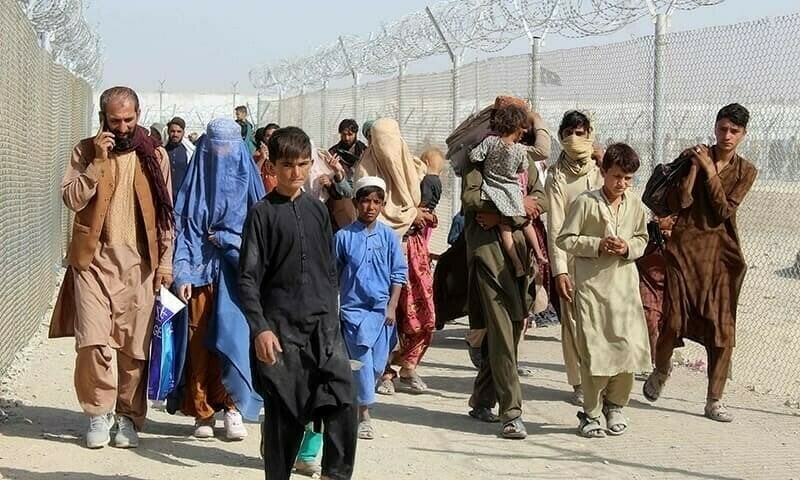
Header image: In this file photo, Afghan people walk inside a fenced corridor as they enter Pakistan at the Pakistan-Afghanistan border-crossing point in Chaman on August 25, following the Taliban’s stunning military takeover of Afghanistan. — AFP/File