

Sulala Animal Shelter has reached out to UN, Israeli government and other aid agencies but heard back from no one.
On December 3, almost three months after Israel began its relentless bombing of Gaza, two dogs defied all the odds and walked seven kilometers south of the besieged enclave to reunite with Saeed Al-Er, a man who has been their only family for the past several years.
One of these dogs was rescued years ago while the other was born at the Sulala Animal Shelter — the Gaza Strip’s first and only charity rescuing abandoned animals. Saeed, the founder, hopes more dogs will find their way to safety.
The 51-year-old Palestinian, who once provided a home to 400 dogs and 100 cats, has been forced to abandon his shelter and relocate to the south in recent months due to the ongoing Israeli offensive in Gaza. But even in adversity, Saeed is rescuing, feeding, and providing first aid to stray animals.
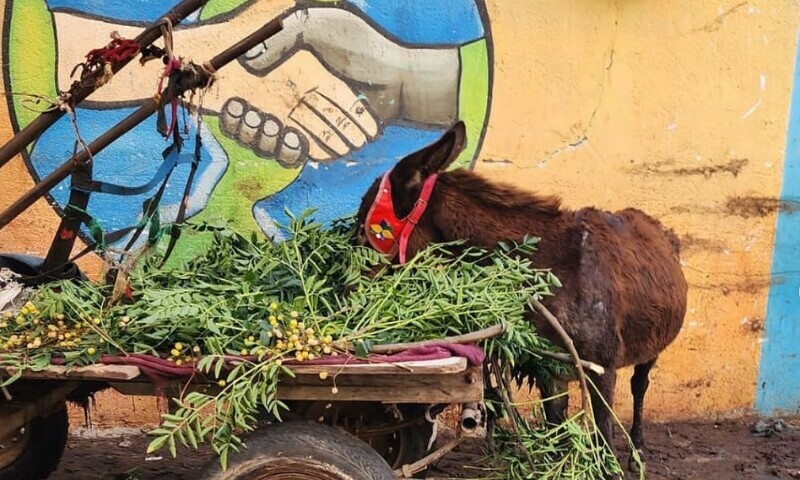
Currently, he is looking after over 120 cats, at least a dozen dogs, and even donkeys and horses. “Saeed calls it the ‘shelter for the displaced dogs’ because they share their fate of displacement with the humans,” Annelies Keuleers, a volunteer at the Sulala Animal Rescue, tells Dawn.com.
But it is now becoming increasingly difficult for Saeed to keep feeding stray animals in the enclave as he is running out of food, with just a week’s supply remaining. Due to the desperate situation, he has also had to stop handing out cat and dog food to residents with pets.
According to the shelter, animal food has not entered the besieged enclave since Oct 9.
“We managed to buy a very large quantity of food in the first days of the conflict and it’s now running out,” Keuleers said, adding that supplies at pet shops had also been exhausted.
“For the last few months, we have been distributing food to pet owners to help them, but since we will soon run out of food for animals in our own care, we were forced to stop,” she added.
Appeals for aid
In the past few days, Sulala has written to the United Nations several times pleading for aid. “But we have come to realise that it has no say in what goes in and out of Gaza,” Keuleers said.
“Israeli forces take the final decision regarding the aid entering the Strip.”
Sulala also reached out to Israel through interlocutors, she continued. “We haven’t reached out to the Israeli authorities directly, we have asked through an Israeli animal aid organisation,” the volunteer told Dawn.com.
Moreover, Saeed has also sought a permit from the Israeli military that would allow him to feed stray animals in the coastal enclave.
But the charity hasn’t heard back from Israel or any other aid agency yet. According to Keuleers, Animals Australia, Sulala’s donor organisation, has been mobilising rights groups for the delivery of aid into Gaza.
Keuleers added that an Egyptian organisation had sent two pallets of animal food and medicine packages to Rafah but there were thousands of trucks waiting to be inspected at the crossing, a process that takes weeks.
She said there were reports regarding the opening of the Kerem Shalom crossing on the Israeli side which has greater capacity than Rafah to let through aid trucks.
Sulala was also told that on the Israeli side, 60 bags of food had already been donated and were waiting to come through, Keuleers added.
How do rescue operations work in conflict zones
Four Paws — an international animal welfare organisation that has also worked for animals in the besieged strip previously — told Dawn.com that it was not able to provide any help for animals on site due to the unpredictability of the situation in Gaza.
It explained that rescue operations in conflict zones were an extensive and complex task that required a lot of preparation i.e. logistics, security, permits, and the safety of teams.
“We work with local authorities on the ground, and with safety and security experts that help us monitor developments on a daily basis, as well as evaluate potential partners on site,” Four Paws’ head of public relations said.
She elaborated that the decisions to conduct a mission in a conflict zone were taken and agreed upon by many different parties. “Based on many factors, a team entering a conflict zone has to consist of experts and people trained in navigating such challenging surroundings,” the spokesperson added.
Hurt and frustrated
Even as it slowly becomes difficult to see light in the darkness, Saeed hasn’t completely lost hope. During the week-long Israel-Hamas truce in November, he traveled to Gaza City in search of the dogs he had left behind at the shelter.
But deep down Saeed knew the dogs would have had spread out due to the unabated bombing. During the same visit, he also found out that his residential area had been targeted in recent days and reduced to rubble. His home, too, was no more in a livable condition.
“He has lost everything. He is seeing everything that he once dreamt of breaking down, which has left him frustrated and hurt,” said Kuleers, who has been in constant touch with Saeed.
“Every day, Saeed stands by the door of his apartment in the south and speaks to the dogs he left behind, hoping his message would reach them some way,” the volunteer said.
He apologises for not being able to rescue them in time and also assures them that their friends are safe with him. “I love you as much as the sea and fish” is a phrase Saeed often says, Keuleers revealed.
Saeed still believes in peace, she added. “Disappointed in the world, he thinks animals will be able to unite the world.”
Dawn.com was unable to talk to Saeed because he only has access to the internet for 10 minutes a day.
How to donate for Sulala
In its latest Instagram post, Sulala said donations can be made via PayPal and the Animals Australia urgent appeal, assuring that they would “100pc reach” the charity.
It said that even in the current situation, donations were welcome as they could be used to purchase whatever was available to make sure the animals survive.
“If your donation is not used now, it can be used after the conflict to rebuild. Of course, the urgency is with getting animal food in,” it said.
At the same time, Sulala said it was difficult to provide information regarding providing help because “it seems the whole world is powerless”.
“We need this war to end as soon as possible, so we can reach the wounded animals all over the Gaza Strip, rebuild, and return to our homes. The only thing we can say is: help put pressure on a ceasefire,” it added.