

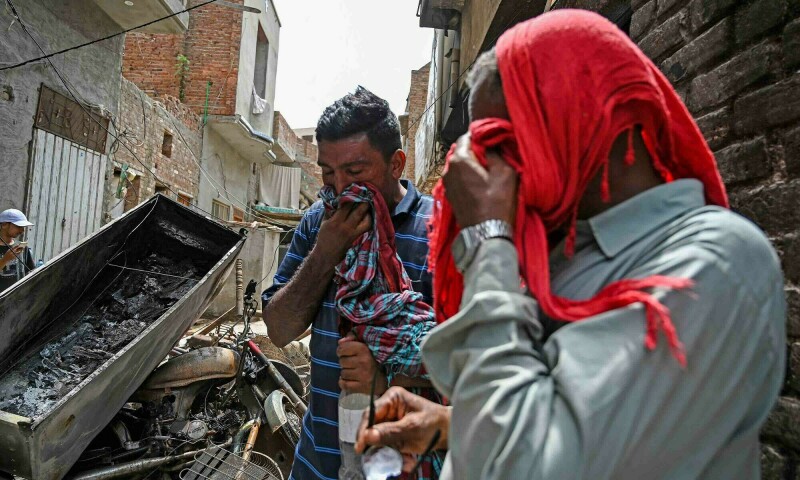
For Christians, no consolation or compensation can bring back what they have lost — dreams, jobs and even homes.
At an hour’s distance from Faisalabad, Saima Younas sits on the roof of her charred house near Cinema Chowk, coaxing her 12-year-old nephew to go to school. But Zaid is adamant not to return because the bullying hasn’t stopped since August 16 — the day Jaranwala burned.
“They look at me as if it was all my fault,” he says. “As soon as I walk into the classroom, all of them [the students] look at me with accusatory eyes, exchanging whispers. Even my best friend.”
Zaid is among dozens of Christian students living in the Jaranwala tehsil who have abruptly quit school in the last two months.
On August 16, a mob ransacked and torched nearly two dozen churches, and attacked the residences of members of the Christian community as well the office of the local assistant commissioner in Jaranwala.
As per police and local sources, the violence erupted after some locals alleged that several desecrated pages of the Holy Quran were found near a house at Cinema Chowk in Jaranwala, where two Christian brothers lived.
During the attack, 91 houses bore the brunt of violence, resulting in losses to the tune of Rs38.5 million, the district administration estimated. The list of items destroyed included fans, air-conditioners, water filter plants, generators, carpets, furniture, and other electrical appliances.
“It was a nightmare,” describes Saima, who witnessed the events unfold before her eyes. Unlike Saima though, her house, now charred and crumbling, bears trauma marks that she has since learned to hide.
“We first heard commotion from the streets at 6am. My brother went out to inspect, but he came back terrified and just uttered one word: ‘blasphemy’.”
“Announcements were made from mosques,” she recalled, “and even though I could not decipher everything said in the chaos, I distinctly remember hearing revenge.”
Within the next 30 minutes, Saima fled from her house with her brother, a widowed sister-in-law, and five nephews and nieces.
“We ran to a hospital my brother works at and begged them to transport us to our village in Naser Colony. They provided us an ambulance for Rs10,000 and took us to Faisalabad, where some of our distant relatives live,” she added.
Finding a new life
There are several families like Saima’s that fled Jaranwala that day. Some ran towards the fields while others sought refuge on the streets of unknown towns, scared but hoping to return to the comfort of their homes soon. They were, however, unaware that what awaited them in Jaranwala were mere structures, many charred beyond recognition.
“I had a two-storey house that we had just renovated last year … it was built from my entire life’s savings,” Saima told Dawn.com. “Now it is just soot.”
The 28-year-old’s house was among the several homes that were burned to rubble on Aug 16. “Along with it, all the items I had collected for my jahaiz (dowry), my parents’ last few memories, even my mobile phone — everything was reduced to ashes.”
Today, Saima continues to live in the one room of her house that surprisingly survived the storm. Its walls are as black as coal. On one side lay three huge sacks of cement and gravel while the other houses tents and charpoys.
The only standing washroom in the house recently caved in, after which Saima and her family now use bathrooms at the church nearby. “We use the streets for everyday washing, which includes doing the dishes and clothes.
“Our relatives have moved out. Some went to Lahore while others began a new life in Faisalabad,” she said. “But for me, everything begins here.”
Three months on, however, Saima is mulling on leaving Jaranwala and moving to Lahore permanently. The reason is not the black walls, broken water pipes, or a house that can barely stand.
Her nephew, the smartest in his grade, has refused to go to school and there is nothing his aunt could say that would change his mind. Initially, it was the fear of another Aug 16, another night of chaos, another storm. But eventually, Saima realised it was something else that was haunting Zaid.
“Every day, behind my back, I hear students saying ‘you deserve whatever happened’,” the 12-year-old boy told Dawn.com. He said he didn’t want to complain to his teacher or “create a scene”.
Police in Jaranwala have held several seminars with private schools in the tehsil to prevent what happened with Zaid and counsel students in trauma post Aug 16. According Jaranwala Senior Superintendent of Police Dr Muhammad Rizwan, these sessions resulted in the re-enrollment of a number of students who had quit school altogether. But for Saima, there is no going back now.
“What can we do? It is better to move. In Lahore, we will enroll Zaid in a new school and restart our lives,” she said.
Like her, several Christian families in Jaranwala are still engulfed in the fear and trauma of Aug 16. For them, no consolation or compensation can bring back what they have lost — dreams, jobs, and even homes.
Half-hearted compensation
Almost five days after Jaranwala burned, caretaker Prime Minister Anwaarul Haq Kakar visited the tehsil and distributed cheques worth Rs2 million among members of the Christian community whose homes were destroyed.
Shafique Masih, a resident of Christian Town, is one of the people who collected the cheques and like several others, he still hasn’t been able to cash it.
Shafique’s house too was burnt to the ground during the mob attack. The attackers had set fire to the upper portion of the house because of which the roof caved in, leaving behind debris and rubble. After spending the initial days in camps set up by the police, he now lives in a rented two-room house with his two children and wife.
Shafique’s family hasn’t had a good night’s sleep since Aug 16. “My children, six and 10, often wake up in the middle of the night, trembling with fear,” he told Dawn.com.
“The day we left our house is etched in our brains … and all we were able to secure was our jaan and izzat (life and honour),” he said.
Shafique recalled that during his visit to Jaranwala, the premier had distributed 42 cheques. “But every time I go to the bank to collect the money, they say there is a clearance issue,” he said, adding that he had filed several complaints with the government but no action was taken yet.
There is another problem with the compensation process. Cheques, Shafique explained, were given to the heads of the families and not individuals. “Here, four to five families — comprising a total of 25-35 people on average— live in each house. How will Rs2 million be sufficient for all of them?”
Saima concurred. She said her uncle had received the cheque and now refuses to give money to her family. “Neither does he want to renovate our burnt house. We are left to fend for ourselves.”
For his part, SP Rizwan told Dawn.com that the senior members of the Christian community had taken up the issue with the government and negotiations were under way.
Stuck in limbo
Apart from compensation cheques, the government had also decided to take over the responsibility of renovating churches, but that task too, residents say, is stuck in limbo.
According to Father Khalid Mukhtiar, a total of 26 churches, including five pastors’ houses, were ransacked on Aug 16. The attackers had left behind shattered windows, mauled deities, and burnt holy books. Even the furniture inside the churches was dragged out into the streets and set ablaze.
According to Faisalabad’s district administration, the churches suffered damages of approximately Rs29.1 million. SSP Rizwan told Dawn.com that four of the damaged churches have been reconstructed while as many are under construction.
However, Mukhtar said only 70 per cent of the work has been completed. “There were six contractors hired for the renovation, but in the last few days they have halted the construction due to a break in funding,” he said, adding that some churches had been opened while others were still closed.
On the other hand, an application for the renovation of pastors’ houses has also been submitted to the administration, but cheques have not yet been issued.
For Christians in Jaranwala, churches are not only just houses of worship but, more importantly, also communal spaces — a place where they experience the rare emotions of safety, brotherhood, and friendship. “This is why it feels like the attack was aimed at tearing us apart,” said Saima.
“When I think about it, the day I saw what the mob did […] the visuals are fresh in my mind and every time I remember them, they bring tears to my eyes,” she told Dawn.com.
She can’t help but question why someone would do that to them. How can someone have so much hate in their heart? Could they go to this extent to punish those who hadn’t even committed the crime in the first place? All these questions plague her, but never has she dared say this out loud, fearful of the repercussions.
“But I know one thing for sure … whoever did this, whoever, they can’t be believers of any religion. Because no religion in the world allows this,” she added.
Hurdles in prosecution
A day after the Jaranwala incident, the Punjab government claimed to have arrested two prime accused. Meanwhile, 1,470 other people were booked for the attacks, out of which several suspects were arrested.
SSP Rizwan confirmed to Dawn.com that 330 people are currently either under arrest or being investigated in connection with the case. Many of these suspects are on judicial remand, others are in police custody and some have managed to get bail.
The arrests were made on the basis of 22 first information reports — five registered by the police and the remaining lodged by Jaranwala residents and members of the Christian community.
However, in the past few days, a number of Christians have withdrawn their complaints after they were allegedly threatened by the families of the accused. “Several people in the community are being pressured to take back the charges, some gave in while others have refused to withdraw the case,” Father Mukhtar said.
In other cases, complainants managed to reach an agreement with the opposing party.
On the other hand, Shafique Masih told Dawn.com that a number of suspects had managed to get bail. “These are people who can be seen in videos of the mob filmed on Aug 16,” he lamented, adding that this was particularly the case in FIRs registered by the police.
For his part, SSP Rizwan agreed that cases had been withdrawn. “Initially, people refused to identify the suspects out of fear and submitted affidavits pertaining to the same, creating hurdles in the prosecution process.”
Consequently, he continued, the police had arranged a press conference in the area in which investigating officers, bishops, and locals were called. “Christian lawyers were also taken on board and the complainants/witnesses were assured of police compliance and safety,” the officer said.
Separately, the government has also set up ‘Meesak centres’ in the area where people from minority communities may register their grievances. “All of these measures were taken to prevent any resentment among the Christians,” Rizwan said.
He added that a complaint cell and a WhatsApp helpline have been established at the Jaranwala police office to address issues related to the August 16 incident for redressal of grievances.
Moreover, interfaith harmony meetings between Ulema of all sects and Christian religious leaders to alleviate any misunderstandings and initiate confidence-building measures were also held. Some of these meetings were chaired by Regional Police Officer Dr Abid Khan, who was stationed in Jaranwala for several days after the incident. The SSP added that even the provincial police chief, IGP Dr Usman Anwar, visited several churches and homes vandalised by the mob, where he met various stakeholders and affectees and assured them that their grievances would be addressed.
At least 1,200 police officials are now deployed in the Jaranwala tehsil at all times — a measure that is both a sigh of relief and a grim reminder for its residents.
Investigation status
While the police claim to have arrested the prime suspect in the case, several twists and turns have come forth during the two-month-long investigation.
Nearly two weeks after the incident, the Punjab police had claimed that the blasphemy case in Jaranwala was linked to an enemy country’s spy agency, adding that they had successfully eliminated the network behind the nefarious designs.
However, in September, one of the arrested suspects told the police that he hired a hitman, Allah Ditta Maseeh, and provided him with money and a motorcycle to eliminate his opponent, the main accused in the desecration incident.
When Ditta’s attempt to murder the target failed, the suspect devised a plan involving the desecration of the Quran to frame his opponent. Ditta was subsequently arrested.
Both versions have been rejected by Minorities Alliance Pakistan chief Akmal Bhatti, who says the Christian community has no hope of justice from the police due to its defective and biased approach.
On the other hand, the Human Rights Commission of Pakistan (HRCP), in a fact-finding report released in August, suspected that the Jaranwala rioters were not a “spontaneous or random crowd”, but part of a “larger campaign of hatred against local Christians”.
It stated that the commission’s inspection of the mob site pointed towards “planned arson and deliberate desecration of religious symbols”.
Talking to Dawn.com, SSP Rizwan said 90 per cent of desecration cases reported were usually false. “But in this case, we can confirm that desecration took place … they [the suspects] wanted to settle the score with a fellow Christian,” said the officer.
“Some 12 to 15 people knew about it beforehand. The Inter-Services Intelligence (ISI) and Counter Terrorism Department (CTD) are working on this angle,” he said.
SSP Rizwan further stated that the desecration was “deliberately” done in front of the houses of Tehreek-i-Labbaik Pakistan and Jamaat Ahle Sunnat leaders.
“Nearly 50 Whatsapp groups of Muslim religious parties were pre-prepared and photos of the desecration were shared within seconds,” he said, recalling that people affiliated with the aforementioned political parties gathered in Jaranwala for the mob attack.
“It is fortunate that the police prevented casualties and injuries … I have seen incidents where people have been killed or set ablaze in such cases,” Rizwan said.
However, he raised a very important question. “Why don’t our intelligence agencies monitor religious parties that are known to be violent? Why is there no scrutiny?”
Every time such an incident occurs, it is always the police that is blamed. The police do have a huge role here, but it is the CTD and the Federal Investigation Agency that are responsible for vigilance.
“There is a disconnect between the agencies and the people, and integration efforts are needed to bridge these gaps for a better tomorrow,” SSP Rizwan added.