

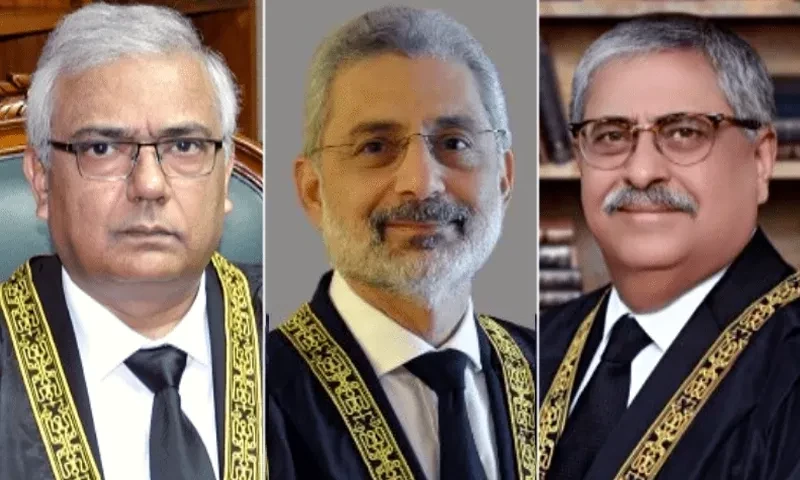
Referring to former Pemra chief Absar Alam’s statement on “media coercion” during the 2017 Faizabad sit-in, Chief Justice Pakistan (CJP) Qazi Faez Isa on Wednesday observed that all institutions, including the Election Commission of Pakistan (ECP), were not independent.
He also rejected the government’s recently formed fact-finding committee responsible for compliance with directions included in the Supreme Court’s Feb 6, 2019 judgement in the Faizabad dharna case.
The development comes as a three-member Supreme Court bench resumed hearing a set of review petitions against the 2019 verdict. The panel also included Justice Aminuddin Khan and Justice Athar Minallah.
Authored by Justice Isa years before he took oath as the chief justice of Pakistan (CJP), the searing judgement had instructed the defence ministry and the tri-services chiefs to penalise personnel under their command who were found to have violated their oath.
It had also directed the federal government to monitor those advocating hate, extremism and terrorism and prosecute them in accordance with the law.
Adverse observations were also made against several government departments for causing inconvenience to the public as the 20-day sit-in paralysed life in both Islamabad and Rawalpindi.
Pleas were subsequently moved against the verdict by the Ministry of Defence, the Intelligence Bureau, the PTI, Pemra, the Election Commission of Pakistan (ECP), the Muttahida Qaumi Movement (MQM), Rashid and Ijazul Haq.
However, most of the petitioners — including the government, IB, Pemra and PTI — withdrew their pleas at the previous hearing on Sept 28, prompting the CJP to ask “why is everyone so afraid to speak the truth”.
Last week, the federal government informed the SC that it had constituted a three-member special fact-finding committee to ensure compliance with directions included in the 2019 judgement.
The committee — comprising additional secretaries of the ministries of defence, interior and the Inter-Services Intelligence (ISI) — held its first meeting on Oct 26 and expects to furnish its final report to the defence ministry by Dec 1.
A day earlier, a former Pemra chairman submitted alleged in a concise statement that he received calls from the then ISI Director General Major General Faiz Hamid and his subordinates, who asked him to take action against senior journalist Najam Sethi and completely black out former ambassador Husain Haqqani from TV channels, though these demands were never heeded.
Absar Alam also claimed that Gen Faiz and/or his subordinates controlled the policies of TV channels through unlawful means by changing their numbers and moving them to the tail end of cable networks, if they refused to follow the instructions.
The hearing
At the outset of the hearing today, Attorney General for Pakistan (AGP) Mansoor Usman Awan read out the order of the previous hearing.
Subsequently, the top judge asked if Absar Alam was present in court. “We were told that he is on the way,” AGP Awan replied.
CJP Isa noted that the former Pemra chairman had levelled “serious allegations” on the defence ministry and inquired if the government still wanted to withdraw its review petition.
“If Absar Alam’s accusations are true, then this matter is linked to you,” he told the AGP.
For his part, Awan said a fact-finding committee had been constituted on Oct 19 and then read out the notification regarding the same. On Justice Isa’s question regarding who the committee would report to, the AGP said it would submit the findings to the defence ministry.
“The report will then be presented in the SC,” he added.
However, the chief justice highlighted that the exercise was an “eyewash” and the “real thing” was missing from it. “When everyone is withdrawing their review petitions, the terms of reference of the committee are synonymous to dust in the eyes.”
At one point, Justice Minallah asked whether what was happening in the country today was as per the Constitution while CJP Isa said the government was not qualified to handle the matter.
“A person is imported from abroad and paralyses the entire country,” the top judge remarked.
He further stated that the court wanted to know who was the mastermind of the Faizabad dharna. “You have broadened the TORs so much that everyone will be acquitted,” Justice Isa said, lamenting that losses in billions were incurred but the government does not care.
He also highlighted that the TORS of the fact-finding committee did not mention the exact incident being probed. “Our job is to order and your job is to implement,” the chief justice said.
Meanwhile, Justice Minallah asked who had constituted the committee to which the AGP replied that the federal government had formed it.
“Was the approval of the federal cabinet taken? Was this committee formed under the Inquiry Commission Act?” the judge asked. Here, Justice Isa said that if this was not so, then the notification of the commission was a mere piece of paper.
“This committee too is illegal,” the CJP stated and then proceeded to ask why the inquiry was not conducted under the Inquiry Commission Act. “Let’s suppose that the committee summons Absar Alam but he doesn’t show up. What will you do then?” he asked.
A committee formed under the Inquiry Commission Act has powers and all institutions are bound to cooperate with it, the chief justice pointed out. “No one will appear before your committee,” he told the AGP.
At that, Awan assured the court that the government would work on the matter.
Justice Minallah emphasised that the supremacy of the Constitution must be ensured at any cost. CJP Isa remarked that when one person gets affected, it makes others mindful of the consequences of doing something wrong.
The chief justice further stressed that the inquiry should also reveal why everyone appealed the 2019 verdict.
“You have an opportunity to get the inquiry done from a person who respects the Constitution,” Justice Minallah said while Justice Isa said it was up to the government to choose whoever they wanted to conduct the probe.
“As per Absar Alam’s statement, all institutions, including the Election Commission of Pakistan (ECP), are not independent,” the CJP said.
Subsequently, the court summoned incumbent Pemra chief Saleem Baig over Alam’s note.
The petitions
The IB’s review petition had urged the court to set aside the adverse observations made against the department, adding that it was a premier civilian intelligence agency which was responsible for state security.
It had contended that the impugned order created a “bad impression” on the public that the IB was involved in unlawful activities and politics, after transgressing constitutional boundaries.
It had said the observations made in the verdict were based on “vague facts” and that during the sit-in, the department was in close contact with the federal and Punjab governments and forewarned them about the plans and intentions of the TLP, with a view to foiling their attempt to storm/lockdown Islamabad.
Meanwhile, In response, the defence ministry had requested the court to set aside the explicit or implicit observations about the armed forces and/or the Inter-Services Intelligence (ISI).
The ministry’s petition had said that a host of factors may affect morale. However, it said, what was fatal was the belief amongst the rank and file that their officers while acting like “self-proclaimed saviours” were violating the fundamental rights of citizens and instead of serving “Pakistan and thus all its citizens”, supporting a “particular political party, faction or politician”.
“…When the source of such remarks is the highest court in the land, it can promote fissiparous tendencies and has the capacity to destroy the ability of the armed forces to act as a cohesive fighting force,” the review petition had argued.
It had further said there was no evidence before the court to suggest that the armed forces or ISI were, in any manner, involved with either the sit-in or a particular outcome of the general elections of 2018 or the abridgement of free speech or intimidation or censorship of the press.
In its petition, the ECP had contended that it had comprehensively applied and enforced the Constitution, law and code of conduct by issuing a letter to the TLP on Aug 16, 2017, asking the party to provide details of its bank account and even had issued notices to it with a warning to cancel its registration.
Meanwhile, the PTI had questioned the mention in the verdict of the 2014 joint sit-in organised by it and the Pakistan Awami Tehreek in Islamabad, and had said the impression one gets from it was that the party conducted an illegal protest for publicity and deliberately made wrong allegations.
The petition contended that the party had nothing to do with the TLP Faizabad sit-in and therefore the remarks should be expunged.
Rashid had approached the court to remove his name from the judgement. In his petition, the AML chief pleaded that if the words concerning him in para-4 of the judgement were not expunged, he would suffer adversely in his life.
Faizabad sit-in
Daily life in Islamabad was disrupted for 20 days (from Oct 2 to Nov 27, 2017) when protesters belonging to religiopolitical parties occupied the Faizabad Interchange which connects Rawalpindi and Islamabad through the Islamabad Expressway and Murree Road, both of which are the busiest roads in the twin cities.
The agitators claimed that during the passage of the Elections Act 2017, the Khatm-i-Nabuwwat oath was deliberately modified as part of a larger conspiracy. The amendment to the oath was deemed a “clerical error” by the government and was subsequently rectified through an act of Parliament.
The government had attempted to negotiate in vain with the protesters to end the sit-in several times. Finally, it launched an operation to disperse the protesters, in which at least six people were killed and scores others injured. After the botched operation, the government decided to call in the army for help.
Negotiations were undertaken with protesters once again, and the government accepted a number of their demands in return for ending the protest. The agreement document bears the signatures of then interior minister Ahsan Iqbal, TLP chief Khadim Hussain Rizvi, and Gen Faiz Hameed, who was a major general at the time, among others.
More to follow