
Lubna says seeing women running businesses has created a change. Her daughter looks up to her and says she wants to run a shop as well after finishing her education.
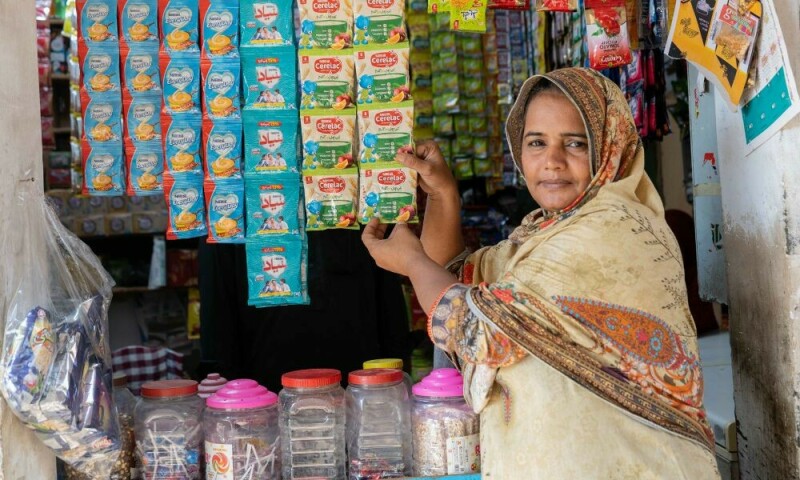
In a small town some two hours away from Lahore, Yasmin Bibi proudly welcomed us to her shop in Renala Khurd right outside her home. The business owner was accompanied by her husband, Asif, who she says has supported her throughout her career.
This is not how it has always been. With few options available, she started her retail business many years ago selling candy on a charpoy. In 2019, she expanded her merchandise to include other household products. She has never looked back since.
“Today my children are able to go to school, we are able to eat well,” she said.
In 2019, Yasmin Bibi was approached by Nestle under the Nestle BISP Rural Women Sales programme. The programme was initiated in 2017 in partnership with the Benazir Income Support Programme (BISP), a national safety net system, among the largest of its kind in South Asia, that aims to uplift women out of poverty. The programme falls under Nestle’s larger ‘rural deep outreach’ project.
BISP is a federal cash transfer programme that provides women with a quarterly stipend — currently at Rs8750. BISP also acquires the largest national database on the economic conditions of women across Pakistan. It is this database that Nestle uses to determine and recruit potential areas and sales agents.
Goodwill or profit?
Nestle claims that the main premise of the programme is to uplift the rural women of Pakistan and put them on the path to prosperity.
With 375 beneficiaries in Renala alone, where the project was first piloted in 2017 and almost 3,000 across 26 districts in Pakistan, the project has been largely successful in achieving what it had set out to. It has since expanded to 26 districts across Pakistan, most recently Larkana and Sukkur.
According to Sheikh Waqar Ahmad, Head of Corporate Affairs & Sustainability at Nestle Pakistan, “We now plan to cover BISP beneficiaries in the rural belt of Hyderabad district with an ambition to reach 5,000 women nationwide by 2025.”
“Rural women play a key role in achieving sustainable development and contribute significantly to the economy,” he added.
But this may prompt one to think: is this an opportunity to create sales, market products and establish Nestle’s presence in areas that have previously been left out of the global corporate establishment’s reach, or a genuine effort to lend women a hand out of poverty?
Perhaps both, perhaps one more than the other depending on whom you ask.
Rahat Hussain, a spokesperson for Nestle Pakistan, said: “This programme is part of our creating shared value efforts where we as an organisation want to be a force for good.”
Of course, ‘good’ under corporations comes with strings attached, and in this case, the good is directly proportional to the number of sales earned by the corporation. However, under the programme, Nestle BISP sales agents earn a higher profit margin than their regular counterparts — 8-12 per cent compared to the regular 4pc. Trickling down, participants of the programme earn an average incremental income of around Rs5,000 to Rs10,000.
The principle of ‘creating shared value’ (CSV) is an emerging and increasingly popular one among corporations. It is driven from the perspective that profit and social good need not be mutually exclusive. It takes a step away from the idea that corporations must think of social good and sustainability as an afterthought to redeem them of the impact they have on society, and incorporates these values within the business model. Thus, with increasing their own sales and profits, corporations aim to also benefit other stakeholders along the way.
Nestle USA writes, “In the past, corporate investment in community and environmental initiatives were often seen as ‘obligations’ or simply philanthropy: added costs that had to be borne to minimise operational risks and protect reputation. CSV redefines many of these obligations as opportunities to strengthen the business long-term — adding value for shareholders and our stakeholders.”
According to Adnan Mushtaq, Nestle’s Rural Deep Reach project manager, “This project is purely operating from a CSV angle.”
“Rural sales account for only about 1pc of all Nestle sales in Pakistan,” said Mushtaq. (Dawn.com has not been able to verify the sales statistics).
“We also do not bring in our regular micro-distributors into these areas because we want to help develop the capacity of the BISP beneficiaries. And we give them higher profit margins for this reason,” he explained.
However, from Rs1m in its pilot year, annual sales from Nestle BISP sales agents have increased to Rs169m today.
Similar models have been adopted by multinational companies worldwide and in South Asia. A prime example is Unilever’s Shakti Amma project in India from 2010, which also targeted women from villages and rural areas. Today, there are 160,000 Shakti Ammas in India who serve as micro-entrepreneurs and sales agents for the corporation. It has been replicated in countries across the developing world, with our own local variation called the ‘Guddu Baji’ project.
Let’s break down how the project exactly works.
How does it work?
Within the outlined towns and villages, Nestle representatives shortlist women who have the potential to become sales agents. Many, like Yasmin Bibi, already have some experience with sales, or there are women who themselves or whose families run small shops. While there is no scientific criteria, things to look out for include socio-cultural factors, such as families’ permission, community participation, work background, sales potential etc.
In Renala, Abida Tabassum works as the rural territory executive for sales. She is among the key persons guiding the participants through the process — from recruitment to sales.
Tabassum explained that sometimes, conversations with families make a big difference in removing hesitations and addressing any questions they may have.
The shortlisted sales agents then buy stock from Nestle depending on their purchasing power. In lower-income neighbourhoods, products are mainly sold in sachets, keeping price points and affordability in consideration.
The key products that are targeted for this programme are Everday (tea whitener), Bunyad (powdered milk), and Cerelac. The latter two are mainly products for children to provide nutritious food and supplements. On average, Tabassum said that women are able to buy stock of up to Rs 2,500.
The beneficiaries are then trained on pricing and best sales practices. A crucial aspect of the programme is training the sales agents on nutrition awareness and demand generation for the products within their communities. Additionally, Nestle also organises awareness sessions on nutrition for mothers and residents. Tabassum explained that in areas where these sessions have been conducted, demand for Nestle Bunyad and Cerelac has gone up significantly.
Sajida Jafar, a micro-entrepreneur from Renala who sold vegetables and other items on a cart, would ask customers if they had children at home and would advise them to buy “Cerelac or the iron-rich Bunyad for deficient children”.
Sales agents fall under three categories under the programme. The first are micro-distributors. Microdistribution is a sales category that mainly serves rural areas that are difficult to reach with existing distribution channels. Micro-distributors serve as the connection between companies and retailers by providing stock to multiple retailers in an area. Nestle micro-distributors earn a 3 per cent profit on the stock they sell.
The second category is the retailers or shop owners. Under the Nestle BISP programme, retailers earn a larger profit margin compared to regular retailers.
Under the third category fall the door-to-door sales agents, or women who buy stock and sell it from their homes. Many micro-distributors also do both — sell to other retailers and sell products directly to the consumer — the latter allows them to earn a higher cumulative profit. Sajida bibi is one such entrepreneur. She runs her own shop and distributes products to 12 other stores in her area.
Mushtaq estimates that of the current 3,000 beneficiaries, 40-50pc are shop owners while the remainder are door-door-sales agents or micro-distributors.
Akhuwat microfinance loans
Nestle has also partnered with Akhuwat, a non-profit organisation that provides interest-free microfinance loans. Through this partnership, beneficiaries looking to upscale or start their businesses are provided with loans averaging Rs15,000 to buy Nestle stock.
Mushtaq explained that Nestle provided Akhuwat with Rs2 million to redistribute as loans. “Since this is not an area we have expertise in, we took Akhuwat on board,” he said.
“Akhuwat has strict standards and mechanisms to provide loans and their recovery rate is exceptional. During our project, we have not had a single case where a beneficiary has defaulted on her loan.”
Akhuwat runs background checks, such as determining the ability to repay loans or whether the beneficiary or their family owes loans to other people or organisations.
“We recommend people for loans but the selection is an entirely independent process. We do not interfere with it,” said Mushtaq. So far, 250 participants have taken loans from Akhuwat while about 750 applicants have been rejected.
Towards better lives
For Yasmin Bibi, the biggest blessing to come out of her financial stability is that her children are now able to go to school. The journey, however, has not been easy. Her husband, Asif who stood next to her, joked, “If we start telling you about the challenges, you won’t be able to listen”.
He pointed towards his now-cemented home adjoining the shop and said, “We did not have a roof over our head or four walls around us. Our family had separated us from our home. We had a makeshift roof made of bamboo. We started selling candies and that is when appi Nasreen (Abida’s predecessor) came to us.”
“We were very poor. I thank Allah for giving us a livelihood.”
A year after enrolling in the programme, Yasmin also began placing other products in her shop. Today, her shop makes sales of about Rs60,000, a large percentage of which are Nestle sales. With her daughter’s wedding coming up, she has also added freshly cooked samosas and pakoras to her shop to gain extra income.
She proudly ushered her way inside to show her currently under-construction home. “We are making renovations here,” she said.
And yet, the programme has not been as transformative for all. For some, it has given a nominal increase in their monthly income at best.
Asiya* from Renala now owns three shops. Her husband started the business when he was diagnosed with an illness and had to leave his job in a factory. Her shop was already running well and for her, Nestle profits amount to a mere Rs1,000-1,500, including sales from the relatively higher-in-demand fruit juices.
“People from the village prefer fresh milk, they have cows in their homes,” she said, explaining that Everyday does not have a huge demand in her area.
“The earnings I get from Nestle are much less compared to other, local products such as fruit, paapar, vegetables, which have higher profit margins,” she explained.
Sajida Bibi, on the other hand, recounted her journey from where she began. “Before this, there was only poverty. My husband was diagnosed with a heart condition and was unable to work. All our savings went towards his treatment. My children were unable to go to school. My eldest daughter had to miss out on two years of her schooling. Even our relatives stopped visiting us because they thought ‘they are just going to ask for money’.”
Sajida decided to take matters into her own hands and began selling products on her husband’s cart. This is when Nestle approached her. “They told me, ‘buy these products from us. God will give you barakah’. At first, I only bought one string each of Everyday, Bunyad and Cerelac.”
Her sales gradually grew higher and today she owns a store and distributes stock to the other shops in her area. Her children are back in school and her daughter has started ninth grade.
Lubna Mushtaq had a similar story. Hailing from Chak 5 in Okara, her husband too was unable to work due to an illness. Nestle approached her and sold a small amount of products to her. She proudly said: “Today I have boxed products as well [not just strings of sachets]. I am able to make sales of up to Rs60,000 of which I get about a Rs6,000 profit from Nestle alone. I also have other products and fruits and vegetables at my shop. I provide stock to other shops in the area too with my son on our donkey cart.”
“I have also employed a shopkeeper to look after the store. My shop is still running while I am here,” she smiled.
“We are in a much better position than we were before. My husband is happy too. My kids are doing much better. I am doing much better.”
While Nestle sales alone have not been sufficient to run a household for many, the programme has allowed women to set up and upscale their businesses by adding more products with time, or for others such as door-to-door sales agents, it has been a source of supplementary income to support their households.
Challenges and support
In a male-dominated society, women running businesses, especially a business that requires going outside the home or interacting with other people — particularly other men — has raised eyebrows. But the support has been greater.
Lubna Bibi recounted the words she would sometimes have to hear: “yeh kya tum mardon mein jaati ho, mardon mein meeting karti ho.” [What is this going out among men and meeting with men?].
“‘Officers come and you to go to shops with them’ they’d say. But my husband would say, ‘it’s okay. I have given her permission myself to go. We have to work, we can’t stay hungry’.”
“It’s not like anyone else is going to take care of us. Fine, if anyone wants to give us money, we won’t do this,” said Lubna.
Lubna said seeing women running businesses has made a change. Her daughter looks up to her and wants to run a shop as well after finishing her education.
Sajida too has been on the receiving end of unkind comments. “People say, ‘yeh kya drama kar rahi hai?’ [What is this drama?] Some people don’t even let the women in their families meet me out of fear that they might want to do the same or might learn something from me.
“Others are more supportive. They say it is good that I am earning and supporting my children.”
In a lesser-common example, Salma Bibi from Renala Khurd, inherited the business from her in-laws. Her mother-in-law had been running a small store on the ground floor of her home along with her husband since 1985. When her mother-in-law got injured and could not work anymore, Salma Bibi and her husband took over.
A few years ago, Nestle approached her: “Abija baji came to us and explained the programme to us very nicely. We then started selling Nestle Bunyad and their other products.”
“We also run a milk business. But Everyday is still quite popular. We ourselves use Everday for tea at home.”
“Since we kept Nestle products, our sales increased quite a bit and we are doing much better now, Alhamdulillah. I have six daughters and all of them are studying,” she said.
Salma Bibi is also one of the beneficiaries who secured a loan from Akhuwat to upscale her business. “When they saw our shop and how well it is doing, they gave us a loan of Rs40,000,” she said.
People around her too have criticised her for running a business. Her husband, however, has remained a source of great support. “Even today, when I had to come here with Abida baji, he said go. Whenever Abida baji calls you, you should definitely go,” she said, with great admiration towards Abida.
Lubna chimed in, “Other than the sales, this has given us great confidence and self-esteem. We are able to answer and interact with people confidently.”
Empowered women empower women
Although the number of female entrepreneurs is quite limited as compared to their male counterparts, becoming financially able has allowed women to become stronger, productive members of the community, countering stereotypes and persisting through challenges.
It has given young girls the ability to dream bigger, to think that they too can be entrepreneurs and take up roles traditionally reserved for men.
Importantly, this has given women the ability to be in positions where they are able to help and uplift other women.
Sajida pointed to a young woman in a black chaadar. “Her husband has recently left his job. She has three kids. I told her, take some stock from me, you can pay me back later. Just take it with you and try to sell it,” said Sajida.
Even though the woman lives only two streets down from Sajida’s shop (and her home), she encouraged her to start and told her she would help her along the way.
Within the ambits of capitalist development, the project seems to be achieving what it is set out to. It is creating shared value for both, the corporation itself while also generating income and livelihoods for rural women. As a result, women have been able to not only become self-sufficient but also decision-makers and active members of their communities while setting examples for young girls.
*The beneficiary’s name has been changed for anonymity.
Header image: Yasmin bibi showing the products available in her store. — Photo courtesy: Nestle Pakistan