

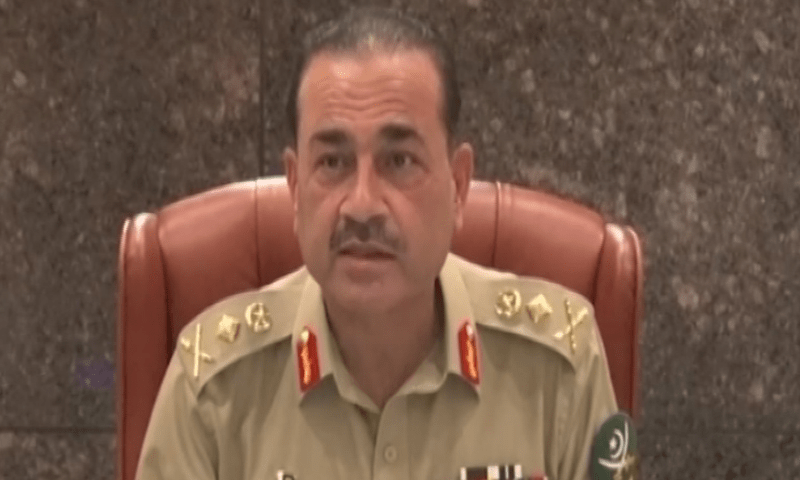
The military’s top brass resolved on Thursday to “wholeheartedly” assist the government in curbing all illegal activities that hamper economic growth, stability and investor confidence.
The resolve was expressed during the 259th Corps Commanders’ Conference at the General Headquarters (GHQ) in Rawalpindi, where the military leadership’s “full support” for ongoing efforts for socioeconomic growth under the umbrella of the Special Investment Facilitation Council was also reiterated, according to a statement issued by the military’s media affairs wing.
“The need for the speedy development of the economic potential of newly merged districts (NMDs) and border districts of Balochistan for sustainable peace and growth was also emphasised,” the Inter-Services Public Relations statement said.
It comes less than a week after Chief of Army Staff (COAS) General Asim Munir — who also presided over today’s meeting at GHQ — assured the business community on Sunday of fostering transparency in dollar exchange and interbank rates.
“The money exchanges would be brought under the purview of taxation, fostering transparency in dollar exchange and interbank rates,” the COAS said while talking to the business community at a meeting held at the Lahore Corps headquarters.
He had also highlighted the pivotal role of the Special Investment Facilitation Council (SIFC), emphasising its potential to attract substantial investments of up to 100 billion dollars from countries such as Saudi Arabia, the UAE, Kuwait, and others. To bolster economic decision-making, he revealed the formation of task forces focused on economic matters and different sectors.
The COAS’ statement had come as the country faltered on the economic front, with the rupee falling sharply against the dollar.
The trend, however, reversed in the interbank market on Wednesday, as a crackdown on the informal currency market started to help the gap between the interbank and open-market rates edge closer to the International Monetary Fund’s (IMF) target of 1.25 per cent.
Meanwhile, the State Bank of Pakistan also stepped up supervision of the foreign exchange market, ordering banks to set up separate entities to conduct forex transactions and extending a clampdown on hard-currency hoarders and smugglers. The central bank decided to introduce structural reforms in the exchange companies’ sector to provide “better services to the general public and bring transparency and competitiveness”.
Subsequently, a Dawn report said today that inside sources from the financial sector had indicated that authorities have tightened their grip on exchange companies, relentlessly pursuing illegal currency merchants across the country.
Pledge or defend country’s sovereignty
Besides, pledging support for economic growth, the military leadership also resolved today to defend the sovereignty and territorial integrity of Pakistan against “all kinds of direct and indirect threats”, the ISPR statement said.
“The forum reaffirmed that inimical propagandists’ desperate attempts to cause a wedge between the state institutions and the public are indicative of their mounting desperation and will only result in more humiliation of such elements, Inshallah (God willing),” it added.
The statement further said that participants of the conference were briefed on the prevalent geo-strategic environment, challenges to national security and their own strategy in response to evolving threats.
“The forum resolved that all terrorists, their facilitators and abettors, working on the behest of hostile forces to destabilise Pakistan will be dealt with the full might of the state,” it said.
For his part, COAS Munir stressed on maintaining high standards of professionalism and motivation during operations and achieving excellence during the training of the formations.
He commended the commanders for their constant focus on the wellbeing of their soldiers and maintenance of morale, which he said constituted the foundation of the army’s operational readiness.
During the meeting, the statement said, rich tribute were paid to “supreme sacrifices” of shuhada (martyrs), including officers and men of the armed forces, law enforcement agencies and citizens who laid their lives for the safety, security and territorial integrity of the country.
Fateha was offered for the martyrs and it was reiterated that the state of Pakistan and its armed forces would continue to hold martyrs and their families in the highest esteem, ever honouring them with utmost respect and dignity.
Moreover, the forums appreciated the commemoration of Defence and Martyrs Day on September 6 “across the country by all segments of the society … for which the armed forces of Pakistan remain ever thankful to our proud nation”.