

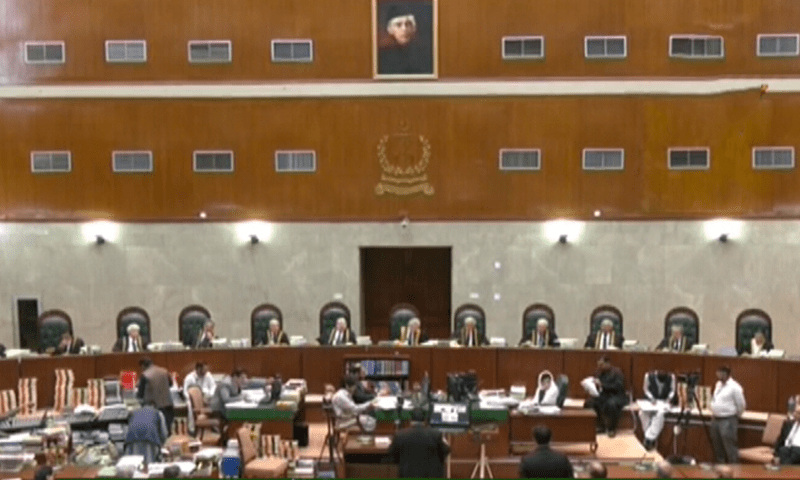
As the Supreme Court heard on Tuesday petitions challenging a law that would curtail the top judge’s powers, Chief Justice of Pakistan Qazi Faez Isa asked his fellow judges to allow lawyers to complete their arguments before questioning them after the counsels were repeatedly interrupted by the judges.
The remark came as a 15-judge full court heard nine challenges to the Supreme Court (Practice & Procedure) Act, 2023, which is being streamed live on television.
Headed by CJP Isa the bench consists Justice Sardar Tariq Masood, Justice Ijazul Ahsan, Justice Syed Mansoor Ali Shah, Justice Munib Akhtar, Justice Yahya Afridi, Justice Aminuddin Khan, Justice Sayyed Mazahar Ali Akbar Naqvi, Justice Jamal Khan Mandokhel, Justice Muhammad Ali Mazhar, Justice Ayesha A. Malik, Justice Athar Minallah, Justice Syed Hasan Azhar Rizvi, Justice Shahid Waheed and Justice Musarrat Hilali.
The Supreme Court (Practice & Procedure) Act, 2023, would require a committee of three senior judges to form benches for constitutional matters of public importance and suo motu notices, among other amendments.
The law, which was passed by parliament in April, has been seen by the petitioners as an attempt by the government to curtail the chief justice’s powers.
In April, the Supreme Court, then led by former chief justice Umar Ata Bandial, barred the government from implementing the law until the petitions challenging it were decided.
At the previous hearing, Chief Justice Isa observed that Parliament must not be hampered from doing something good merely because it lacks two-thirds majority.
In the hearing before that, he questioned the many legal challenges to parliament’s legislative authority, noting that there had been much criticism of laws enacted by assemblies, but in the face of martial laws imposed in the country, there was always a complete surrender.
Justice Isa had intended to wrap up the case the same day, but it was adjourned till Tuesday due to time constraints.
Today’s hearing
As the hearing began, MQM-P’s lawyer Faisal Siddiqui argued that the petitions should be dismissed on merit.
Siddiqui said he would not raise the question of admissibility of the applications, but discuss two judgments cited by the petitioners.
During the hearing, the chief justice asked his fellow judges to allow the counsel to complete his arguments after Justice Munib Akhtar questioned Siddiqui in the middle of his argument.
“I think counsel is entitled to argue any which way they want to. Let us hear you. I have to hear you to decide what you say and if we have already formed opinions, we can reflect them in our judgements,” the chief justice said.
Justice Akhtar, however, stressed that it was not an opinion but his right to question the lawyer as a member of the bench, protesting being “interrupted all the time”. In response, the chief justice responded by saying it was the counsel that was being interrupted, and asked Siddiqui to continue his arguments.
For his part, the MQM counsel said petitions against the practice and procedure law were maintainable but should be dismissed on merit. However, the CJP responded that despite four hearings, it was the court’s performance that the case had not concluded.
Meanwhile, Siddiqui recorded his contention that an intra court appeal was “liberating” and both the SC and Parliament could provide for them.
More to follow