

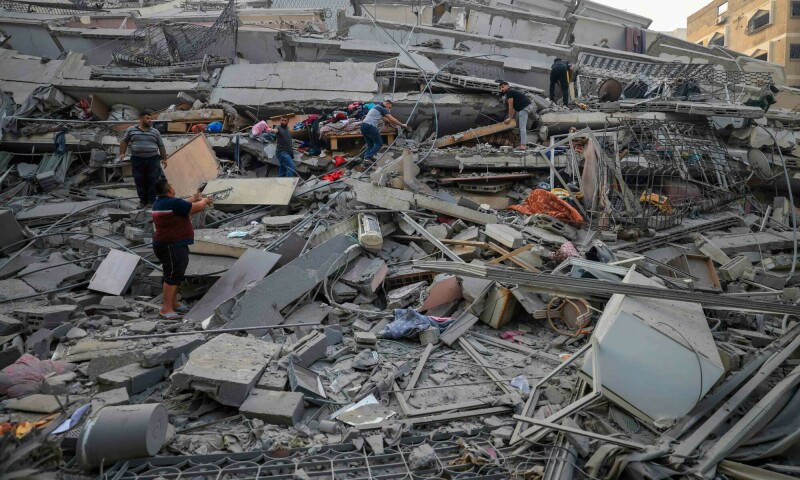
Fighting between Israeli forces and the Palestinian group Hamas raged on Sunday, with hundreds killed on both sides after a surprise attack on Israel prompted Prime Minister Benjamin Netanyahu to warn they were “embarking on a long and difficult war”.
The conflict’s bloodiest escalation in decades saw Hamas carry out a massive rocket barrage and ground, air and sea offensive early on Saturday that Israel’s army said had killed more than 200 Israelis and wounded 1,000.
Gaza officials said intense Israeli air strikes on the coastal enclave had brought the Palestinian death toll to at least 232, with nearly 1,700 wounded.
Gun battles raged into Sunday morning between Israeli forces and hundreds of Hamas fighters in at least 22 Israel locations, including at least two where gunmen were holding hostages, the army said.
It later added that it had fired artillery on southern Lebanon in response to a shot from the area, without providing further details.
“We are embarking on a long and difficult war that was forced on us by a murderous Hamas attack,” Netanyahu said on X, formerly Twitter, early on Sunday.
“The first stage is ending at this time by the destruction of the vast majority of the enemy forces that infiltrated our territory.
“At the same time, we have begun the offensive phase, which will continue with neither limitations nor respite until the objectives are achieved. We will restore security to the citizens of Israel and we will win,” he said.
Earlier, the premier warned that “all the places in which Hamas is based, in this city of evil, all the places Hamas is hiding in, acting from – we’ll turn them into rubble”.
The fighting — which comes half a century after the outbreak of the 1973 Arab-Israeli war — prompted Israel to cut off Gaza’s electricity, fuel and goods supplies, Netanyahu said.
Meanwhile, Foreign Minister Jalil Abbas Jilani said on Sunday morning that Pakistan was “deeply concerned by the escalating hostility in the Middle East and the loss of innocent lives”.
“We stand in solidarity with Palestinians and call for an immediate end to the violence and oppression by Israeli occupation forces. A viable and sovereign state of Palestine must be established on the basis of pre-1967 borders and UN resolutions,” he said.
Jilani said the international community needed to intervene to “bring an end to the conflict, protect civilians, and work towards a lasting peace in the Middle East”.
Israel has a right to defend itself: Biden
As the UN Security Council called an emergency meeting for Sunday, US President Joe Biden voiced “rock solid and unwavering” support for the US ally and warned “against any other party hostile to Israel seeking advantage in this situation”.
Biden spoke by phone to Israeli Prime Minister Benjamin Netanyahu on Saturday to offer US support, with scenes of violence playing out on American news networks. The two leaders have had strained relations but met in New York last month in a show of solidarity.
“I made clear to Prime Minister Netanyahu that we stand ready to offer all appropriate means of support to the government and people of Israel,” Biden said in a written statement issued after their call.
In his televised remarks later, Biden issued a blunt warning.
“Israel has a right to defend itself and its people — full stop,” he said. “Let me say this as clearly as I can. This is not a moment for any party hostile to Israel to exploit these attacks to seek advantage. The world is watching.”
The United States has been seeking a deal to normalise ties between Israel and Saudi Arabia, seen by Israelis as the biggest prize yet in their decades-long quest for Arab recognition. Palestinians fear any such agreement could sell out their dreams of an independent state.
‘So many bodies’
US State Secretary Antony Blinken also spoke to Egypt, a key intermediary between Israel and Hamas about the “urgency in achieving an immediate halt” to the fighting, State Department spokesman Matthew Miller said.
As night fell, the Israeli army said its forces were still engaged in gun battles in a string of Israel locations, in an operation labelled “Swords of Iron”, as reservists were being called up.
“There are still 22 locations where we are engaging with terrorists that came into Israel, from the sea, from the land and from the air,” said army spokesman Richard Hecht on what he labelled a “robust ground invasion”.
The Israeli army launched air strikes into Gaza later in the night while fighters fired rockets, an AFP journalist reported.
Hamas earlier released images of several Israelis taken captive, and another army spokesman, Daniel Hagari, confirmed that soldiers and civilians had been kidnapped.
“I can’t give figures about them at the moment,” he said, adding that Hamas would “pay the price” for the attacks. Hecht said there was also a “severe hostage situation” in the Negev desert communities of Beeri and Ofakim east of Gaza.
The group started the multi-pronged attack around 6:30am (0330 GMT) with thousands of rockets aimed as far as Tel Aviv and Jerusalem, some bypassing the Iron Dome defence system and hitting buildings.
Hamas fighters — travelling in ground vehicles, motorised paragliders and boats — breached Gaza’s security barrier and attacked nearby Israeli towns and military posts, opening fire on residents and passersby.
“Send help, please!” one Israeli woman sheltering with her two-year-old child pleaded as fighters outside opened fire and tried to break into their safe room, Israeli media reported.
Bodies were strewn on the streets of the Israeli town of Sderot near Gaza and inside cars, the windscreens shattered by a hail of bullets.
“I saw many bodies, of terrorists and civilians,” one man told AFP, standing beside covered corpses on a road near Gevim Kibbutz in southern Israel. “So many bodies, so many bodies.”
AFP journalists witnessed Palestinian armed men gather around a burning Israeli tank, and others driving a seized Israeli military Humvee vehicle back into Gaza, where they were met by cheering crowds.
‘Gates of hell’
Israeli army Major General Ghasan Alyan warned Hamas had “opened the gates of hell”.
An AFP journalist in Gaza saw clouds of dust from the remains of bombed residential towers which Gaza’s interior ministry said contained 100 apartments.
Israel’s military said it had warned residents to evacuate before targeting the multi-storey buildings used by Hamas.
Israel’s state-run electricity company cut the power supply to Gaza as army flares lit up the night sky.
The escalation follows months of rising violence, mostly in the occupied West Bank, and tensions around Gaza’s border and at contested holy sites in Jerusalem.
Before Saturday, at least 247 Palestinians, 32 Israelis and two foreigners had been killed this year, including combatants and civilians, according to Israeli and Palestinian officials.
Hamas labelled its attack “Operation Al-Aqsa Flood” and called on “resistance fighters in the West Bank” as well as in “Arab and Islamic nations” to join the battle.
Its armed wing, the Ezzedine al-Qassam Brigades, claimed to have fired more than 5,000 rockets, while Hecht said Israel had counted more than 3,000 incoming rockets.
Hamas chief Ismail Haniyeh said the group was on the “verge of a great victory”.
“The cycle of intifadas (uprisings) and revolutions in the battle to liberate our land and our prisoners languishing in occupation prisons must be completed,” he said.
He said the assault that began in Gaza would spread to the West Bank and Jerusalem. Gazans have lived under an Israeli blockade for 16 years.
In a speech, Haniyeh highlighted threats to Jerusalem’s Al-Aqsa Mosque, the continuation of an Israeli blockade on Gaza, and Israeli normalisation with countries in the region.
“How many times have we warned you that the Palestinian people have been living in refugee camps for 75 years, and you refuse to recognise the rights of our people?”
Osama Hamdan, the leader of Hamas in Lebanon, told Reuters that Saturday’s operation should make Arab states realise that accepting Israeli security demands would not bring peace.
Hamas deputy chief Saleh al-Arouri told Al Jazeera that the group was holding a large number of Israeli captives, including senior officials. He said Hamas had enough captives to make Israel free all Palestinians in its jails.
‘Dangerous precipice’
Air raid sirens wailed across southern and central Israel, as well as in Jerusalem. In Tel Aviv, a gaping hole was ripped into a building, with residents boarding a bus to flee to safety.
The conflict sparked major disruption at Tel Aviv airport, where many carriers cancelled flights. Schools will remain closed on Sunday, the start of the week in Israel.
Hamas took control of Gaza in 2007, leading to Israel’s crippling blockade of the impoverished enclave of 2.3 million people.
Israel and Hamas have since fought several wars. The last major military exchange, in May, killed 34 Palestinians and one Israeli.
In northern Gaza on Saturday, hundreds of people fled their homes, carrying food and blankets, an AFP correspondent said.
Violence also erupted across the West Bank, including annexed east Jerusalem, with five Palestinians killed and 120 wounded in clashes with Israeli forces and settlers, Palestinian medical services said.
Western capitals condemned the wave of attacks by Hamas, which Israel, the United States and European Union consider a terrorist group.
European Commission President Ursula von der Leyen called the attack “terrorism in its most despicable form”.
But Hamas drew support from other foes of Israel, with Iran’s supreme leader declaring he was “proud” and Lebanese militant group Hezbollah praising the “heroic operation”.
UN Middle East peace envoy Tor Wennesland warned of “a dangerous precipice” and called on all sides to “pull back from the brink”.