

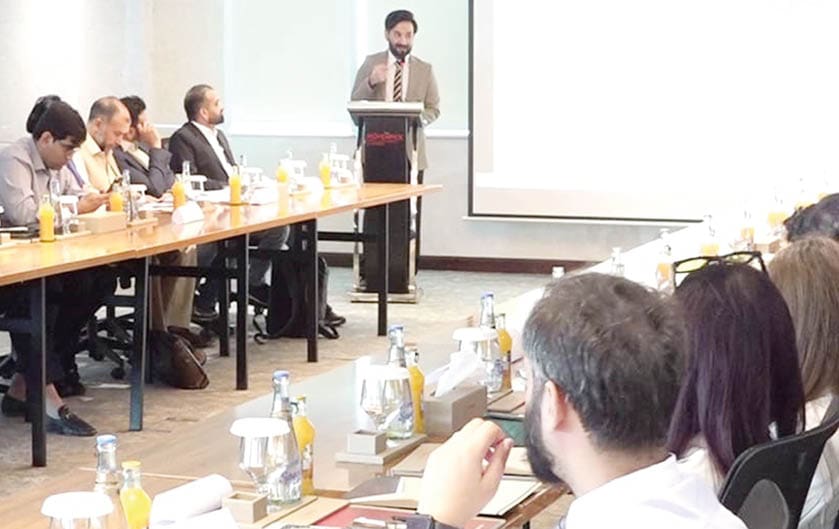
CEO Kaiwan Hamid calls for closer varsities, media organisations partnerships
The ATOM Council Symposium, titled “Academia to Media,” was held at Mövenpick Hotel Islamabad on Monday, bringing together leading academics, media professionals, industry representatives, researchers and students to deliberate on strengthening collaboration between Pakistan’s universities and the rapidly evolving media industry.
The symposium focused on bridging the gap between academic learning and professional media practice, with participants stressing the need to equip students with practical skills, industry exposure and an understanding of the technological and professional requirements of modern newsrooms.
The ATOM Council, which stands for Academia to Media Council, has been conceived as a collaborative platform connecting universities with media organisations and professionals.
The initiative is being advanced under the broader vision of the Khyber Academy for Media Technologies (KAMTECH) and Khyber Network to develop an industry-ready media workforce. Earlier consultations between Khyber Network and academic institutions highlighted practical training, curriculum alignment, internships, studio-based learning, digital content creation and applied research as key areas of cooperation.

The symposium provided an opportunity for academics and media practitioners to discuss the changing nature of journalism and media production in the digital age. Guests, including HODs of various universities, news analysts like Anwar ul Hassan & Wahid Hussain, Gauhar Zahid Malik-President Pakistan Observer, Gulmina Bilal- Chairperson NAVTTC, Sardar Tahir-President ICCI & Sardar Yasir Ilyas- CEO Centaurus Group have all collectively called for closer institutional partnerships between universities and media organisations so that students can gain hands-on experience while still pursuing their academic studies. Speakers emphasised that traditional classroom-based education alone is no longer sufficient to prepare students for an industry increasingly shaped by digital platforms, social media, artificial intelligence, multimedia storytelling and rapidly changing audience behaviour.

The ATOM Council was described as an important step towards creating a sustainable mechanism through which academics and media professionals can jointly identify emerging industry requirements and help shape media education accordingly. The initiative seeks to ensure that theoretical knowledge is complemented by practical experience and that graduates enter the professional field with relevant skills.
The symposium also underscored the importance of collaboration in developing responsible and professionally competent media practitioners. Participants observed that Pakistan’s media landscape is undergoing a major transformation, making it essential for educational institutions and media organisations to work together in preparing young professionals for the demands of contemporary journalism and digital communication.

The organisers said the ATOM Council would continue engaging with universities, media professionals and industry stakeholders to expand opportunities for students and strengthen the relationship between classrooms and newsrooms.
The event concluded with an emphasis on sustained academia-industry cooperation, practical learning and professional
mentorship as key
components for building the next generation of
Pakistan’s media
professionals.