

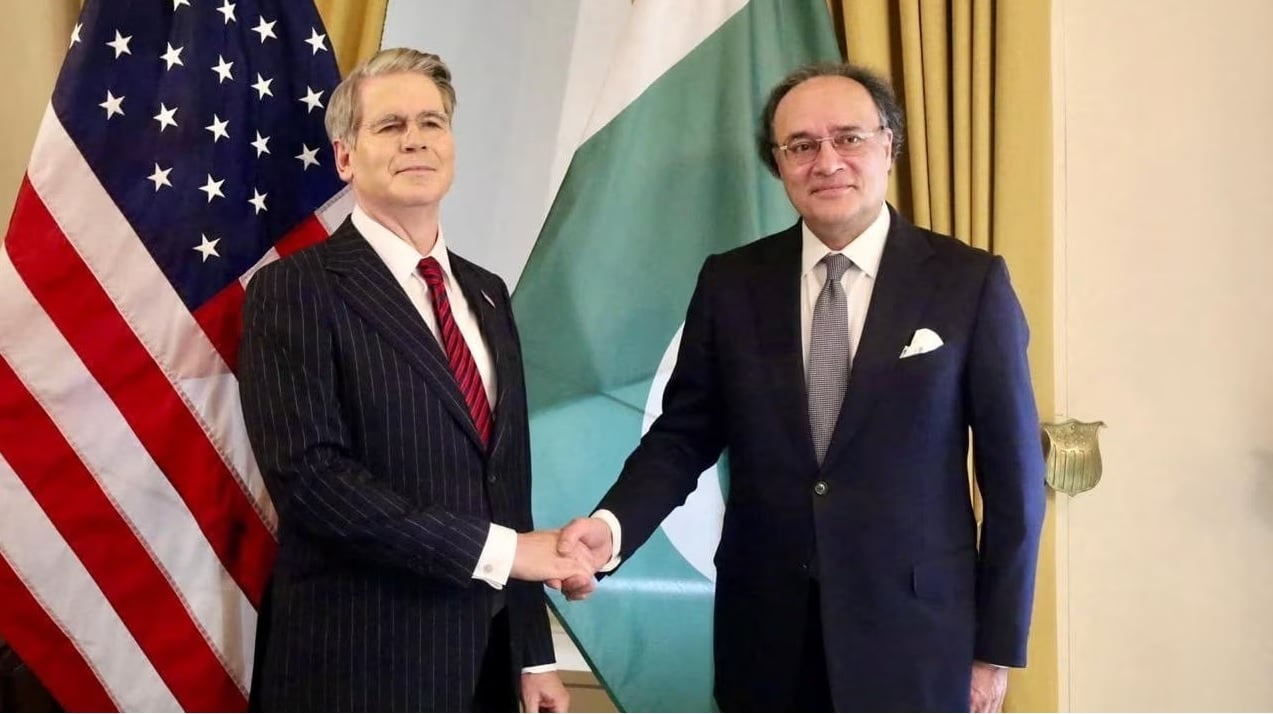
ISLAMABAD: Pakistan plans to return to international capital markets this fiscal year with an initial borrowing target of $1 billion to $2 billion, Finance Minister Muhammad Aurangzeb said, as the government seeks to reduce its reliance on bilateral financing and pivot the economy toward trade and investment.
Aurangzeb told the Financial Times that Pakistan is focused on securing U.S. financing in a significant shift after years of depending on state loans from China. He said the $10 billion swap line that Pakistan requested from Washington last month was intended to serve as “a confidence signal” to private investors as Islamabad’s military-backed government looks to capitalize on close ties to the Trump administration and accelerate international borrowing.
“It’s a combination of engagement with the U.S. primarily to focus on trade and investment flows, and to help signaling with respect to international capital markets,” Aurangzeb said.
He said Islamabad had received “constructive engagement” from Washington over the swap line and hoped to receive an answer “in the next couple of months.”
The cash-strapped nation has reduced fiscal deficits, brought down inflation and rebuilt reserves under a $7 billion, three-year International Monetary Fund program approved in 2024. But GDP growth, estimated by the government at 3.7% for the 2025-2026 fiscal year, remains insufficient to meet the needs of its fast-growing population, and poverty levels have risen.
Aurangzeb said the government wants to stimulate exports to break the import-dependent country’s perennial balance of payments crises. Pakistan’s trade deficit widened to a four-year high of $39.5 billion in the year through June, and exports fell.
“If you look at our last episode where we put the foot on the pedal by pumping liquidity, going for consumption-led growth … we get into trouble very quickly because we are an import-dependent economy,” he said. “So we’re keeping a very close eye on that … [on] more export-led growth.”
A former executive at Citibank and JPMorgan who also ran Pakistan’s Habib Bank, Aurangzeb is keen to shift the economy “from aid to trade and investment.” He said the U.S. Export-Import Bank could finance sales of Boeing aircraft to the newly privatized Pakistan International Airlines and help U.S. companies upgrade Pakistan’s oil refineries, while the U.S. International Development Finance Corporation could take equity stakes in Pakistani conglomerates.
Pakistan’s armed forces chief and de facto leader Field Marshal Asim Munir has forged a close personal bond with President Donald Trump and helped facilitate peace talks with Iran, a link Washington believes it can leverage to tilt Islamabad away from Beijing’s orbit.
China is Pakistan’s largest creditor, holding 23% of its $129.7 billion in total outstanding foreign debt as of 2024, according to World Bank figures published in December. Although Aurangzeb insisted the choice between the U.S. and China was “not an and-or discussion,” he confirmed Pakistan was not seeking additional financing from China at the moment.
As part of the planned return to international borrowing, Pakistan last month appointed a consortium of banks with a three-year mandate to issue Eurobonds, another group to issue Islamic sukuk and a third to tap rupee-denominated, dollar-settled bonds. Standard Chartered and Citi are part of all three consortiums.
Aurangzeb said Eurobond issuance would depend on market pricing and maturity but estimated Pakistan was “looking at $1 billion-$2 billion” this fiscal year.
A fourth tender is planned for a consortium to issue $750 million of renminbi-denominated “panda” bonds, which Aurangzeb called “very, very significant” given the size of China’s capital markets.
S&P last month upgraded Pakistan to a B rating, five notches below investment grade. Fitch rates it one grade lower at B-minus with a stable outlook.
“At this point we are working with the rating agencies to get back to B-plus over the next 12 months or so,” Aurangzeb said. “But our aim is to at least look at double B and work back from there. And there is no reason why we cannot get there.”