
xAI installed 59 gas turbines for Tennessee data centre without federal air permits, Reuters analysis finds
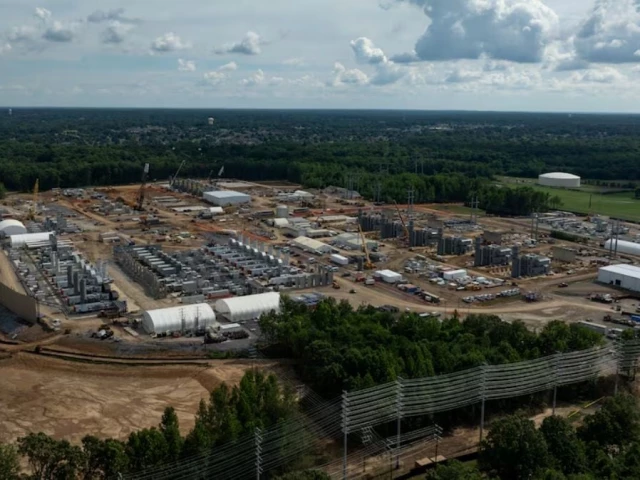
A drone view shows xAi’s gas turbines in Southaven, Mississippi, U.S., May 30, 2026.PHOTO: REUTERS
Elon Musk’s artificial intelligence company xAI has installed 59 natural gas turbines for its Colossus 2 data center project in Tennessee without securing federal clean air permits, according to communications between regulators and xAI representatives.
Potential emissions from the turbines are far beyond the threshold that would require a federal permit, and would be released near predominantly Black communities already estimated to be suffering disproportionately high rates of lung disease, according to a Reuters analysis based on government data and information in the correspondence with regulators.
The findings, which have not been previously reported, reflect how exploding electricity demand from AI data centers is driving companies to build off-grid power plants at a pace outstripping environmental oversight, with potentially big risks to public health.
The number of unpermitted turbines identified by Reuters is about double what xAI has publicly acknowledged. The company previously said it was running 27 unpermitted turbines for Colossus 2 as of January and has argued the permits are not required. At least 57 of the 59 turbines are located in Mississippi, just over the state line from Tennessee where the data center is located.
The xAI turbines are among scores of off-grid power plants for data centers proposed or under construction around the country. Local authorities often fast-track approvals in just weeks or months, without the years of environmental studies and public hearings typically required for such power generation projects that connect to the grid, Reuters has reported.
Mississippi regulators in March issued a permit for permanent turbines for Colossus 2, allowing construction of 41 gas-fired turbines. The approval came three weeks after the state’s only public hearing on the project.
The xAI cluster of temporary turbines in Mississippi is already among the biggest off-grid data center power projects, according to Ben King, an analyst with think tank Rhodium Group, who reviewed the Reuters analysis.
Read More: Nobel laureates among more than 200 experts urging action on AI’s economic impact
“This looks to be an unprecedented level of behind-the-meter gas being installed in one place,” he said, referring to off-grid natural gas plants serving just one customer.
The communications reviewed by Reuters show xAI, now owned by trillionaire Musk’s SpaceX, has installed 57 off-grid turbines in Southaven, Mississippi, just across the state line from its Colossus 2 data center in Memphis, a facility supporting the Grok chatbot and other AI systems. The records show the company has also installed two other unpermitted turbines for the project on a different site. Reuters could not determine the location.
The communications, obtained through a Reuters public records request, included emails between Trinity Consultants, representing xAI and subsidiary MZX Tech, and the Mississippi Department of Environmental Quality (MDEQ).
xAI did not respond to Reuters’ request for comment.
xAI’s turbines are part of a widening environmental justice battle over whether the AI boom is adding disproportionate pollution burdens to communities of color.
Civil rights groups including the NAACP and the Southern Environmental Law Center sued xAI in April to halt their operations, arguing the turbines produce emissions subject to the federal Clean Air Act and shouldn’t be operated without permits. They contend the turbines are polluting homes, schools and churches in historically Black communities.
“The scale of it is astonishing,” said Patrick Anderson, an attorney with the Southern Environmental Law Center. “This is an absolutely huge Clean Air Act violation that threatens public health.”
Securing a Clean Air Act permit would have exposed xAI’s project to extensive review and public comment, potentially taking years. Mississippi environmental regulators and xAI have argued in court filings that the turbines are exempt because they are “mobile” and intended to operate onsite for less than a year.
“MDEQ has determined that portable/temporary turbines do not require an air permit,” the agency said in a statement to Reuters.
The US Environmental Protection Agency said in January 2026 that even temporary turbines exceeding emissions thresholds must obtain permits. The agency, however, told Reuters it’s considering changes allowing “regulatory flexibilities” for portable units while continuing to protect public health.
xAI, the MDEQ and the EPA did not answer questions from Reuters about pollution impacts on communities of color from power generation to serve data centres.
The US Justice Department weighed in on the lawsuit in a June 15 filing, saying that restricting the turbines could threaten national security interests because xAI’s systems support US military operations, including operations involving Iran.
The outcome of the lawsuit filed by civil rights groups could help define how environmental laws apply to the fast-growing AI sector, where companies are scrambling to bring power supplies online to support energy-intensive computing.
“This sets up scenarios where the government can create sacrifice zones and tell communities they have to breathe illegal air pollution,” said Mary Rock, a senior attorney for Earthjustice which is representing the NAACP and SELC.
The dispute echoes the findings of a 2022 study by researchers from UCLA and Columbia University and published in the Nature Energy journal that found that previously redlined communities – where banks historically discriminated against Black mortgage applicants – now face disproportionately high exposure to pollutants from fossil fuel facilities.
“Air pollution from these and other sources contributes to systemic racial disparities in chronic disease and ultimately shorter lives,” Lara Cushing, a UCLA public health professor who co-authored the study, told Reuters.
Big emissions
The emails reviewed by Reuters included the manufacturer emissions profiles for 32 of the 59 turbines, including 30 at the Southaven site.
Read More: AI firms’ mass purchase, destruction of books for model training fuels copyright debate
A Reuters analysis based on that information found that those 30 turbines alone could emit nearly 2,500 short tons of nitrogen oxide, 4,000 short tons of carbon monoxide and 22 short tons of formaldehyde annually, assuming they operate continuously at 80% of capacity. According to the EPA, gas turbines are typically operated at loads of 80% or more to achieve efficiency.
Nitrogen oxides contribute to smog and respiratory inflammation, according to the American Lung Association. Carbon monoxide deprives the body of oxygen, and formaldehyde is a carcinogen.
The xAI site’s potential emissions far exceed a Clean Air Act threshold that requires permitting for facilities capable of more than 100 short tons annually of pollutants such as nitrogen oxide.
“This is a massive amount of turbines and an unfathomable amount of air pollution,” Southaven resident Shannon Samsa said in an interview.
“It’s not a hypothetical,” she said, “that air pollution is bad for you.”
The nitrogen oxide emissions calculated by Reuters for about half the plant’s turbines would put the facility “up there with some of the heaviest polluting natural gas power plants across the entire country,” said Nicholas Mailloux, a postdoctoral researcher at the University of Wisconsin-Madison who studies air quality and health benefits of the clean-energy transition.
He said the facility would be on par with the top 25 U.S. gas plants for nitrogen oxide emissions, citing EPA data for actual emissions.
The people affected
In the Colonial Hills neighborhood of Southaven, the turbines serving Colossus 2 can be heard around the clock, often firing off noisy bursts that residents compare to jet engines.
Ervin Laws, a Colonial Hills resident in his 20s, said the noise wakes him up at night. “I can’t do anything about it, because he’s got more money than me,” he said, referring to Musk.
The turbines were installed in communities already estimated to be facing relatively high respiratory disease burdens, according to a Reuters analysis of CDC data.
In 27 of 28 census tracts within five miles of the site – spanning both Mississippi and Tennessee – the estimated asthma rates were higher than their respective countywide figures. In 24 tracts, chronic obstructive pulmonary disease rates were also higher.
Five miles is a distance commonly used in environmental health research to capture populations likely to be exposed to air pollution from a stationary source.
A separate Reuters analysis of Census Bureau data found that the residents living near the facility are disproportionately Black. Because the five-mile radius crosses state lines, Reuters compared each side against its own county baseline.
Within five miles of the facility in DeSoto county, Mississippi – where the turbines are located – about 46% of residents are Black, compared with 33% countywide, according to census data.
Across the state line in Tennessee, where residents have no say in Mississippi’s permitting process, about 94% of residents within five miles of the facility are Black, compared to 52% in surrounding Shelby County.
Jayajit Chakraborty, a professor at the University of California, Santa Barbara, said the Reuters analysis was consistent with research that shows communities of color face higher exposure to fossil fuel pollution.
Shelby County and portions of DeSoto County have also previously failed to meet federal ozone standards and remain subject to EPA-approved plans to ensure they do not slip back into violation, according to regulatory documents. Nitrogen oxide is a key precursor to ozone formation, which the EPA says can harm respiratory health.
“Given this community struggles with high asthma rates, additional NOx exposure at such high rates could exacerbate public health issues in a community that is already seeing more than its fair share of exposure to toxic air pollution,” said Victoria Nelson, an independent environmental engineer, formerly at EPA.
Sarah Gladney, 72, has watched the rapid expansion of xAI’s Memphis-area presence from her home in the historically Black neighborhood of Boxtown, a few miles from where the company built its Colossus 1 data center in 2024.
“Once they got their foot in the door in Memphis, I feel like it’s going to be a continuous movement of xAI into these other communities,” she said. “It’s all about the money, and it’s not about the health or wellness of the people that live in or near these communities.”