

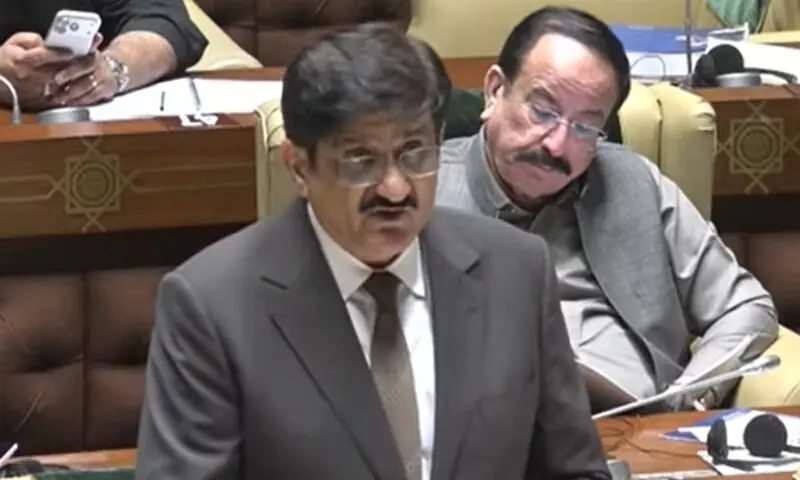
Sindh Chief Minister Syed Murad Ali Shah presented a Rs3.56 trillion budget for FY2026–27 on Wednesday, without imposing any new taxes and announcing a 7 per cent increase in government employees’ salaries and pensions.
The session was delayed due to a ruckus created by lawmakers of the Muttahida Qaumi Movement-Pakistan (MQM-P). MPA Ali Khurshidi said the party was boycotting the session because the opposition had not been consulted beforehand.
CM Murad said that in the upcoming fiscal year, the government’s goal was to “maintain fiscal discipline, strengthen public finances, and sustain development momentum during a very challenging year”.
For development, the provincial government has allocated Rs720.39bn.
Total tax receipts, including sales tax, are projected at Rs690bn for the upcoming fiscal year. Provincial non-tax receipts are projected at Rs85bn.
For capital receipts, local repayments are projected at Rs7.54bn, while bank borrowing is estimated at Rs60.8bn, bringing total capital receipts to Rs68.34bn.
Among other inflows, the Sindh government expects Rs256bn from the Foreign Project Assistance fund, along with Rs64.33bn from the federal Public Sector Development Programme. It is also projected to receive Rs8.14bn in foreign grants.
The provincial budget also allocated Rs402bn for the health sector, Rs185bn for transport and communication, Rs103bn for irrigation, Rs49bn for sanitation, and Rs347.6bn for local government and service delivery.
Furthermore, in FY2026-27, the Sindh government is allocating Rs222bn for law and order.
The government also allocated Rs72.8bn for the agriculture, livestock and fisheries sector. The energy, climate and environment sector would receive Rs84bn.
The Sindh government is allocating Rs3.5bn for the minorities and women development sector, while the chief minister added that this allocation is protected from expenditure rationalisation measures.
For people with disabilities, the government has set aside Rs22.8bn, which would likewise remain a fully protected allocation, according to the chief minister.
Furthermore, the provincial government has proposed Rs26.4bn for the social protection sector.
“Every rupee has been directed towards projects that deliver the highest social and economic return for the people of Sindh,” the chief minister said in the assembly session.
He added that the budget is “a carefully prioritised investment strategy designed to protect human development, strengthen infrastructure, improve connectivity, enhance water security, promote economic growth and create opportunities for future generations.”
The budget also proposed a reduction in sales tax on education support services to 5pc. The tax rate on insurance agents and brokers will be reduced from 5pc to 2–3pc, according to the budget speech.
The provincial government also increased the minimum wage to Rs43,000. Chief Minister Murad Ali Shah said the minimum pay of Grade 1 government employees would be aligned with the revised minimum wage.
Murad also referred to the deadly Gul Plaza fire, saying that the provincial government had approved one of the largest relief packages in response to the incident, amounting to Rs8.45bn, including compensation of Rs10 million for the family of each deceased victim.
Provincial cabinet approves budget
Earlier today, the Sindh cabinet approved the proposed provincial budget for fiscal year 2026-27, state broadcaster PTV reported.
It was approved in a session chaired by CM Murad, who said that every class had been catered to in the proposed budget and steps were being taken to eradicate poverty from the province, PTV said.
The report added that the Sindh government also decided on the minimum wage for workers in the budget.
During the meeting, the provincial cabinet appreciated the “record” development initiatives taken during the previous fiscal year, according to the CM House.
It added that the cabinet also “reaffirmed its commitment to public service” under the leadership of PPP Chairman Bilawal Bhutto-Zardari.
As per the statement, the budget also includes an increase in minimum wage for workers.
Ahead of the provincial budget, CM Murad, in a meeting a day earlier, reviewed the performance of major revenue-generating departments and directed them to strengthen collection mechanisms and improve fiscal efficiency to support the province’s development agenda.