

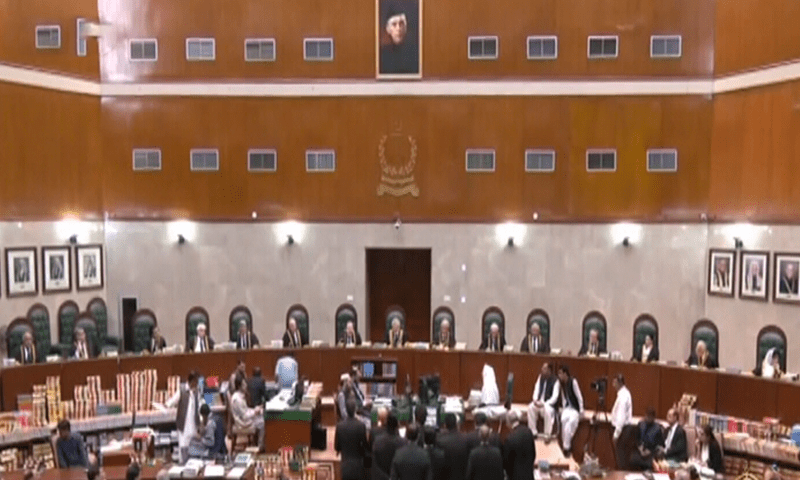
Chief Justice of Pakistan (CJP) Qazi Faez Isa on Tuesday indicated that the apex court may conclude proceedings on a set of petitions challenging the Supreme Court (Practice and Procedure) Act 2023 today.
He made the remarks as a full court resumed hearing pleas against the law which requires the formation of benches on constitutional matters of public importance by a committee of three senior judges of the court. Like last time, the hearing is being streamed live on television.
Headed by CJP Isa, the bench consisted of Justice ardar Tariq Masood, Justice Ijazul Ahsan, Justice Syed Mansoor Ali Shah, Justice Munib Akhtar, Justice Yahya Afridi, Justice Aminuddin Khan, Justice Sayyed Mazahar Ali Akbar Naqvi, Justice Jamal Khan Mandokhel, Justice Muhammad Ali Mazhar, Justice Ayesha A. Malik, Justice Athar Minallah, Justice Syed Hasan Azhar Rizvi, Justice Shahid Waheed and Justice Musarrat Hilali.
In a pre-emptive move, the Supreme Court — then led by former CJP Umar Ata Bandial — in April had barred the government from implementing the bill seeking to curtail the chief justice of Pakistan’s powers once it became a law.
Replies submitted to court
On the very first day of assuming charge as the chief justice, CJP Isa had ordered the hearing to be live-streamed and had implicitly vacated the April 13 suspension of the enforcement of the Supreme Court (Practice & Procedure) Act, 2023.
Though the court order did not explicitly say that the stay on the implementation of the law regulating the powers of the top judge had been vacated, Justice Isa stated he would consult with two senior-most judges Sardar Tariq Masood and Ijazul Ahsan regarding the formation of benches — a key clause in the law. Subsequently, the full court had asked the parties concerned to submit written replies before the next hearing.
Last week, the Pakistan Muslim League-Q (PML-Q) had pleaded before the apex court that the Act was aimed at promoting the independence of judiciary, the rule of law, and the right to access to justice and fair trial.
The party, represented by its counsel Zahid F. Ebrahim, said SC rules provided that the legislature could determine the practice and procedure of the court in relation to the constitution of benches, in particular. Parliament has the right to enact the subject legislation and has done so strictly in accordance with the law and the Constitution, the response said.
Meanwhile, the government had argued that if the Supreme Court (Practice and Procedure) Act 2023 was sustained, verdicts handed down by benches constituted before enactment of the law would be saved as past and closed transactions.
But if the benches are still hearing the cases, then such benches should be reconstituted by a committee of three most senior judges, said a reply filed by Additional Attorney General Chaudhry Aamir Rehman on behalf of the federal government.
Referring to a question put by the full court on Sept 18 that could a right of appeal against judgements arising out of Article 184 (3) be created through ordinary legislation, as opposed to a constitutional amendment, the government contended that the original jurisdiction of the apex court under the provision was sui generis in nature and it cannot be bifurcated into criminal and civil aspects.
Those aggrieved by judgements under Article 184 (3) may go for a review on the same grounds as are available for review of judgements rendered under Article 185, the reply said.
On the question of whether the regulation of practice and procedure by Parliament undermines the judiciary’s internal independence, the government stated that no restraint could be placed on the institution’s performance and operation. Independence of judiciary implies independence of judges, institutionally as well as individually, from the executive, the government further stated.
Today’s hearing
At the outset of today’s hearing, CJP Isa said that the law affected the chief justice and the two senior most judges of the apex court. “On one hand, the CJP’s powers, if not being limited, are being reduced. On the other, the same powers are being distributed among senior judges,” he said.
Justice Isa said that the law would also apply to future chief justices and senior judges of the apex court. He said that he had felt that he should not be a part of the bench hearing the pleas but because it affected all judges, it was deemed fit that a full court preside over the case.
Addressing the lawyers gathered, he urged them to talk about points that were relevant to the case. “We want to try to conclude [the case] today,” he said as he highlighted the backlog of cases in the SC. He said that if the lawyers wished to make additional arguments, they could submit a detailed response to the court.
Starting his arguments, lawyer Ikram Chaudhry, representing petitioner Niazullah Khan Niazi, read out the opening paragraph of the Act. He argued that the paragraph indicated that the law was being enacted for a “certain or a specific purpose”.
However, CJP Isa interjected and asked whether the law stated this or the lawyer was implying this. “Let’s not put words in a statute which don’t exist. If that is your impression, then say so,” he remarked.
The lawyer then went on to Section 3 of the Act, which states that a committee of judges would constitute a bench to hear matters of public importance. He said that the clause was an “encroachment on the area which falls within the legal framework”.
Regarding the provision of appeal under the Act, the lawyer said that “additions” to Article 183 of the Constitution — which empowers the SC to entertain public interest litigation in its original jurisdiction — could only be made with a two-thirds majority in Parliament. He further said that Section 8 of the Act had “bulldozed the concept of the independence of the judiciary”.
“So an effort has been made to enter into an area which is not within Parliament’s domain,” Chaudhry said. “In a parliamentary system, parliament and the executive are one, the same phenomenon in the Constitution. They have a nexus amongst themselves,” he said.
He further said that the law was passed by a “truncated” Parliament, which did not have the authority to make constitutional amendments.
At one point, the lawyer argued that the enactment of the Act “totally denies the Constitution itself”. “When there is a wide law, [which is] fundamentally unconstitutional, it would be within the SC’s authority to look into it and declare it ultra vires,” he said.
At one point, CJP Isa asked, “When you talk about the independence of the judiciary, is it a unique thing or is it for the people and their rights? Is independence of the judiciary a standalone concept which should be defended under all circumstances?”
During the hearing, Justice Akhtar said that the question at hand was of legislative competence. “Not perhaps how ‘good’ or ‘bad’ this law is. The question that is perhaps agitating the petitioners […] is that is there legislative competence? If the answer is [yes], then the matter proceeds in one direction. But if the answer is that there is no legislative competence, then that ends the matter.”
Justice Akhtar said that the technical term used in constitutional law, for when the legislature tries to make a law beyond its competence, was a “fraud on the constitution”. “Those are very strong words,” he said as he again highlighted the question of legislative competence.
He referred to Section 7 of the Act, which states that an application pleading interim relief shall be fixed for hearing within 14 days from the date of its filing. “Now some may say this is a ‘good thing’. The question is can Parliament regulate SC down to this nitty gritty level? Is this what independence of judiciary and separation of powers is all about?”
At one point, however, CJP Isa highlighted the amount of time the lawyer was taking to present his arguments. “This case will not go on after today,” he said as he told the lawyer that he would have to spend the same amount of time listening to the other petitioners in the case.
During the hearing, Chaudhry said that Article 239 barred the government from making constitutional amendments without having a two-thirds majority.
Justice Ahsan then went on to say that Parliament was not competent to make the Act as it “essentially requires a constitutional amendment which is a totally different species of laws and which requires a totally different procedure which Parliament needs to adopt . And since that procedure has not been adopted it can be argued that Parliament was not competent to make this law which has the effect of amending the Constitution.”
“Yes, my lord. That’s my submission,” Chaudhry said.
Justice Minallah said that in his opinion, all the law did was to secure and ensure access to justice. “Is Parliament not competent to legislate in relation to access to justice? Providing an appeal is access to justice. Even regulating the chief justice’s powers is also an element of access to justice.”
Chaudhry said that the legislation in question affected the independence of the judiciary and also completely regulated the internal workings of the court. He said that the Parliament had acted beyond its mandate as he concluded his arguments.
Lawyer Hassan Irfan, representing petitioner Mudassar Hassan Jura, then took the rostrum. He started off by saying that the question at hand was of legislative competence. He said that the judiciary was one of the three pillars of the state.
Referring to Article 50, he said that it highlighted that it concerned the Majlis-i-Shoora. He said that the bill was sent to the president for his assent, who then raised an objection. The lawyer said that this indicated a “dispute” within Parliament over the passage of the bill.
Talking about Article 184(3), he argued that the law was replacing the SC’s function and transferring it to the committee, which “may not even be considered as a judicial function and would be an administrative function”.
“Are you contending that individually, chief justices cannot invoke this power and this power vests exclusively in the SC, which means the chief justice and all the judges of the SC?” CJP Isa asked.
Irfan said that the powers were given to the apex court which then drafted the SC rules. “The SC then delegated their own power as a whole to the chief justice,” he said.
Here, Justice Ahsan noted that Article 191 had empowered the SC to make rules that were administrative in nature, adding that the formation of benches and fixation of cases was an administrative power.
“So what the law does is, it removes the power from the chief justice and assigns it to two more judges, a committee of three judges,” he noted. Justice Ahsan said that in exercise of administrative powers the court could delegate its powers.
“That power has been exercised under Article 191 which is a constitutional mandate. So where a constitutional mandate empowers the SC to make rules, those rules have a certain sanctity attached to them,” Justice Ahsan said.
Article 191 reads: “Subject to the Constitution and law, the Supreme Court may make rules regulating the practice and procedure of the Court”.
The court then took a break in proceedings. When they resumed, Irfan continued his arguments and urged the court to review the “true purpose” of Article 184(3). He contended that the article did not state that a constitutional right had to be violated for an appeal to be filed. He then proceeded to read out the article out loud.
When asked which fundamental right the petitioner seeking was seeking to enforce, the lawyer responded that it was the right of access to justice.
Here, Justice Mazhar pointed out that the lawyer was referring to the part about public importance rather than fundamental rights. Justice Minallah then asked, “If the chief justice has exclusive rights, then access to justice is not affected?”
“It is his prerogative whether he fixes for hearing or not but he will not decide whether this petition should go for hearing or not, whereas this committee is going to decide [that],” the lawyer contended.
Here, CJP Isa asked Irfan about his interpretation of the new law. Justice Ahsan then remarked that the lawyer was “going into the nitty gritty of the law” when he first needed to answer what fundamental rights were being impacted by its passage.
He also observed that the full court hearing the case amid the petitioners’ and the government’s differing views proved that the case was a “maintainable petition”, hence, arguments on that aspect were not needed.
At one point, Justice Ayesha asked the lawyer if the absence of the right of appeal in the case of a full court barred the petitioner from access to justice. “Is this a substantive right that is being prevented?” she asked.
The lawyer replied that it did bar access to justice and said the solution was in Article 186, which would allow a full court to hear the case.
Irfan noted that the Constitution was the one thing supreme to both, the SC and the Parliament. The oaths for all offices have the words “preserve, protect and defend the Constitution” in common, he stated. The lawyer then proceeded to read out the oath for judges out loud.
When Irfan said that it was “equally incumbent upon the Parliament to follow the Constitution”, CJP Isa asked rhetorically, “Can there be two opinions on this?”
The top judge remarked that the lawyer touched upon one topic but then moved to the other without completing his arguments for the former. “I haven’t used my pen yet. I will write if I understand your arguments.”
When asked by Justice Mazhar whether Parliament had the competence to enact the law or not, Irfan answered in the negative. Upon being asked if the lawyer considered that the SC’s verdict on a matter should be final and not valid for appeal, Irfan replied that he did not think so.
Here, CJP Isa highlighted that lawyers and civil society had objected to the overuse of Article 184(3) in the past.
The lawyer then proceeded to argue that each time a new CJP would come to power, there would be no certainty of decisions and benches. At this, CJP Isa asked, “Do you want us to open the door for the next martial law?”
At one point during the hearing, CJP Isa observed that it needed to be ascertained whether the law pertained to the benefits of the people or to their loss rather than the benefits to the chief justice.
Here, Justice Akhtar noted that the apex court did not need the right to appeal in order to correct its past verdicts. He asked whether section 3 of the law was in direct conflict with Article 184(3).
Justice Shah then asked the lawyer if he thought the Parliament could legislate regarding the SC’s practice and procedures under Article 191 of the Constitution. To this, Irfan answered in the negative.
Justice Shah noted that Article 191 authorised Parliament to “go ahead with a legislation” about the practice and procedures of the SC, as well as when read with Article 58. He asked Irfan to explain how the said articles did not empower Parliament to do so, as the lawyer had contended.
“Until you don’t admit, there cannot be a correction,” CJP Isa said as he noted that prioritising the verdict of a bench could amount to a violation of the Constitution.
Multiple judges then asked the lawyer to elaborate the meaning of the words “subject to the Constitution and law” in the law empowering the SC to make rules, and whether it limited the apex court’s powers.
Here, Justice Akhtar pointed out a conflict in the Act that as per the lawyer, there could not be a repeal or an implied repeal but section 2 of the Act meant repealing of Order 8.
The judge then read out aloud Article 171 of the 1956 Constitution, which he said provided a “direct enabling grant” and had different language from today’s Constitution.
The lawyer argued that the committee was “preventing access to the Supreme Court directly and preventing the Supreme Court from making an order”.
Justice Akhtar then stated that the Parliament’s jurisdiction to legislate on SC matters, if it existed, came into being under the 1973 Constitution, noting that there was a “continuity perhaps” as the SC rules had already existed before but were just amended in 1980.
At this point during the hearing, Justice Minallah asked Irfan to cite any examples, if there were, from “any jurisdiction around the globe that give precedence to rules made by an unelected court over a primary legislation made by a competent forum”.
To this, the lawyer responded that the rules enacted would have to be within the Constitution.
Here, Justice Mandokhail asked the counsel whether the Constitution had placed any bar on the Parliament to make a law that was inconsistent with the SC rules. Irfan replied: “If there is no bar, there is no permission either.”
CJP Isa then remarked that the lawyer was simply answering in “yes or no” rather than presenting arguments for his stances. He proceeded to observe that the Act was not only regulating the Supreme Court’s practice and procedures as indicated in its name but also “creating a substantive right of appeal”.
More to follow