

ISLAMABAD: A successful bid of Rs135bn by Arif Habib won the auction for Pakistan International Airlines Corporation Ltd (PIAC) after the process moved to an open auction round at a ceremony in Islamabad, marking the country’s first major privatisation in nearly two decades.
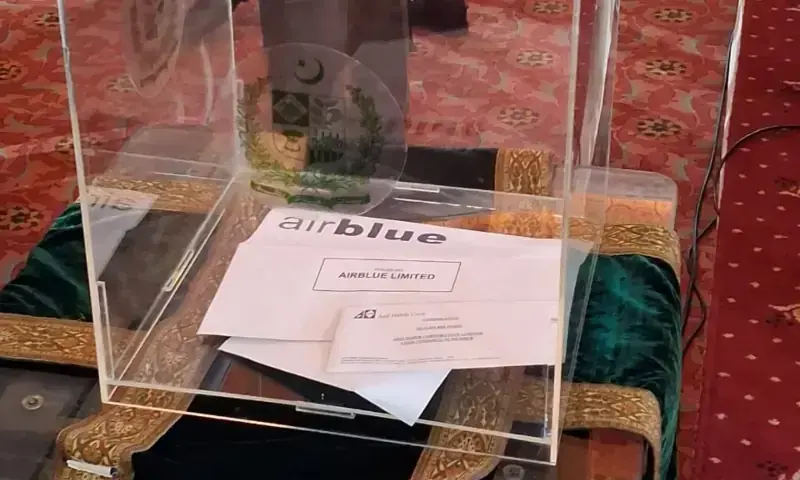
Initially, pre-qualified bids were submitted by Lucky Cement, private airline Airblue and investment firm Arif Habib in the morning. Airblue exited the race after the first round of bidding, with a proposition lower than the reference price of Rs100bn.
In the first round, Lucky Cement put up a bid of Rs101.5bn, Airblue Rs26.5bn, and the Arif Habib consortium bid Rs115bn, after which the reference price was announced.
Following that, a 30-minute break was taken so that the two top bidders could hold consultations. A second round was then commenced.
It began with the base bid at Rs115bn, and the minimum increment was at Rs250 million. The base price was set on the basis of the highest bid made during the first round by Arif Habib.
Both bidders engaged in a brief competition to outbid each other during the round. However, when Lucky Cement raised its bid to Rs134bn, Arif Habib countered with Rs135bn, forcing Lucky Cement to bow out and congratulate Arif Habib.
The whole process was telecast live and streamed across all TV channels as well as the respective social media handles of the government.
Adviser to the prime minister on privatisation, Muhammad Ali, will also hold a press conference after the conclusion of the bidding process.
Privatisation will ‘promote’ investment
After winning the bid to acquire the national airline, business owner Arif Habib said the privatisation will “promote” investment in the country.
“PIA is our national institution,” Habib said.
“The national airline has witnessed days of glory and was once ranked number two in the world. All its employees are very competent,” he added.
Habib said he is hopeful of resolving all shortcomings with the new capital investment.
When asked about his expansion plans, he said, “Initially, we plan to expand the fleet to 38 aircraft in the first phase, then to 65, depending on demand.”
The successful bidder assured he would give “confidence to PIA employees” and help in “realising their potential.”
“Employment opportunities will grow as we expand,” Habib said. “The existing experienced employees will also get opportunities.”
“When all necessary capital investment is made, they will perform well.”
’A very good start“
Khaqan Najeeb, a seasoned economist and policy expert, hailed the privatisation as a “sought-after” micro-economic reform that “must take place”.
Talking to Geo News, Najeed said, “It is a very good start that after 19-20 years, we have successfully privatised a major institution.”
“We have achieved this milestone on the third attempt. We must always remember that, despite parking Rs650 billion – not a small amount – in a holding company, it couldn’t be achieved,” he said.
“After removing a liability of Rs33 billion from the balance sheet of PIA and adding various other incentives in the form of tax or other concessions, only then have we made this happen,” Najeeb said.
The economist termed the development a “good outcome” and “positive” for the national airline.
“However, we achieved this by offering tax favours, deferred credits, and creating positive equities,” he said.
“We must notice that, as a good sweetener, it was necessary to reinvest 92.5% of the sold 75% in PIA, while only giving 7.5% to the state to run the company, because it is in need of significant funds to manage its affairs.”
“The company needs money to grow despite having multiple landing rights and air services agreements.”
He highlighted that the national airline has 18 planes in its fleet and carries four million passengers, but “it will not be enough to achieve economies of scale.”
“We have to reconsider how we have supported our SOEs, giving repeated sweeteners and unnecessary concessions, while selling a national airline that holds dozens of landing rights.”
Najeeb said that if anyone runs this company with “financial muscle,” a hidden value could be rediscovered. “I hope that when we finalise this deal, we will design a proper business and investment plan to expand the current fleet from 18 to 50 aeroplanes, reach further destinations, and carry more passengers,” he said.
“It’s a long way to go.”
Labelling the development as “positive,” he added, “There was a time when we were losing Rs50 to Rs100 billion. We can now avoid such losses – a good way to save taxpayers’ money.”
“However,” he reminded, “we have to keep in mind that for the Rs650 billion parked in the holding company, we have to pay around Rs30 billion every year from taxpayers’ money, according to estimates.”
He remarked that an “overhang” exists in Pakistan’s aviation policy, which has to be “fixed.”
The economist further stated the three important aspects of a good economy. “The first is a good regulatory environment, the second is a smooth policy-making process, and the last is the efficiency of operations,” he explained. “That’s how the economy works.”
‘Pakistan has won today’
Interior Minister Mohsin Naqvi congratulated all fellow countrymen on the privatisation of PIA.
“Pakistan has won today,” he exclaimed.
“By the grace of God, the process has been conducted with transparency,” Naqvi said.
He also extended felicitations to Advisor on Privatisation Mohammad Ali and his team, the prime minister, and especially to those who “secured PIA”.
“We are all looking forward to travelling through PIA again,” he added.
The Ministry of Privatisation also congratulated the consortium for winning the auction.
Aurangzeb hopes PIA sale will bring investment
Finance Minister Muhammad Aurangzeb, speaking at the bidding ceremony, thanked the PM‘s aide and his team for their efforts and hailed the bidding process in terms of transparency.
“It takes a lot of time and effort to get to a good place where we are today,“ he said.
“All of the bidders today are from Pakistan. I used to say that no matter which team wins, Pakistan would win.”
He lauded Pakistan‘s biggest conglomerates for “vying for the best airline” and said that the flag carrier would be led by investors and some of Pakistan’s most experienced businesspeople.
“The fact that they have stepped up is a doubtless sign that anyone who is the successful bidder will take it not only to where we were, but where we need to be in the comity of nations,” Aurangzeb added.
“We need to stop the bleeding and losses, but more importantly, our institutions need to be part of the comity of nations, and we will take them there,” he added.
Aurangzeb also expressed hope that the bidding would increase the number of local investors and, in turn, the number of foreign investors entering the country.
“The government, through the privatisation of business entities under state custody, will not only save itself from losses in the thousands of billions but also accelerate the process of economic recovery,” he wrote, congratulating the privatisation commission.
Defence Minister Khawaja Asif took to X to celebrate the sale, calling it a “growing vote of confidence in the national economy”.
Asif added that Europe and the UK lifting bans on PIA‘s operations was a major contributor to the success of today’s deal.
“From a bid of Rs10bn in the past to a price of Rs135bn today, it is proof of trust in our Civil Aviation Regulator.”
He also assailed the PTI government for leaving “no stone unturned to destroy PIA”, adding that it took three years to rebuild the flag carrier.
At the outset of the ceremony, the adviser to the prime minister on privatisation addressed the audience.
Ali hoped that PIA’s privatisation would open “paths for investment in the country”.
“I would also like to thank all bidders who are present today, and those who were part of the bidding process but did not reach the final round. We wouldn‘t have been here without them, and this process wouldn’t have been completed,” he said.
“We actively engaged with all the bidders. Two of them demanded to take up to 75 per cent at least, and the other two demanded 100pc,“ he said.
“We wanted a multitude of bidders so the process of bidding would be transparent and competitive,” he continued.
He said that the government had “decided to sell at least 75pc of shares, and simultaneously, we also decided to offer the other 25pc”.
“Bidders will have the right to consider and let the government know if they also want to buy the other 25pc in the next 90 days,” he said.
He further said, “The transaction would be from 75pc up to 100pc; however, 75pc of them will be made available for sale today”.
“The government wanted to structure this transaction so it would also get a fair share and investment to be made,” he said, adding that the government did not just want to sell PIA but “to bring the national airline back to the glory it enjoyed in the past”.
He stressed the need for bringing in “new investment, buy new carriers and repair the engine, cut the liabilities, pay the employees on time”.
“If we want to expand the fleet from 18 planes to 30-40 or more, then investment is the only way,” he added.
Pre-qualified bids
In the morning, representatives of the bidding groups had walked in one by one to deposit sealed offers into a transparent box, briefly fumbling as they pushed envelopes through the slot in a separate public ceremony in Islamabad that was also broadcast on state television.
Following that, the reference price for PIACL’s bidding was approved by the Privatisation Commission Board and the Cabinet Committee on Privatisation after bids were received.
Meanwhile, speaking to the media, Ali said, “God willing, we will get a good bid, there will be good investment, and we will succeed.“
The auction was Pakistan’s second attempt at selling the once storied flag carrier after televised bidding last year collapsed when a solitary offer fell far below the government‘s reference price, derailing what would have been the country’s first major privatisation in nearly two decades.
Meanwhile, Prime Minister Shehbaz Sharif, while addressing a meeting of the federal cabinet, thanked government officials and the Privatisation Commission for their role in the national carrier’s privatisation.
He stressed that the process has been made “transparent“, stating that it will be the “largest transaction” ever in Pakistan’s history.
“Today, as the bidding starts [..] the bids will come in sealed envelopes, there will be transparent boxes, there will be a live telecast. When the price is determined, the envelopes will be opened. They will compete, and whoever has the highest bid will [succeed],“ he said.
“Only God knows how high the bid will go, but the process must come back to the cabinet,” he said.
Unsuccessful bidders to be excluded from PIA management
Earlier, Ali said the two unsuccessful bidders will be excluded from any future role in the airline’s management thanks to a unique stipulation.
In recent remarks, he explained that losing bidders will have no right to join the winning bidder, and only those groups who were not party to the auction would be able to join the new management.
This means that while only one of the three consortiums currently in the running for the flag carrier will become part of its administration upon acquisition of a majority stake, Fauji Fertiliser Company Ltd retains the option to join with them subsequently, if it wishes to.
The company was previously in the race for PIA but then decided to quit the bidding process.
Ahead of Tuesday’s bidding, reports surfaced of a behind-the-scenes deal involving at least two of the parties involved — the Arif Habib and Lucky Cement groups — that reportedly fell through.
In a tweet, journalist Kamran Khan alluded to a meeting where it was proposed to split the controlling stake among three of the four interested parties. However, Khan claimed, this arrangement fell through as one of the parties — i.e. the Muhammad Ali Tabba-led Lucky Cement group — did not agree to it.
Both Tabba and a high-ranking government official privy to developments confirmed this, but clarified that this was not a government-brokered meeting, but rather an informal interaction.
Talking to Dawn, Tabba expressed unwavering confidence in the privatisation process, and clarified that the proposal was floated to him after a meeting in Islamabad, which he did not pursue.
Additional input from Reuters


