
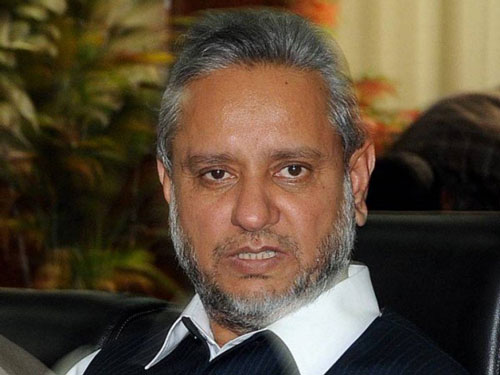
Sardar Attique Ahmed Khan
Kashmir Solidarity Day is not merely a commemoration. It is a moral appointment with a people who have endured decades of uncertainty and loss alongside the denial of their basic political rights. For Pakistanis it is also a day of national conscience. It serves as a reminder that our solidarity must be expressed not only through emotion but through consistency and responsible statecraft.
This solidarity did not emerge overnight. One of the earliest major expressions of organized support at a national level is traced to 1975 when Prime Minister Zulfikar Ali Bhutto called for a nationwide strike and protests on February 28. This was in response to the agreement between Sheikh Abdullah and Indira Gandhi. Many Kashmiris saw that agreement as an effort to dilute their political status and sideline their aspirations. Pakistan witnessed a broad shutdown and protests also took place in occupied Kashmir. It was an early moment when the Kashmir cause began to take the shape of collective national expression.
The tragedy of the early 1990s deepened this cause in the public mind and made it impossible to treat Kashmir as a distant dispute. In early 1990 as the movement in the Valley reached a peak Srinagar witnessed massive processions. People came out in large numbers with a simple demand for the right to live with dignity and to determine their own future. The response was brutal. Under Governor Jagmohan Indian forces opened fire on unarmed civilians and hundreds were killed. A curfew followed and the Valley entered days of grief that still live in memory. For many the most haunting image was not only of lives lost but of a society made to mourn under fear and silence.
That pain travelled beyond Srinagar. Protests and rallies were seen in occupied Kashmir and across Pakistan while many raised their voices abroad as well. In that climate the Amir of Jamaat e Islami Qazi Hussain Ahmed announced that February 5 would be observed as Kashmir Solidarity Day. The call gained wide support across political and religious circles and it was later adopted formally at the national level. Over the years February 5 became an established observance and with it came a responsibility to ensure that solidarity remains purposeful rather than ceremonial.
Many also recall an earlier historical reference that continues to carry weight in Kashmiri memory which is the resolution in Srinagar supporting accession to Pakistan shortly before Pakistan came into existence. For a large number of Kashmiris and Pakistanis this is not just a point of history. It reinforces the belief that the bond between Pakistan and the people of Jammu and Kashmir is rooted in shared geography and culture rather than short term politics.
Precisely for that reason Kashmir Solidarity Day must not become routine. A dignified cause cannot be served by predictable speeches alone. It must be marked with better organization and clearer purpose. Pakistan must continue to challenge misinformation and negative propaganda internationally but it must do so through steady diplomacy and credible documentation of human suffering. The world responds to clarity and seriousness rather than noise.
This year the observance comes at a time when regional perceptions are being reassessed. In public discourse developments associated with Bunyan un Marsoos and Marka e Haq have been linked with renewed confidence in Pakistan defensive preparedness. For years India sought to project Pakistan as weak and isolated while presenting itself as an unchallengeable regional power. Recent realities have complicated that picture and the professional capability of Pakistan is more widely acknowledged. This has also strengthened morale among many Kashmiris who draw hope from the belief that Pakistan remains steady in both resolve and capacity.
On this occasion, Prime Minister of Pakistan Mian Shahbaz Sharif, Field Marshal General Syed Asim Munir, Air Force Chief, Naval Chief, and the people of Pakistan deserve heartfelt tribute for forcing India to retreat and opening the doors for Pakistan to advance in regional and global affairs.
Strength must be accompanied by restraint and confidence must be guided by clarity of purpose. Policy must also remain anchored in principle. No credible process can be built on unilateral actions. Any future engagement cannot rest on the constitutional and administrative changes imposed after August 5 2019. There is a concern that India may attempt to confine the attention of the world to the realities it created after that date and seek acceptance of those changes as permanent. That approach is not acceptable. Any serious discussion must return to the legal and constitutional position that existed before August 5 2019 and it must be anchored in the spirit of United Nations resolutions and international law.
The issue of large scale settlement of non Kashmiris in occupied Jammu and Kashmir is also central. It cannot be treated as a side matter. Attempts to alter the demographic and political character of a disputed territory strike at the heart of any fair settlement. No lasting peace can be built on measures that reshape identity and representation through administrative force.
From time to time proposals for dividing Kashmir are presented as practical. But convenience is not justice. Such ideas often deepen division and postpone resolution. A durable settlement must be peaceful and negotiated with dignity. Above all it must recognize the people of Jammu and Kashmir as the primary party. No settlement can endure if their voice is treated as secondary and no process can claim legitimacy if it sidelines the very people whose future is at stake.
We owe more than words to the martyrs of Jammu and Kashmir and to those who remain imprisoned. Their sacrifices are too great to be reduced to an annual ritual. The Kashmiri struggle is marked by courage and the refusal to surrender hope. Kashmir Solidarity Day should therefore renew the commitment of Pakistan in a manner worthy of the cause. Let this day remind us that solidarity is not proven through slogans but through seriousness and moral confidence.